Choosing O Level subjects is one of the most important academic decisions a student will make at age 13 or 14 often before they have any real sense of what they want to study at university or do as a career.
Get it wrong and you either overload yourself with subjects you cannot handle, or you close off university pathways before you even knew they existed. Get it right and you build a foundation that makes A Level, university admissions, and career preparation significantly easier.
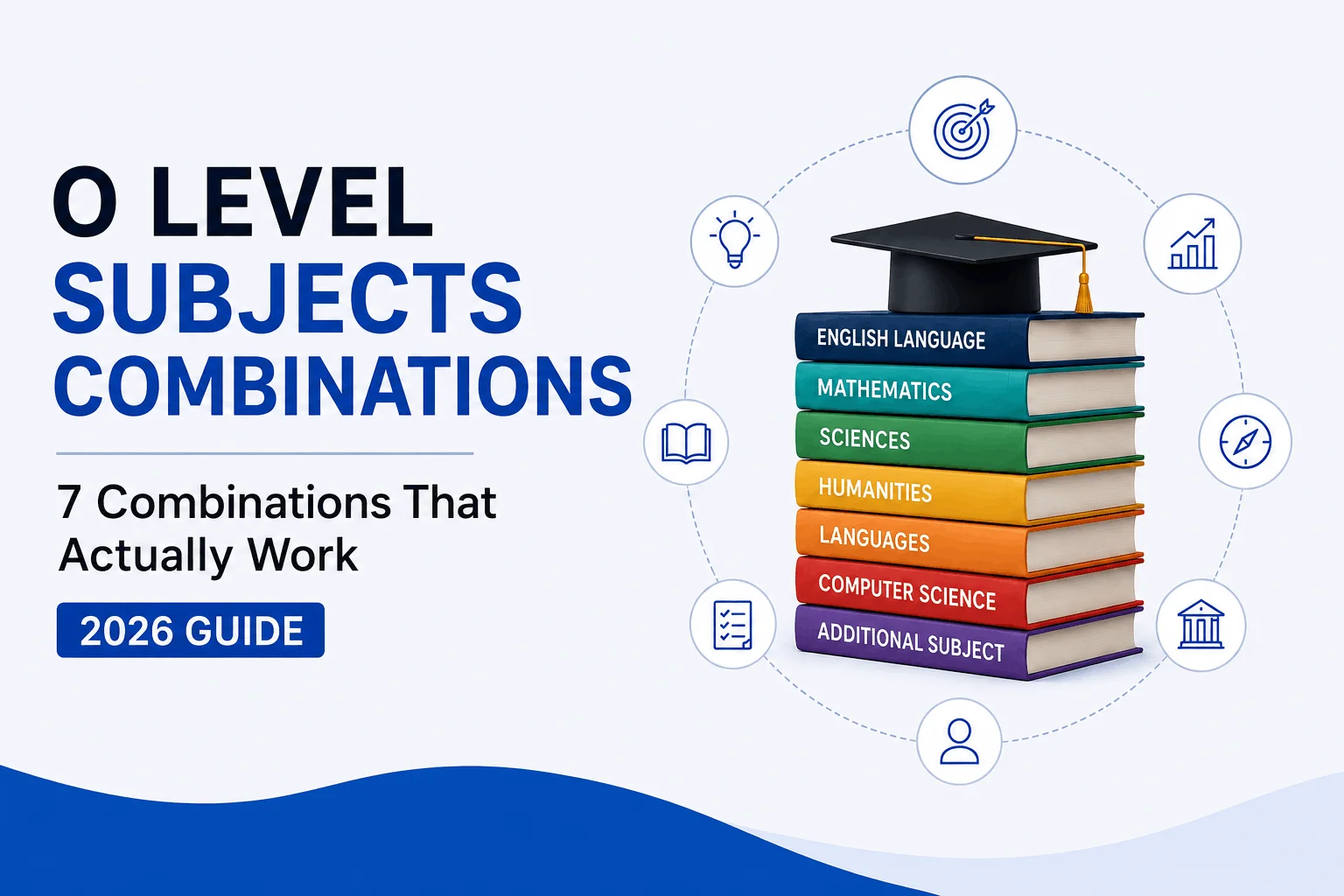
This guide gives you the complete O Level subjects list available in Pakistan, explains what each group is for, and then lays out 7 subject combinations designed for specific career goals so you are not guessing.
How Many O Level Subjects Are There in Pakistan?
Cambridge Assessment International Education (CAIE) offers over 70 O Level subjects globally. In Pakistan, most registered schools offer between 40 and 45 subjects depending on the school’s resources and student demand.
Students typically sit for 8 to 9 subjects in total a mix of compulsory and elective subjects. Taking fewer than 8 can limit your IBCC equivalence calculation. Taking more than 9 significantly increases exam pressure and workload.
| Category | Subjects | Who Chooses Them |
| Compulsory (Government-mandated) | English Language, Mathematics, Islamiyat, Pakistan Studies, Urdu | All students |
| Elective — Science | Physics, Chemistry, Biology, Additional Mathematics | Pre-medical, Pre-engineering students |
| Elective — Commerce | Business Studies, Economics, Accounting | Commerce / business-track students |
| Elective — IT & Tech | Computer Science | Tech-track students |
| Elective — Humanities & Arts | History, Geography, Sociology, English Literature, Art & Design | Arts / social science students |
The Compulsory O Level Subjects in Pakistan
Four subjects are compulsory for all O Level students in Pakistan under government requirements. Your school will register you for these automatically:
| Subject | CAIE Code | Why It’s Compulsory |
| English Language | 1123 | National language requirement; critical for all future academic and professional work |
| Mathematics | 4024 | Core numeracy; required for almost all A Level and university pathways |
| Pakistan Studies | 2059 | Mandated by Government of Pakistan for all secondary students |
| Islamiyat | 2058 | Mandated for Muslim students by Government of Pakistan |
| Urdu A or Urdu B | 3247 / 3248 | Mandated by Government of Pakistan for all secondary students |
The Full Elective Subjects List by Group
CAIE organises elective O Level subjects into broad groups. Pakistan’s registered schools typically offer subjects from the following categories:
Group 1 — Sciences
| Subject | CAIE Code | Opens Pathway To |
| Physics | 5054 | Engineering, architecture, computing, physical sciences |
| Chemistry | 5070 | Medicine, pharmacy, chemical engineering, dentistry |
| Biology | 5090 | Medicine, nursing, dentistry, biotechnology, veterinary science |
| Additional Mathematics | 4037 | Engineering, mathematics, economics, computer science at A Level |
Group 2 — Commerce & Business
| Subject | CAIE Code | Opens Pathway To |
| Business Studies | 7115 | Business, management, entrepreneurship, marketing |
| Economics | 2281 | Economics, finance, public policy, law |
| Accounting / Principles of Accounts | 7110 | Accounting, finance, CA/ACCA qualifications |
Group 3 — Technology
| Subject | CAIE Code | Opens Pathway To |
| Computer Science | 2210 | Software engineering, IT, data science, cybersecurity |
| Information & Communication Technology (ICT) | 0417 | IT support, digital media, systems administration |
Group 4 — Humanities & Social Sciences
| Subject | CAIE Code | Opens Pathway To |
| History | 2147 | Law, journalism, political science, civil service |
| Geography | 2217 | Urban planning, environmental science, development studies |
| Sociology | 2251 | Social work, psychology, public policy, media studies |
| English Literature | 2010 | Law, journalism, media, English language studies |
| Global Perspectives | 2069 | Liberal arts, international relations, research skills |
Group 5 — Creative & Vocational
| Subject | CAIE Code | Opens Pathway To |
| Art & Design | 6010 | Architecture, fashion design, graphic design, fine arts |
| Environmental Management | 5014 | Environmental science, sustainability, development studies |
| Food & Nutrition | 6065 | Nutrition, hospitality, food science |
| Travel & Tourism | 7096 | Hospitality, hotel management, travel industry |
Real data: In 2024, the most chosen O Level subjects in Pakistan were Pakistan Studies, Islamiyat, Mathematics, English Language, and Urdu confirming the dominance of the compulsory block. Among electives, Physics, Chemistry, and Computer Science led the science/tech group.
The 7 O Level Subject Combinations That Actually Work
Every combination below is built around the 5 compulsory subjects (English, Mathematics, Pakistan Studies, Islamiyat, Urdu) plus carefully chosen electives. The 3–4 electives you pick on top of these five determine your entire A Level and university pathway.
Combination 1: Pre-Medical (Medicine, Dentistry, Pharmacy, Nursing)
| Subject | Code | Why It’s Included |
| English Language | 1123 | Compulsory; medical communication |
| Mathematics | 4024 | Compulsory; required for MDCAT and science stream |
| Islamiyat | 2058 | Compulsory |
| Pakistan Studies | 2059 | Compulsory |
| Urdu | 3247 | Compulsory |
| Physics | 5054 | Core science requirement for all medical programmes |
| Chemistry | 5070 | Non-negotiable for medicine, dentistry, pharmacy |
| Biology | 5090 | Essential for medicine; MDCAT biology is a major component |
Total: 8 subjects. This is the minimum viable set for medical aspirants. IBCC requires Physics, Chemistry, and Biology in your O Level results for medical equivalence at Pakistani universities.
University example – NUST requirement: “More than 60% marks in required subjects/group” with IBCC equivalence certificate. (NUST Official Admissions Page, 2024)
Combination 2: Pre-Engineering (Electrical, Mechanical, Civil, Chemical Engineering)
| Subject | Code | Why It’s Included |
| English Language | 1123 | Compulsory |
| Mathematics | 4024 | Compulsory; foundation for all engineering math’s |
| Islamiyat | 2058 | Compulsory |
| Pakistan Studies | 2059 | Compulsory |
| Urdu | 3247 | Compulsory |
| Physics | 5054 | Non-negotiable for all engineering streams |
| Chemistry | 5070 | Required for chemical, materials, and civil engineering |
| Additional Mathematics | 4037 | Strongly recommended; bridges O Level to A Level Math’s |
Combination 3: Computer Science / Software Engineering
| Subject | Code | Why It’s Included |
| English Language | 1123 | Compulsory |
| Mathematics | 4024 | Compulsory; programming logic relies on mathematical thinking |
| Islamiyat | 2058 | Compulsory |
| Pakistan Studies | 2059 | Compulsory |
| Urdu | 3247 | Compulsory |
| Physics | 5054 | Recommended; underpins hardware, circuits, computing |
| Computer Science | 2210 | Core subject; algorithms, programming, data structures |
| Additional Mathematics | 4037 | Recommended for students targeting A Level CS or Data Science |
Total: 8 subjects. NUST specifically notes that “Computer Science may be pursued at limited local institutions with only A Level Mathematics as a prerequisite” — making strong O Level Math’s and CS preparation essential.
Combination 4: Business, Finance & Economics
| Subject | Code | Why It’s Included |
| English Language | 1123 | Compulsory; business communication |
| Mathematics | 4024 | Compulsory; financial calculations, statistics |
| Islamiyat | 2058 | Compulsory |
| Pakistan Studies | 2059 | Compulsory |
| Urdu | 3247 | Compulsory |
| Business Studies | 7115 | Core commercial knowledge; leads to A Level Business |
| Economics | 2281 | Macro/micro economics; essential for finance degrees |
| Accounting / Principles of Accounts | 7110 | Strongly recommended for CA, ACCA, finance tracks |
Combination 5: Law, Journalism & Social Sciences
| Subject | Code | Why It’s Included |
| English Language | 1123 | Compulsory; writing and communication are central |
| Mathematics | 4024 | Compulsory |
| Islamiyat | 2058 | Compulsory |
| Pakistan Studies | 2059 | Compulsory; directly relevant to law and public policy |
| Urdu | 3247 | Compulsory |
| English Literature | 2010 | Develops analytical writing and critical reading |
| History | 2147 | Essential for law, political science, civil service |
| Sociology or Geography | 2251 / 2217 | Broadens social awareness; useful for policy and journalism |
Combination 6: Architecture & Design
| Subject | Code | Why It’s Included |
| English Language | 1123 | Compulsory |
| Mathematics | 4024 | Compulsory; structural calculations and geometry |
| Islamiyat | 2058 | Compulsory |
| Pakistan Studies | 2059 | Compulsory |
| Urdu | 3247 | Compulsory |
| Physics | 5054 | Required for structural engineering elements of architecture |
| Art & Design | 6010 | Core creative subject for design-track students |
| Computer Science or Additional Maths | 2210 / 4037 | Supports digital design tools or advanced spatial geometry |
Total: 8 subjects. Architecture sits at the intersection of science and arts. Most Pakistani architecture programmes at NCA, NUST, and UET require both strong mathematical ability and demonstrated creative skill.
Combination 7: The ‘Keep All Options Open’ Combination
For students who are genuinely undecided — or who want maximum flexibility for A Level and university choices:
| Subject | Code | Why It’s Included |
| English Language | 1123 | Compulsory |
| Mathematics | 4024 | Compulsory |
| Islamiyat | 2058 | Compulsory |
| Pakistan Studies | 2059 | Compulsory |
| Urdu | 3247 | Compulsory |
| Physics | 5054 | Keeps science pathways open |
| Chemistry | 5070 | Keeps medical and engineering pathways open |
| Economics or Business Studies | 2281 / 7115 | Keeps commerce pathway open |
| Computer Science | 2210 | Keeps tech pathway open (optional 9th subject) |
Total: 8–9 subjects. The Biology + Chemistry + Mathematics + Physics combination as “the only combination which will keep all your options open for Medicine, Dentistry, all Engineering fields, Computer Science, Humanities, Social Sciences and the Arts.” At O Level, this translates to taking Physics and Chemistry as your minimum science base, then adding a commerce or tech subject.
Important: Taking 9 or more subjects significantly increases workload. Only attempt 9 subjects if your school recommends it and you have strong prior academic performance. Quality of grades matters far more than quantity of subjects.
How Many Subjects Do You Actually Need?
CAIE imposes no minimum — technically, you can sit for one subject. But in the Pakistani context, the number of subjects has real consequences:
| Number of Subjects Passed | IBCC Equivalence | University Admission Impact |
| Less than 5 | Not eligible for equivalence | Not eligible for Pakistani universities |
| 5–7 | Not eligible for equivalence | Limited options; many universities require specific electives |
| 8 subjects (A*–E) | Full equivalence certificate issued | Eligible for all major Pakistani and international universities |
| 9+ subjects | Full equivalence ( Equivalence is granted on 8 subjects) | Competitive edge, especially for A Level subject flexibility |
The consensus across IBCC guidelines, school advisors, and university counsellors is: 8 subjects at grades A* to E is the target. This is enough for full IBCC equivalence and meets the minimum bar for all major university programmes in Pakistan and most international ones.
5 Common Mistakes Students Make When Choosing O Level Subjects
- Following friends instead of career plans.
Your subject combination should reflect your goals, not your social group. Taking Computer Science because your friend did, when you want to study medicine, is a significant strategic error.
- Taking too many subjects.
Some schools push students to take 10 or 11 subjects. Unless you are an exceptionally strong student, this usually results in mediocre grades across the board. 8 solid A/B grades will always outperform 11 C/D grades in both IBCC equivalence and A Level readiness.
- Ignoring the A Level pathway.
O Level and A Level are connected. The subjects you take at O Level will determine which A Level subjects you can take. A student who skips Chemistry at O Level cannot take it at A Level which closes off medicine and chemical engineering immediately.
- Choosing subjects based on ‘easiness’ alone.
Subjects like Sociology or Environmental Management are sometimes chosen for being manageable. That is not necessarily wrong — but if these subjects are chosen instead of Chemistry or Physics, and the student later wants to do medicine, they will have no path forward.
- Not verifying what your school offers.
CAIE may offer a subject, but your specific school may not. Cambridge offers approximately 40–45 subjects in Pakistan, but individual schools typically offer 15–25 depending on their resources and teaching capacity.
Frequently Asked Questions
How many O Level subjects should I take in Pakistan?
The standard recommendation is 8 to 9 subjects. Eight subjects give you full IBCC equivalence and meet all major university entry requirements. Nine subjects can provide an advantage, particularly for students who want to keep both science and commerce pathways open. Going beyond nine is generally not advisable unless your school specifically recommends it based on your academic record.
Can I take Additional Mathematics and regular Mathematics together?
Yes. Many O Level students take both Mathematics (4024) and Additional Mathematics (4037). Regular Maths is the standard compulsory paper. Additional Math’s is a harder, more advanced elective that bridges directly to A Level Mathematics. It is particularly recommended for students targeting engineering, computer science at A Level and is considered one of the best preparatory subjects for A Level Mathematics.
Is Computer Science hard at O Level?
Computer Science (2210) has a reputation for being one of the more demanding electives, particularly Paper 2 (problem-solving and programming in pseudocode). However, students with a genuine interest in technology typically find it manageable with proper preparation. It is worth the investment for any student considering software engineering, data science, or IT as a career.
Does the number of O Level subjects affect IBCC equivalence?
Yes, significantly. IBCC requires a minimum of 8 O Level subjects for full equivalence. Each subject contributes to the IBCC percentage calculation. If you pass fewer than 8, IBCC will only issue a partial equivalence, which many Pakistani universities will not accept for admission. This is one of the most important practical reasons to aim for 8 subjects, regardless of which specific combination you choose.
Final Word: The Combination Is a Strategy, Not Just a List
Most parents and students think of O Level subject selection as picking from a menu. It is actually a strategic decision that determines the next 6 to 8 years of a student’s academic and early career life.
The right combination is one that: (1) meets IBCC’s minimum of 8 subjects, (2) keeps your preferred A Level pathway open, (3) matches your genuine strengths not just your friends’ choices, and (4) is manageable enough to allow you to score well in every subject.
If you are unsure about which subjects to choose, or if your child is already enrolled and struggling with specific subjects, working with a subject-specialist CAIE tutor early even in Grade 9 can make a measurable difference both in subject selection guidance and in actual exam performance.

1 thought on “O Level Subjects List: The 7 Subject Combinations That Actually Work (2026 Guide)”
Pingback: O Level Means Which Class in Pakistan? Fully Explained 2026.