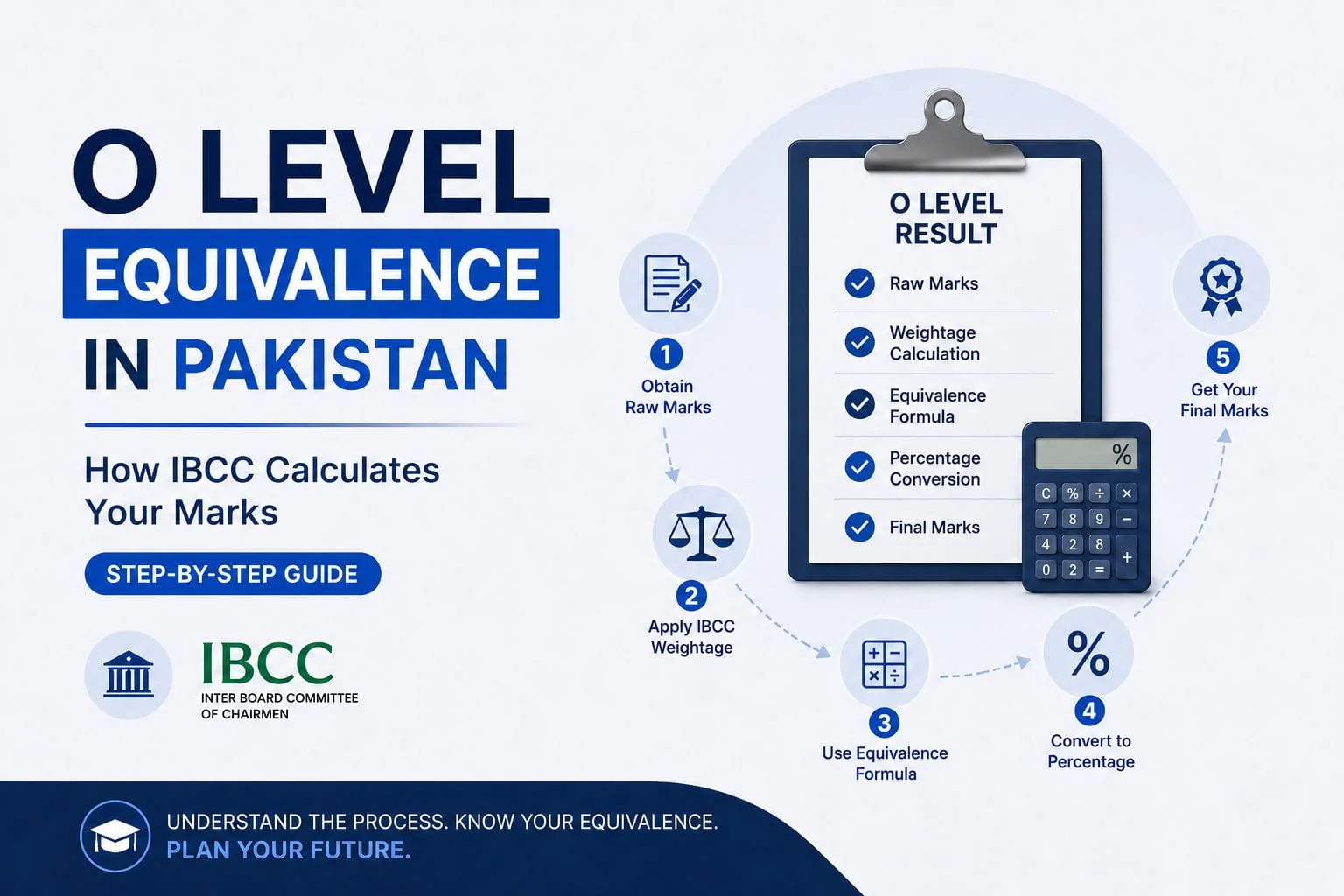
O Level students in Pakistan face a system within a system. Cambridge grades their work in letters A*, A, B, C. Pakistani universities measure performance in percentages. Between the two sits IBCC: the Inter Board Committee of Chairmen, the government body that bridges them.
Without an IBCC O Level Equivalence Certificate, Cambridge results cannot be used for admission to any Pakistani university, competitive examination (MDCAT, ECAT), scholarship application, or government employment. The equivalence is not optional — it is the required translation layer between two education systems that do not natively speak to each other.
This guide explains the complete O Level equivalence process: what IBCC does, exactly how the marks formula works, how to calculate your equivalence percentage before you apply, what Pakistani universities require, and a step-by-step application guide.
What Is IBCC and Why Does It Matter?
IBCC stands for Inter Board Committee of Chairmen: A government body under Pakistan’s Ministry of Federal Education and Professional Training. Its primary function is to evaluate international qualifications and issue equivalence certificates that allow holders of foreign academic credentials to participate in Pakistan’s education and employment systems.
The Inter Board Committee of Chairmen (IBCC) is the official authority in Pakistan that evaluates O and A Level results and converts them into marks equivalent to the local education system. This equivalence is essential for students who wish to apply to Pakistani colleges and universities, as admissions, scholarships, and merit lists are often based on local grading criteria.’
| Your Qualification | IBCC Converts It To | Certificate Issued | Used For |
| O Level (Cambridge) | SSC (Secondary School Certificate) — Matriculation equivalent | SSC Equivalence Certificate | A Level college admission; MDCAT/ECAT eligibility; university applications; government jobs; scholarships |
| A Level (Cambridge) | HSSC (Higher Secondary School Certificate) — Intermediate equivalent | HSSC Equivalence Certificate | University admissions; MDCAT/ECAT; CSS/PMS; HEC recognition; government employment |
The IBCC O Level Equivalence Formula: Exactly How It Works
This is the section most Pakistani blogs leave vague. Here is the exact formula, step by step.
Step 1: Convert Each Grade to Marks (out of 100)
IBCC assigns a specific mark value to each Cambridge letter grade. These are the official IBCC marks as published on IBCC.
| Cambridge O Level Grade | IBCC Marks Assigned (out of 100) | Percentage | IBCC Accepts? |
| A* | Varies by subject — typically 90–95 (see note below) | 90–95% | Yes |
| A | 80 | 80% | Yes |
| B | 70 | 70% | Yes |
| C | 60 | 60% | Yes |
| D | 50 | 50% | Yes |
| E | 40 | 40% — IBCC minimum accepted grade | Yes — minimum pass |
| F | 0 | 0% | No — not accepted |
| G | 0 | 0% | No — not accepted |
| U (Ungraded) | 0 | 0% | No — not accepted |
Step 2: Sum the Marks for Your Best 8 Subjects
IBCC takes your best 8 O Level subjects (including the 5 compulsory subjects). Each subject is scored out of 100. The maximum possible from 8 subjects is 800 marks.
Formula: Total O Level Marks = sum of marks for 8 subjects (each out of 100)
| Subject | Grade | IBCC Marks (out of 100) |
| English Language (1123) | A | 80 |
| Mathematics (4024) | A* | 94 (example — verify for your session) |
| Islamiyat (2058) | A* | 95 (example — verify for your session) |
| Pakistan Studies (2059) | A | 80 |
| Urdu (3248) | B | 70 |
| Physics (5054) | A | 80 |
| Chemistry (5070) | A | 80 |
| Biology (5090) | B | 70 |
| Total | 649 / 800 |
Step 3: Scale to 1050 (Matriculation Total)
Pakistan’s Matriculation system has a total of 1050 marks. IBCC scales your O Level total (out of 800) to an equivalent out of 1050 using this formula:
IBCC SSC Marks = (Your Total ÷ 800) × 1050
Using the example above:
| Formula Step | Calculation | Result |
| Total O Level marks (8 subjects) | 649 | 649 / 800 |
| Apply scaling formula | (649 ÷ 800) × 1050 | 851.6 marks out of 1050 |
| IBCC SSC Percentage | 851.6 ÷ 1050 × 100 | 81.1% |
This 81.1% is the IBCC SSC Equivalent Percentage that Pakistani universities use to place this student on a merit list alongside Matric student.
Step 4: Full Worked Examples
Example A: Strong Student (Mostly A* and A)
| Subject | Grade | IBCC Marks |
| English Language | A | 80 |
| Mathematics | A* | 94 |
| Islamiyat | A* | 95 |
| Pakistan Studies | A | 80 |
| Urdu | A | 80 |
| Physics | A* | 94 |
| Chemistry | A | 80 |
| Biology | A | 80 |
| Total | 683 / 800 | |
| Scaled to 1050 | (683 ÷ 800) × 1050 | 896.4 marks |
| IBCC Percentage | 896.4 ÷ 1050 × 100 | 85.4% |
Example B: Average Student (Mix of A, B, C)
| Subject | Grade | IBCC Marks |
| English Language | B | 70 |
| Mathematics | B | 70 |
| Islamiyat | A | 80 |
| Pakistan Studies | A | 80 |
| Urdu | B | 70 |
| Physics | B | 70 |
| Chemistry | C | 60 |
| Biology | C | 60 |
| Total | 560 / 800 | |
| Scaled to 1050 | (560 ÷ 800) × 1050 | 735 marks |
| IBCC Percentage | 735 ÷ 1050 × 100 | 70% |
Example C: Minimum Viable Student (All E grades — not recommended for competitive admissions)
| Subject | Grade | IBCC Marks |
| English Language | E | 40 |
| Mathematics | E | 40 |
| Islamiyat | E | 40 |
| Pakistan Studies | E | 40 |
| Urdu | E | 40 |
| Physics | E | 40 |
| Chemistry | E | 40 |
| Biology | E | 40 |
| Total | 320 / 800 | |
| Scaled to 1050 | (320 ÷ 800) × 1050 | 420 marks |
| IBCC Percentage | 420 ÷ 1050 × 100 | 40% |
IBCC O Level Equivalence: Official Subject Requirements
Not all O Level results automatically qualify for full IBCC equivalence. Specific subject requirements must be met.
| Requirement | Detail | Source |
| Minimum subjects | 8 O Level subjects required for full equivalence | IBCC official page |
| Compulsory subjects (all 5 must be passed) | English Language, Mathematics, Urdu, Islamiyat, Pakistan Studies | Five core subjects: English, Mathematics, Urdu, Pakistan Studies, and Islamiyat, are mandatory’ |
| Elective subjects | 3 additional academic subjects of your choice | Can be from science, commerce, humanities, or technology groups |
| Minimum grade accepted | Grade E or above in each subject | IBCC does not accept Grades U |
| Overseas students (sat exams abroad) | Urdu, Islamiyat, and Pakistan Studies exempted; English and Mathematics still required | Confirmed by IBCC |
| For IBCC to issue partial equivalence | Fewer than 8 subjects may get partial equivalence; many universities will not accept partial equivalence | Always aim for at least 8 subjects for full eligibility |
How to Apply for O Level IBCC Equivalence: Complete Step-by-Step
| Step | Action | Details |
| 1 | Register on IBCC portal | Go to services.ibcc.edu.pk; create an account or log in if already registered |
| 2 | Select application type | Choose ‘O Level (GCE) SSC Equivalence’ from the application menu |
| 3 | Fill application form | Enter personal details, subjects, and grades exactly as shown on your Statement of Results; name and date of birth must match CNIC/B-Form exactly |
| 4 | Upload documents | Scanned copies of: O Level Statement of Results (or original certificate); CNIC/B-Form (yours); parent/guardian CNIC |
| 5 | Pay the fee | PKR 6,000 — normal processing (15–20 working days); PKR 12,000 — urgent processing (faster). |
| 6 | Submit application | Online submission preferred; or submit physical copies by courier/in person to nearest IBCC office |
| 7 | IBCC verification | IBCC verifies your results through Cambridge’s online portal; certificates older than 5 years require prior British Council verification |
| 8 | Receive certificate | SSC Equivalence Certificate issued and posted/collected; check status on services.ibcc.edu.pk |
Documents Required
| Document | Requirement | Critical Rules |
| Original O Level Statement of Results or Cambridge Certificate | Original only; must not be laminated | Statement of Results valid for 6 months only; after 6 months, original certificate required |
| Two sets of attested photocopies of results/certificate | Back-to-back photocopies, attested by gazetted officer or notary | Both sets required; missing one causes rejection |
| Attested copy of applicant’s CNIC / B-Form / Smart Card | NADRA-issued; attested copy | Name and DOB must match certificate exactly; any mismatch causes rejection |
| Attested copy of parent/guardian CNIC | Attested copy | Required for all applicants |
| IBCC application form (filled) | Available at ibcc.edu.pk or services.ibcc.edu.pk | Must be completed accurately; corrections may delay processing |
| Fee payment proof | Bank draft or online challan from IBCC portal | Fee: PKR 6,000 normal; PKR 12,000 urgent |
Document warning: IBCC states explicitly: ‘Fake documents will be confiscated and referred to relevant authorities.’ Laminated certificates are not accepted. Downloaded result prints (even if school-verified) are not accepted. Only the official CAIE Statement of Results or original certificate is valid.
How Pakistani Universities Use Your IBCC O Level Percentage
Once you have your IBCC SSC Equivalence Certificate and percentage, this is how Pakistan’s top universities use it in their admissions:
NUST (National University of Sciences & Technology)
From the NUST Official Eligibility Criteria page:
“All non FSc stream candidates having qualifications like Cambridge Overseas Higher School Certificate… must have equivalence certificate of their qualification, duly obtained from IBCC, Pakistan in relevant groups/subjects and with minimum 60% marks.” “Minimum 60% aggregate marks each in SSC and HSSC OR equivalent exams (as per IBCC equivalence).” “Any deficiency of subjects or non-provision of IBCC equivalence certificate before start of classes will lead to cancellation of admission at any stage.” — NUST Official Eligibility Criteria (nust.edu.pk), April 2026
NUST Aggregate Formula: 10% SSC (IBCC%) + 15% HSSC (IBCC%) + 75% NET score. This means your O Level IBCC percentage contributes 10% of your total NUST aggregate. A higher IBCC % helps, but NET performance dominates.
IBA Karachi
From IBA Karachi’s Official Admissions Policy:
“All foreign degree/certificate holders, including O/A Level and IB, must provide an equivalency certificate from IBCC.” For BS CS, Economics & Mathematics: “A’ Levels with an average of 1B and 2Cs with a minimum total of 7 points in 3 principal subjects (including Mathematics). A maximum of one D grade allowed. E/U grades are not accepted.” — IBA Official Admissions Policy (admissions.iba.edu.pk), fetched May 2025
IBA assesses A Level grades directly alongside IBCC equivalence. For BBA and general admissions: minimum 1 B and 2 Cs in 3 principal A Level subjects including Mathematics.
LUMS (Lahore University of Management Sciences)
LUMS requires minimum 2 Bs and 1 C in three principal A Level subjects for most programmes. Competitive programmes (Economics, CS) expect higher. LUMS does not rely primarily on IBCC percentage for assessment it assesses A Level grades directly alongside LCAT/SAT scores.
University Admission Requirements Summary
| University | IBCC SSC Required? | IBCC HSSC Required? | Minimum IBCC SSC % | Minimum IBCC HSSC % | Additional Requirement |
| NUST | Yes | Yes | 60% | 60% | NET score (75% weight in aggregate) |
| UET (Engineering) | Yes | Yes | 60% | 60% | ECAT (50% weight in aggregate) |
| IBA Karachi | Yes (IBCC cert required) | Yes (IBCC cert required) | Not specified separately | Min 1B+2C A Level (7 points) | IBA Aptitude Test or SAT |
| LUMS | Yes (IBCC cert required) | Yes (IBCC cert required) | Not specified separately | Min 2B+1C A Level | LCAT or SAT/ACT |
| FAST-NUCES | Yes | Yes | 60% | 60% | FAST Entry Test |
| COMSATS | Yes | Yes | 50% | 50% | COMSATS Entry Test |
| MDCAT (medicine) | Yes — pre-medical group | Yes — pre-medical group | 60% minimum to sit MDCAT | 60% minimum | MDCAT score (NMA Pakistan) |
| ECAT (engineering) | Yes — pre-engineering | Yes — pre-engineering | 60% | 60% | ECAT score |
How Each Grade Improvement Affects Your IBCC Percentage
Every grade improvement directly impacts your IBCC SSC percentage. Understanding the exact numeric impact helps students prioritize which subjects to focus on for re-sits or final-year improvement:
| Grade Change | Marks Gained (per subject) | Impact on 1050 Scale | Impact on IBCC Percentage | University Merit Impact |
| E → D | 40 → 50 = +10 marks | (10 ÷ 800) × 1050 = +13.1 marks | +1.25 percentage points | Significant at the 60% minimum threshold boundary |
| D → C | 50 → 60 = +10 marks | +13.1 marks on 1050 scale | +1.25 percentage points | Pushes aggregate above minimum for many universities |
| C → B | 60 → 70 = +10 marks | +13.1 marks on 1050 scale | +1.25 percentage points | Each improvement adds to merit list position |
| B → A | 70 → 80 = +10 marks | +13.1 marks on 1050 scale | +1.25 percentage points | Consistent improvement; moves student up merit lists |
| A → A* (approx.) | 80 → 93/94 = +13–14 marks | +17–18 marks on 1050 scale | +1.6–1.7 percentage points | Highest per-subject impact; A* gives most return |
| All 8 subjects: B → A | 8 × 10 = +80 marks total | (80 ÷ 800) × 1050 = +105 marks | +10 percentage points total (e.g. 70% → 80%) | Massive merit improvement; transforms admissions position |
The bottom row is the most important: a student who improves all 8 subjects from B to A improves their IBCC percentage by a full 10 percentage points. For a student at 70% (borderline for many universities), this takes them to 80% comfortably above the competitive threshold for NUST, UET, and most private universities.
7 Common Mistakes Pakistani Students Make With IBCC Equivalence
| # | Mistake | Consequence | Fix |
| 1 | Applying for A Level equivalence before O Level equivalence | IBCC rejects A Level application immediately | Apply for SSC equivalence first; wait for certificate; then apply for HSSC equivalence |
| 2 | Submitting a laminated certificate | Application rejected by IBCC; certificate returned | Never laminate Cambridge certificates; store flat in a document folder |
| 3 | Name or date of birth mismatch between certificate and CNIC | Application rejected; requires NADRA correction before reapplication | Check all documents match before submitting; resolve discrepancies at NADRA first |
| 4 | Submitting Statement of Results more than 6 months after issue | IBCC rejects Statement of Results after 6 months | Apply immediately after results; do not wait for original certificate if Statement of Results is available and within 6 months |
| 5 | Not checking which 8 subjects are being counted | Students with 9–10 subjects may incorrectly assume their best combination is automatically selected | IBCC uses the 8 subjects specified in your application; verify which 8 give you the highest total before submitting |
| 6 | Assuming equivalence is automatic and not applying | No IBCC certificate = no university admission, no MDCAT/ECAT eligibility, no scholarship | IBCC equivalence is never automatic; always requires a formal application and fee |
| 7 | Applying too late — after university deadlines | Normal IBCC processing is 15–20 working days; applying in September for August results may mean missing September admissions | Apply on results day or within 1–2 days; use urgent service (PKR 12,000) if deadlines are imminent |
Frequently Asked Questions
What is the IBCC O Level equivalence out of?
The IBCC SSC equivalence is calculated out of 1050 marks — the total marks in Pakistan’s Matriculation system. The formula is: (Sum of your 8 O Level subject marks ÷ 800) × 1050. IBCC converts your O-Level grades to marks, then scales the total to produce your SSC equivalence out of 1050, matching Pakistan’s Matriculation system.
Can I calculate my IBCC equivalence online before applying?
Yes. Several reliable online calculators provide accurate estimates and CGPA Calculation.net all use the official IBCC formula. These are estimates — the official figure comes from IBCC after your certificate is issued. Use these to plan your university applications and understand which grade improvements would have the most impact.
What if I took more than 8 O Level subjects?
If you passed more than 8 subjects, IBCC will use the combination of 8 that gives you the highest total but only if you specify this correctly in your application. The IBCC application asks you to list your subjects; ensure you include the 5 compulsory subjects plus the 3 elective subjects that give you the highest marks. Calculators like Maqsad.io allow you to input all subjects and identify your best 8.
My IBCC percentage is below 60%. Am I ineligible for university?
A percentage below 60% makes you ineligible for MDCAT, ECAT, NUST, UET, and most public universities. However, several private universities accept lower thresholds for example, COMSATS requires 50%, and some private colleges accept 45–50%. Your options include: (1) applying to private universities with lower thresholds; (2) re-sitting weak subjects in Oct/Nov to improve your percentage before the next admission cycle; (3) applying for foundation programmes at some universities.
Does IBCC equivalence expire?
The IBCC SSC Equivalence Certificate itself does not expire it is permanently valid. However, the Statement of Results from Cambridge (which you use to apply for IBCC) is only valid for 6 months from the date of issue. If your Statement of Results is older than 6 months, you must use the original Cambridge certificate.
If I re-sit an O Level subject and improve my grade, can I get a new IBCC equivalence?
Yes. If you re-sit a subject and receive a higher grade, you can apply to IBCC for a revised SSC Equivalence Certificate using the improved results. The new certificate will reflect the higher grade. This is one of the primary reasons students choose to re-sit weak subjects in the Oct/Nov series improving grades between the first and second university application cycle can significantly change their merit list position.
Final Word
IBCC O Level equivalence is not complicated once you understand its structure. Eight subjects, five compulsory, three elective. Each grade converted to marks out of 100. Total scaled to 1050. A percentage calculated. That percentage then determines where you sit on university merit lists across Pakistan.
What makes the difference is not understanding the formula — most students can figure that out. What makes the difference is when you apply (same week as results, not weeks later), which 8 subjects you include (the highest-scoring combination), and whether your grades are competitive enough for the universities you are targeting (60%+ for most public universities; 75%+ for genuinely competitive positions at NUST, UET, and private universities).
The single highest-leverage action for a student who is unhappy with their IBCC percentage after O Level results: identify the 2–3 subjects where improving from B to A or C to B would have the greatest impact on their total, and re-sit those subjects in Oct/Nov. A student who moves 3 subjects from B to A gains 3.75 percentage points which can be the difference between meeting and missing a university’s 60% minimum threshold.
If your child is preparing for O Level and wants to maximize their IBCC equivalence percentage, working with a CAIE-experienced tutor who understands both the Cambridge grading system and the Pakistani university admission landscape can significantly improve the outcome.