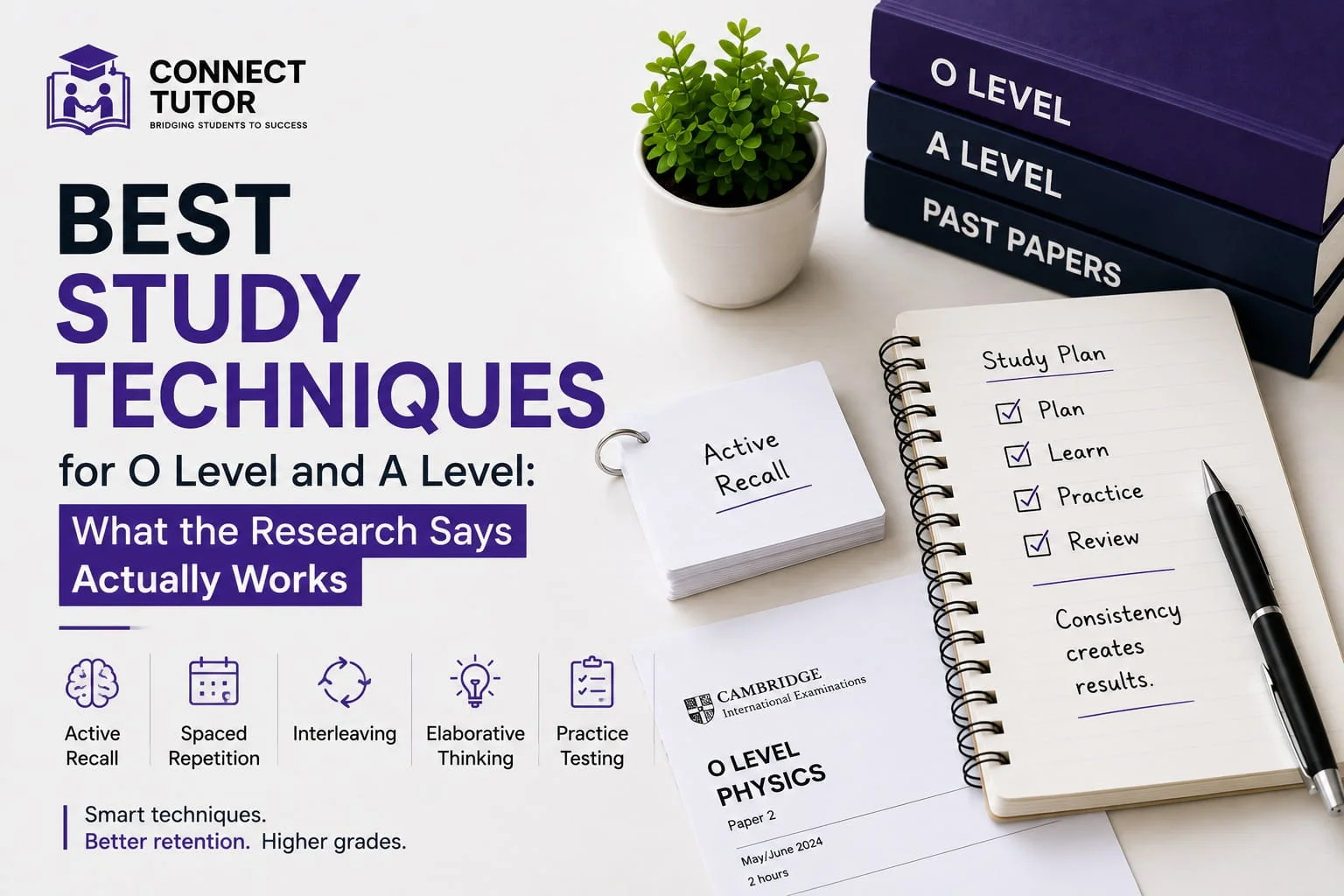
If you have ever spent three hours highlighting a textbook and then struggled to recall anything from it the next day, you have already run the experiment. Highlighting feels productive. It is not.
This is not a personal failing. Most students use study techniques that feel effective — re-reading, summarizing, highlighting because they create a sense of familiarity with the material. Familiarity is not the same as memory. And memory, specifically the ability to retrieve information under exam conditions, is what CAIE papers test.
The techniques in this guide are the ones that consistently produce better exam results not because they feel easier, but because they are built around how memory actually works. Applied to O Level and A Level preparation, they are the difference between revision that transfers to marks and revision that produces a comfortable sense of having done something.
Why Most Popular Study Techniques Don’t Work
Educational psychology research has ranked study techniques by effectiveness across thousands of studies. The results are consistent and, for most students, counterintuitive.
| Technique | How Common | Actual Effectiveness | Why |
| Highlighting / underlining | Very common | Low | Creates familiarity, not retrievable memory. You recognise highlighted text but cannot reproduce it. |
| Re-reading notes | Very common | Low | Same problem, recognition without retrieval. The second read feels easier because the material is familiar, not because it’s learned. |
| Summarising | Common | Moderate | Useful if it forces you to paraphrase and synthesise. Copying notes into shorter notes is just re-reading with extra steps. |
| Flashcards (passive) | Common | Moderate | Depends entirely on how you use them. Reading flashcards = recognition. Testing yourself = retrieval. The latter is far more effective. |
| Active recall / self-testing | Uncommon | High | Forces retrieval pathways to be used, which strengthens them. The discomfort of not knowing is the mechanism, not a side effect. |
| Spaced repetition | Uncommon | High | Revisiting material at increasing intervals produces far better long-term retention than massed revision (cramming). |
| Practice testing (past papers) | Moderately common | Very high | The most effective single technique. Tests under realistic conditions build retrieval pathways and reveal specific gaps simultaneously. |
| Interleaving | Rare | High | Mixing topics within a study session feels harder but produces significantly better retention than blocking (finishing one topic completely before starting another). |
The techniques that feel most productive, re-reading, highlighting, making neat notes, are the ones that consistently produce the weakest exam results. The ones that feel uncomfortable, testing yourself before you’re ready, mixing topics, spreading revision out over time are the ones that work.
Active Recall: The Most Important Technique You’re Probably Not Using
Active recall means testing yourself on material rather than reviewing it. The distinction sounds simple. In practice it changes everything about how a revision session is structured.
A passive revision session: open notes on O Level Chemistry, read through the section on Stoichiometry, feel like you understand it, move on.
An active recall session: close your notes. Write down everything you know about Stoichiometry, definitions, formulas, worked examples, common errors. Open your notes and check. Identify what you could not retrieve. Return to those gaps specifically.
How to Use Active Recall for O Level and A Level
- After studying any topic, close all materials and write down everything you can remember. This is not a test of how much you know it is the process that builds the memory.
- Use past paper questions immediately after studying a topic. A CAIE past paper question is a perfectly designed active recall prompt it forces retrieval under exam-relevant conditions.
- Use flashcards correctly: write a question on one side, an answer on the other. Test yourself by attempting the answer before flipping. Reading both sides simultaneously is not active recall.
- Teach the topic to someone else or explain it aloud to yourself. The act of explaining reveals gaps in understanding that re-reading conceals.
For sciences and math’s: Active recall for calculation subjects means attempting a worked example from memory before checking the solution not reading through a worked solution and feeling like you understand it.
Spaced Repetition: How to Make Revision Stick
Cramming works for 24 hours. Spaced repetition works for months. The difference is the gap between revision sessions.
When you revisit a topic after a gap at the point when you’ve almost but not quite forgotten it the memory is reconstructed more strongly than if you had revised it again the same day. This is the spacing effect, and it is one of the most reliably demonstrated findings in memory research.
For O Level and A Level students, spaced repetition does not require a complex system. A simple approach: after studying a topic, revisit it after 1 day, then 3 days, then 1 week, then 2 weeks. By the fourth repetition, the material is genuinely consolidated.
Building Spaced Repetition Into Your Study Schedule
- Divide your syllabus into topic units. After studying each unit, mark the date and schedule the next review (1 day, 3 days, 1 week, 2 weeks).
- Use the review session to test yourself first (active recall) before re-reading. The test is the review not the re-read.
- For subjects with a large number of topics (O Level Chemistry has 12 topics; O Level Physics has 6 major areas), start early enough that every topic can go through at least 3 spaced reviews before the exam.
Common mistake: Spacing out re-reading instead of spacing out self-testing. Spaced re-reading has almost no benefit over massed re-reading. Spaced testing is the mechanism that makes the technique work.
Interleaving: Why Mixing Topics Makes You Better at Each One
Most students block their revision finishing all of Physics electricity before starting waves, finishing all of Chapter 3 before starting Chapter 4. This feels logical and orderly. It also produces significantly weaker retention.
Interleaving means deliberately mixing topics within a single study session. One hour on Electricity, then 45 minutes on Waves, then back to Thermal Physics. The session feels less coherent and more effortful and that difficulty is exactly why it works.
When you switch topics, your brain must retrieve the context for the new topic and distinguish it from the previous one. This retrieval and distinction-making strengthens both memories in a way that massed practice on one topic does not.
Interleaving in Practice for O Level Students
- In a 3-hour revision session, rotate between 2–3 different topics rather than spending all 3 hours on one. The rotation can be within a subject (different Physics topics) or across subjects.
- For Mathematics specifically, interleaving different problem types within a single session algebra, geometry, statistics is more effective than doing all algebra questions, then all geometry questions.
- For O Level Chemistry past papers, attempt questions from different topics within the same session rather than doing all Stoichiometry questions before moving to Organic Chemistry.
The performance during an interleaved session will feel worse than during blocked revision. Students who compare their during-session scores often abandon interleaving because it feels like they’re performing worse. They’re not — they are learning more, which shows up in exam results rather than in the session itself.
Elaborative Interrogation: Ask Why, Not What
Most O Level and A Level revision focuses on what: what is the formula, what is the definition, what happens in this reaction. Elaborative interrogation adds a second question: why does this work? Why is this the case?
Asking why forces you to connect new information to existing knowledge. That connection is what makes information retrievable under different question formats including the novel application questions that A Level papers regularly use.
Example — O Level Chemistry: Instead of memorising ‘ionic bonds form between metals and non-metals’, ask: why do metals and non-metals form ionic bonds rather than covalent ones? The answer (electron configuration, energy stability, electronegativity) creates a deeper, more connected understanding that survives unfamiliar question formats.
Example — O Level Physics: Instead of memorising ‘pressure increases with depth in a liquid’, ask: why does it increase with depth? The answer (weight of liquid above, particle collisions) means you can answer both ‘state’ and ‘explain’ variants of pressure questions.
This technique is particularly valuable for the explain and suggest command word questions that appear across all O Level and A Level papers, questions that require understanding, not just recall.
Applying These Techniques to CAIE Exam Preparation
These techniques are most powerful when combined with CAIE-specific practice tools:
| Technique | CAIE-Specific Application |
| Active Recall | Attempt past paper questions immediately after studying each topic. Close notes. Write your answer. Then compare word-by-word to the mark scheme. The gap between your answer and the mark scheme is the learning. |
| Spaced Repetition | Schedule topic reviews using the examiner reports for each subject, topics that examiners flag as consistently poorly answered need more frequent review cycles than topics you already handle well. |
| Interleaving | Do mixed past paper questions across topics, not topical question sets where every question is on the same topic. The CAIE exam itself is interleaved; your practice should match that format. |
| Elaborative Interrogation | After every mark scheme review, ask: why does the mark scheme require this specific phrase? Understanding the reasoning behind marking decisions improves performance across future questions. |
| Practice Testing | Full past papers under strict timed conditions are the gold standard. One full paper per subject per week in the final 6 weeks before exams, marked immediately against the mark scheme. |
What to Stop Doing Right Now
- Stop re-reading notes as a primary revision activity. Use it only to fill gaps identified through active recall not as the main session.
- Stop colour-coding and reformatting notes. If you have spent more time on a summary sheet’s visual design than on testing yourself on its content, the session was not revision.
- Stop passive flashcard review. Flip to the answer side and read it. The only productive flashcard use is attempting the answer before checking.
- Stop revising the same topic every day. The spacing effect requires a gap. Revising Chapter 3 on Monday, Tuesday, and Wednesday produces worse retention than revising it on Monday, Wednesday, and the following Monday.
- Stop treating hours as the measure of revision quality. Two hours of active recall and past paper practice with mark scheme review produces more learning than six hours of re-reading. Track what you’ve tested yourself on, not how long you sat at a desk.
The Honest Reality About Effective Study
The techniques in this guide feel harder than the ones most students use. Active recall is uncomfortable. Interleaving is disorienting. Spaced repetition means revisiting topics before you feel confident in them. That discomfort is the feature, not a design flaw.
The most common response when students first apply these techniques is: ‘it feels like I’m doing worse.’ They’re not. They are encountering the gaps in their knowledge that comfortable revision was concealing. Those gaps, once found, can be fixed. Gaps that stay hidden until the exam cannot be.
Apply these techniques to your O Level or A Level preparation, and apply them alongside a solid study schedule and exam-day technique. The combination of the right techniques, the right schedule, and the right exam strategy is what consistent performance looks like. Each element reinforces the others.
Whether you’re just starting O Level, stuck in the middle, or sitting your papers in a few months, Connect Tutor matches you with tutors who understand the CAIE system, know how examiners think, and know exactly what it takes to move your grade up. Not just any tutor. The right one.