Most O Level students in Pakistan do past papers wrong and most of them do not realize it until results day.
The problem is not the papers themselves. PapaCambridge, PastPapers.co, and PapersDaddy between them host virtually every CAIE paper going back 20 years, all free. The papers are available. What most students are missing is a strategy for using them, one that actually builds the specific skills CAIE examiners reward.
Sitting past papers and checking answers tells you how many marks you got. That is useful. Sitting past papers correctly with mark scheme analysis, examiner report review, and a structured error log tells you why you got those marks, which ones you can recover next time, and exactly what to focus on before your exam. That is the difference between past paper practice that improves your grade and past paper practice that gives you a false sense of preparation.
Why Most Students Use Past Papers the Wrong Way
Walk through the most common past paper routine for a Pakistani O Level student: sit the paper, time yourself loosely, check the answers against the mark scheme, note a score, and move on to the next paper. Repeat until exams.
This approach has three structural problems that limit how much improvement it can produce:
- Checking answers is not the same as understanding why marks were lost. A student who gets 55/80 on a Chemistry paper and checks that questions 3b, 5a, and 7c were wrong has identified three wrong answers. They have not identified whether those were content gaps, command word errors, calculation mistakes, or vocabulary problems and without that categorization, they cannot fix the right thing.
- Moving to the next paper before analyzing the current one resets the learning. Each paper has an examiner report that explains where the cohort struggled, what language the mark scheme required, and what common errors were made. Students who skip the examiner report repeat the same errors across every paper they do.
- Doing papers randomly without a sequence means students often practice their strongest topics more than their weakest ones because familiar papers feel more manageable. This reinforces what they already know rather than closing the gaps that are costing marks.
The single most important insight about past paper strategy: the mark scheme review and error analysis after each paper is more valuable than the paper itself. A student who does 5 papers with proper analysis will improve more than a student who does 20 papers without it.
Where to Download O Level Past Papers for Free
Pakistan is in CAIE Administrative Zone 4. This means your papers are Variant 2 — files containing _12 (Paper 1, Variant 2), _22 (Paper 2, Variant 2), _42 (Paper 4, Variant 2) in the filename. Always download Variant 2 papers.
| Platform | URL | What’s Available | Best For |
| PapaCambridge | PapaCambridge | All papers, mark schemes, examiner reports, grade threshold tables — 2024 and 2025 confirmed available | Most comprehensive; clean Variant 2 labelling; best for recent papers |
| PastPapers.co | pastpapers.co | QP, MS, ER, GT all per session; syllabus and specimen papers also listed | Good layout; everything in one place per subject |
| PapersDaddy | Papers Daddy | 96,000+ PDFs across 328 CAIE subjects; going back 20+ years | Deepest historical archive; good for pre-2015 papers |
| CAIE Official | CAIE | Official source for syllabus, specimen papers, grade thresholds; recent papers may need school login | Syllabus downloads, specimen papers, and grade threshold tables |
File naming: CAIE past papers follow this pattern: [subject code]_[series][year]_[document type]_[paper number]. Example: 5054_s24_qp_22.pdf = Physics (5054), May/June 2024 (s24), Question Paper (qp), Paper 2 Variant 2 (22). Always download the matching mark scheme: 5054_s24_ms_22.pdf.
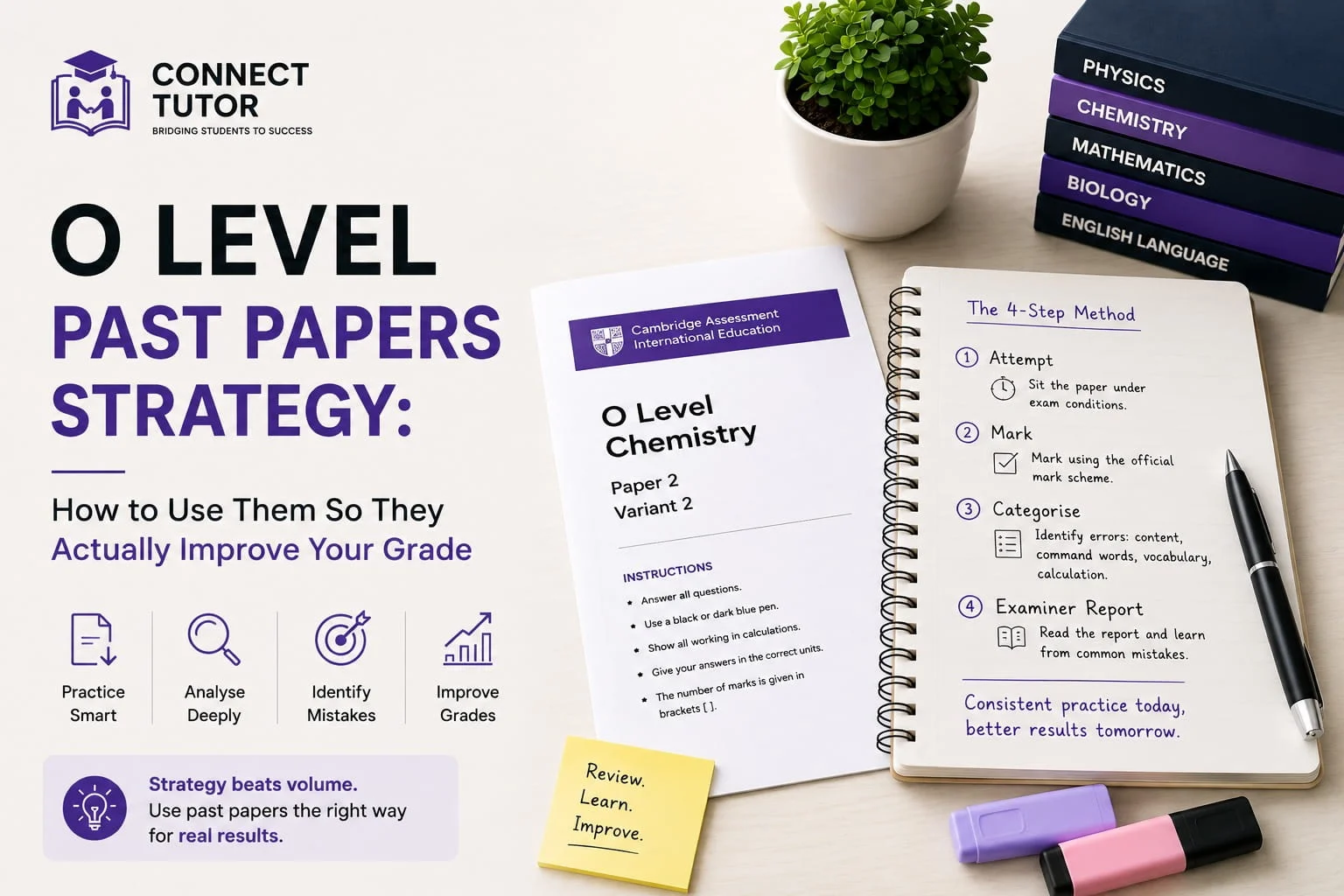
The 4-Step Past Paper Method That Actually Works
This is not complicated. But it requires discipline to follow every time and most students abandon at least one step after the first few papers. The improvement comes from the full process, not just the parts that are comfortable.
Step 1: Attempt Under Proper Exam Conditions
Before you sit any past paper, create the conditions that match the real exam as closely as possible. This is not optional it is the point.
- Set a timer for the exact paper duration (e.g. 105 minutes for Physics Paper 2)
- Clear your desk of notes, textbooks, and your phone
- Write your answers by hand on paper, not on a screen, not in a notebook with open notes beside it
- Do not pause the timer except for genuine emergencies
- If you run out of time, stop, but then note which questions were incomplete and why
The discomfort of running out of time on a practice paper is valuable. It identifies time management as a specific problem to solve. A student who always finishes practice papers with 20 minutes to spare in a relaxed environment may still run out of time in the exam if they’ve never practised under real pressure.
Step 2: Mark Against the Mark Scheme: Word by Word
Most students read the mark scheme quickly, check whether their answer is broadly correct, and award themselves the mark if it seems close. This is the single most common reason past paper practice does not improve grades.
CAIE mark schemes list specific acceptable phrases, specific vocabulary, and critically phrases that are not accepted. A student whose answer says ‘particles move faster’ where the mark scheme requires ‘particles have greater kinetic energy’ has the right idea and the wrong vocabulary. Marking themselves correctly conceals that gap.
The correct approach: for every question you answered, compare your exact wording to the mark scheme’s exact wording. Mark yourself only if your answer contains the specific marking points the mark scheme lists. If your wording is different, note it, even if your answer was ‘basically right’.
Step 3: Categorise Every Lost Mark
After marking, go through every mark you lost and assign it to one of four categories. This is your error log and it is the most useful document you will create during O Level preparation.
| Error Type | What It Means | How to Fix It |
| Content gap | You didn’t know the answer, the topic was not in your notes or you had not studied it | Return to the syllabus. Study the topic. Attempt topical past paper questions on it. Do not move to the next paper until this gap is closed. |
| Command word error | You described when asked to explain, or stated when asked to calculate. You knew the content but answered the wrong type of question. | Drill the CAIE command word list. For every practice question, circle the command word before you write a single word of your answer. |
| Vocabulary / language error | Your answer had the right idea but wrong phrasing ‘particles move faster’ instead of ‘particles have greater kinetic energy’ | Build a subject vocabulary list from mark schemes. After every paper, add the phrases that lost you marks. Test yourself on this list weekly. |
| Calculation / method error | You knew the topic but made an arithmetic mistake, used the wrong formula, or missed a step in the working | For calculations, always write: formula → substitution → calculation → answer with units. Show every step. Identify which specific step went wrong. |
After 3–4 papers, your error log will show a clear pattern. Most students find that one or two error types account for the majority of their lost marks. That pattern is the revision priority list — and it is more useful than any generic study plan.
Step 4: Read the Examiner Report
The examiner report for each past paper session is a document written by the examiners themselves, explaining how candidates performed, which questions were done well, which were poorly answered, and critically what language and approach the mark scheme expected.
Most students have never read an examiner report. This is a significant missed opportunity. Reports regularly contain statements like ‘candidates lost marks by not including [specific phrase]’ or ‘the most common error was [specific mistake].’ This is the examiner telling you exactly what to do differently and it is available for free alongside every past paper set.
Where to find examiner reports: Download files ending in _er from the same platform as your past papers. Example: 5054_s24_er.pdf = Physics (5054), May/June 2024, Examiner Report. Read the report after marking your paper use it to check whether the errors you made match the patterns the examiner flagged.
How to Sequence Your Past Papers Through the Year
Random past paper practice is better than no past paper practice. Sequenced past paper practice is significantly better than random.
Phase 1: Topical Practice (Early Revision)
In the first phase of revision typically 10–14 weeks before exams use topical past paper questions rather than full papers. After studying each topic from the syllabus, immediately find 5–8 past paper questions on that specific topic and attempt them.
PapaCambridge and similar platforms organize questions topically. This approach shows you immediately whether you understood a topic well enough to answer exam questions on it not just whether you can recognize it in your notes.
Phase 2: Full Papers Under Timing (Middle Revision)
From approximately 8 weeks before exams, begin full past papers under strict timing, one complete paper set per subject per week. A paper set means all papers for that subject in one session: Paper 1 + Paper 2 + Paper 4 for Chemistry, for example.
After each full set, apply the 4-step method: mark, categorise, read the examiner report. Track your raw score and the grade equivalent using the grade threshold table for that session.
Phase 3: Final Simulation (Last 4 Weeks)
In the final 4 weeks before exams, do only the most recent papers available the 2023 and 2024 sessions. These are closest in style and difficulty to your actual exam.
In the final 2 weeks, reduce to one paper per subject and focus on consolidating strong topics. Do not attempt a subject’s most recent past paper less than 3 days before the exam you want a paper that feels familiar going in, not one that introduces new anxiety.
| Phase | Timing | What to Do | Goal |
| Phase 1 | 14–8 weeks before exam | Topical past paper questions after each syllabus topic | Confirm understanding topic by topic; identify content gaps early |
| Phase 2 | 8–4 weeks before exam | Full paper sets under strict timing; 4-step method after each | Build stamina, timing, and mark scheme vocabulary; track score improvement |
| Phase 3 | 4–2 weeks before exam | Most recent 2–3 sessions only; full conditions | Final simulation; confirm improvement; identify last remaining gaps |
| Final 2 weeks | 2 weeks to exam | Light review of error log; key formulas; command words | Consolidation only, no new content, no new papers the night before |
5 Past Paper Mistakes That Cost Pakistani O Level Students the Most Marks
1. Doing papers without timing. Untimed practice does not build the time management skills you need on paper day. A student who comfortably finishes Chemistry Paper 2 in 2 hours of relaxed practice may still run out of time when the stakes are real and the question is unfamiliar.
2. Marking yourself generously. Awarding yourself a mark because your answer was ‘basically right’ conceals the vocabulary and language gaps that CAIE examiners penalize consistently. Be harder on yourself in practice than the examiner will be not easier.
3. Skipping the examiner report. The examiner report tells you what CAIE thought was wrong with how candidates answered. If you don’t read it, you’re ignoring the most specific feedback available about what the exam actually requires.
4. Saving the most recent papers for ‘just before’ exams. The most recent papers should be used in the final simulation phase but used properly, with the 4-step method. Saving them and then rushing through them in the last week without analysis is one of the most common missed opportunities.
5. Not keeping an error log. Without an error log, each paper’s lessons disappear after the next paper. With an error log, 10 papers build a cumulative picture of your specific error patterns — which is far more actionable than knowing your average score.
Past Papers Are a Tool: Strategy Is What Makes Them Work
The students who improve most dramatically between their first past paper attempt and their actual exam are not the ones who did the most papers. They are the ones who used each paper to learn something specific, a command word they were misreading, a vocabulary gap in Chemistry, a calculation step they were skipping in Physics and then fixed that specific thing before the next paper.
That process is available to every O Level student with an internet connection and a printer. It does not require a tutor, a special resource, or a particular school. It requires discipline, honesty in the marking process, and the willingness to sit with the discomfort of a bad score long enough to understand what caused it.
Apply this strategy alongside a structured study schedule and solid exam-day technique, and the gap between your current performance and your target grade becomes, in almost every case, a manageable distance rather than an impossible one.
Whether you’re just starting O Level, stuck in the middle, or sitting your papers in a few months, Connect Tutor matches you with tutors who understand the CAIE system, know how examiners think, and know exactly what it takes to move your grade up. Not just any tutor. The right one.






1 thought on “O Level Past Papers Strategy: How to Use Them So They Actually Improve Your Grade”
Pingback: How to Make an O Level Study Schedule That You Actually Follow