
There is a gap between knowing your subject and performing in the actual exam and most O Level students find out about that gap on results day.
You can revise thoroughly, finish every past paper, and still lose 15–20 marks on paper day because of how you managed your time, how you read the questions, or because you wrote a description when the examiner asked for an explanation. These are not knowledge problems. They are technique problems and technique is entirely fixable.
These 12 exam tips are built specifically around CAIE O Level papers. Not generic study advice. The kind of practical, paper-day strategies that change how you approach each question and, more importantly, how examiners actually award marks.
1. Read the Command Word Before You Read the Question
This sounds obvious. Almost nobody does it consistently.
CAIE uses specific command words describe, explain, state, calculate, suggest, deduce and each one tells you exactly what the examiner will and won’t give marks for. A student who ‘describes’ when asked to ‘explain’ can write three correct sentences and earn zero marks.
Describe = what happens. Explain = what happens AND why. These are not interchangeable. Examiners are trained to reject descriptions in explain questions, no matter how accurate.
Before you write a single word, circle the command word. It should determine the structure of your entire answer.
2. Allocate Time by Marks: Not by Question
In O Level Theory papers, every mark is worth roughly the same amount of your time. A simple formula: divide the total paper time by the total marks available.
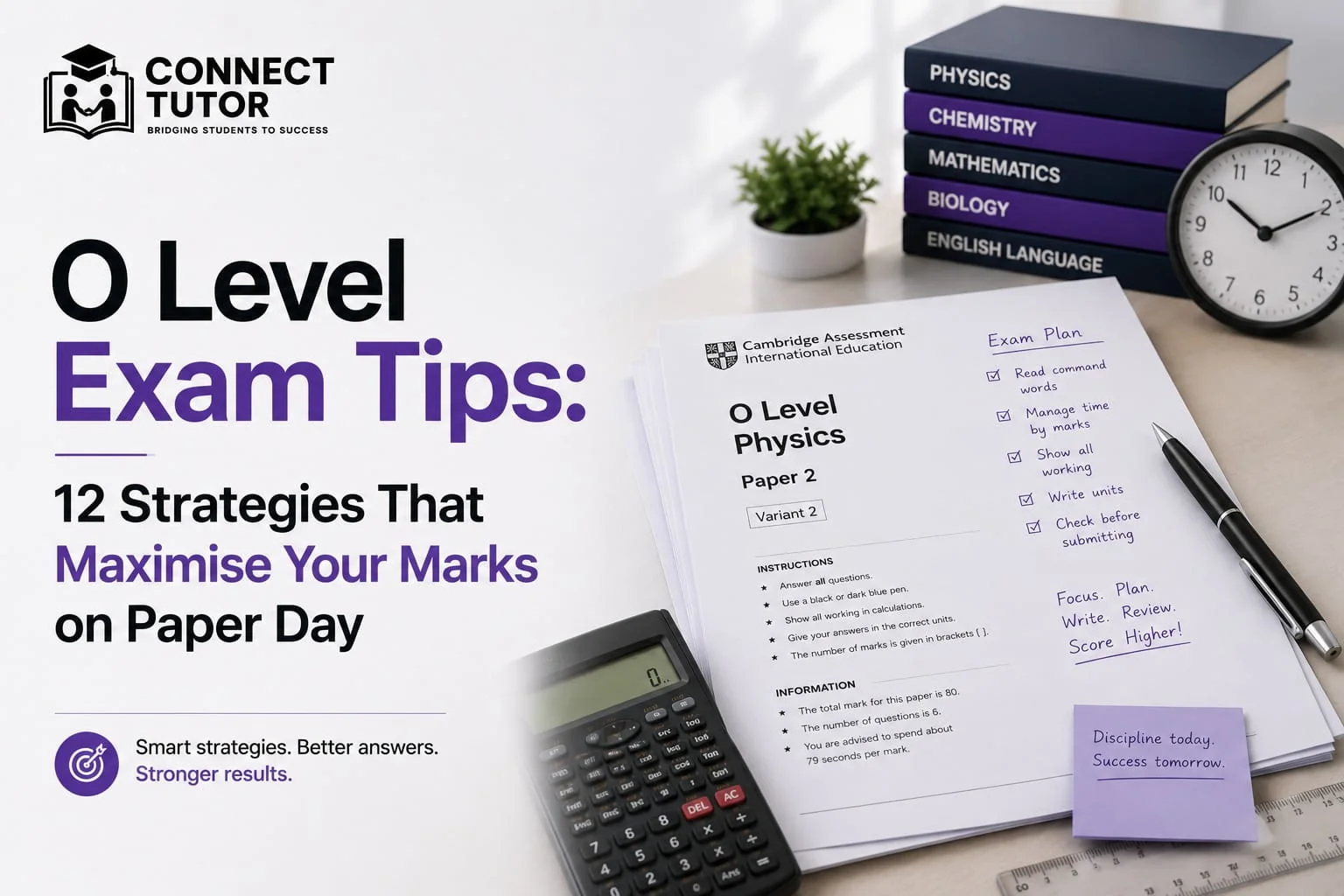
For O Level Physics Paper 2: 80 marks in 105 minutes, that’s about 79 seconds per mark. A 4-mark question gets around 5 minutes. A 10-mark question gets around 13 minutes. If you’re spending 25 minutes on a single 4-mark question, you’re burning time that belongs to marks you haven’t answered yet.
Quick tip: Write the time limit next to every major question before you start. When your watch hits that time, move on even if you haven’t finished.
3. Attempt Every Question: Including the Ones That Scare You
There is no negative marking in CAIE O Level. Leaving a question blank guarantees zero. Writing something even a partially correct answer gives the examiner something to award.
For Paper 1 (multiple choice), this means never leaving a blank. Eliminate what you can, guess from what remains. Even blind guessing gives you a 25% chance. A blank gives you nothing.
For Paper 2, if you genuinely don’t know the answer, write what you do know about the topic. Examiners can only mark what’s on the page and ‘partially related knowledge’ sometimes earns a mark when nothing else will.
4. Show Every Step in Calculation Questions
In any calculation question, CAIE awards Method Marks (M marks) and Accuracy Marks (A marks) separately. If your final answer is wrong but your method is correct, you still earn the M marks.
Write the formula. Then substitute. Then calculate. Then state the answer with units. Skipping any of these steps even if you get the right number can cost you marks that had nothing to do with whether your physics or chemistry knowledge was correct.
The most common calculation mistake: writing only the answer. If the working is not visible, the M marks are gone. This alone costs many B-grade students an A.
5. Use the Mark Scheme Language: Not Your Own Paraphrase
CAIE mark schemes are specific. They list exact vocabulary, accepted synonyms, and wording that is not accepted. Students who learned from good teachers or textbooks but paraphrase in the exam often lose marks on answers they actually know.
The fix is to revise from mark schemes, not just from notes. When you practice past papers, compare your exact words to the mark scheme’s exact words. Build a vocabulary for each subject the phrases that CAIE consistently awards, and the vague alternatives they consistently reject.
Example: In O Level Chemistry, ‘particles have more energy’ is often marked wrong. ‘Particles have more kinetic energy than the activation energy’ is marked correct. One word changes everything.
6. In Section B, Choose Your Questions Before You Start
Papers like O Level Physics Paper 2 and Chemistry Paper 2 offer a choice in Section B, typically answer 2 out of 3 questions. Most students read the first optional question, start writing, and never properly assess the other options.
The correct approach: spend the first 3–4 minutes of the paper reading all three Section B questions in full. Identify which two topics you are strongest in, based on your past paper scores, not your gut feeling. Then commit. Starting a question and switching midway wastes 10–15 minutes and results in two incomplete answers instead of one strong one.
7. Draw Diagrams With a Ruler — Always
Ray diagrams, circuit diagrams, force diagrams these appear across Physics, Chemistry, and Biology. Freehand diagrams in CAIE exams are almost always penalized. The mark scheme requires lines to pass through specific points, and a freehand line that misses by a few millimeter’s loses the mark.
Pack a 15cm ruler. Use it for every straight line in every diagram. This takes an extra 30 seconds and protects marks that have nothing to do with your knowledge of the subject.
8. Don’t Over-Write Long Answers
A common misconception: longer answers earn more marks. CAIE marks specific points, not the length or quality of prose. A 3-mark question has 3 marking points. Writing 200 words does not increase the chance of hitting all 3 but it does eat into time for the rest of the paper.
For structured questions, match your answer length roughly to the marks available. A 1-mark question needs one sentence. A 4-mark question needs 4 distinct points. Train yourself with past papers to write tightly and move on.
9. Check Units After Every Calculation
Units are not optional in CAIE. A numerical answer without a unit is often awarded zero for the accuracy mark, even if the number is correct. Pressure must be in Pa, not just a number. Current must be in A. Energy must be in J or kJ consistently.
Build the habit: every time you write a final numerical answer, immediately write the unit. This costs 5 seconds and saves marks across every paper.
10. Manage the Last 10 Minutes Intentionally
The last 10 minutes of a paper should be reserved deliberately — stop writing new content and use this time to check three things:
- All calculations have units
- All ‘explain’ answers have a ‘because’ or causal statement
- No question has been accidentally skipped
These three checks consistently recover 3–6 marks that were technically known but incorrectly expressed.
11. The Night Before: Stop Revising at 9 PM
This contradicts what most students do but the research on sleep and exam performance is clear. Cramming after 9 PM the night before an exam does not consolidate memory for the next morning. It delays sleep, increases cortisol, and impairs recall.
The night before should be used for one light review of key formulas and command words nothing new. Pack your bag, confirm your exam centre location, set your alarm, and sleep by 10 PM. The extra hour of sleep is worth more marks than any last-minute notes.
What to pack: Calculator (if allowed), two pens, one pencil, a 15cm ruler, an eraser, your Statement of Entry, and your CNIC or school ID.
12. Start Paper 1 From Your Strongest Questions
Paper 1 (multiple choice) is 40 questions in 60 minutes. The questions are not arranged by difficulty. A hard question at number 8 should not slow you to a stop before you’ve reached the easier questions at 22 and 31.
Move through the paper once quickly, answering questions you’re confident about and marking uncertain ones with a small star. Return to marked questions in the final 15 minutes with a clearer head. This ensures you don’t miss easy marks because you got stuck on a hard one early.
CAIE Exam Technique: Quick Reference
Command words: Circle them first. Let them define your answer structure.
Calculations: Formula → substitute → calculate → answer with unit. Never skip a step.
Diagrams: Ruler on every straight line. Label everything the question asks.
Time: ~79 seconds per mark in theory papers. Move on when your time is up.
Blanks: Never leave one. No negative marking in CAIE.
Preparation Is What Makes Exam Technique Work
These 12 tips work because they help you express genuine subject knowledge in exactly the way CAIE rewards it. If you have not already, practice using past papers with the mark scheme open. After every attempt, identify which marks you lost to technique versus content. In most cases, technique losses are the larger number and the more fixable one.
Use these exam tips alongside a solid study schedule, and the gap between your revision effort and your results closes significantly. The students who consistently outperform their revision hours are almost always the ones who’ve learned how CAIE thinks not just what it tests. There is a gap between knowing your subject and performing in the actual exam and most O Level students find out about that gap on results day.
You can revise thoroughly, finish every past paper, and still lose 15–20 marks on paper day because of how you managed your time, how you read the questions, or because you wrote a description when the examiner asked for an explanation. These are not knowledge problems. They are technique problems and technique is entirely fixable.
These 12 exam tips are built specifically around CAIE O Level papers. Not generic study advice. The kind of practical, paper-day strategies that change how you approach each question and, more importantly, how examiners actually award marks.
1. Read the Command Word Before You Read the Question
This sounds obvious. Almost nobody does it consistently.
CAIE uses specific command words describe, explain, state, calculate, suggest, deduce and each one tells you exactly what the examiner will and won’t give marks for. A student who ‘describes’ when asked to ‘explain’ can write three correct sentences and earn zero marks.
Describe = what happens. Explain = what happens AND why. These are not interchangeable. Examiners are trained to reject descriptions in explain questions, no matter how accurate.
Before you write a single word, circle the command word. It should determine the structure of your entire answer.
2. Allocate Time by Marks — Not by Question
In O Level Theory papers, every mark is worth roughly the same amount of your time. A simple formula: divide the total paper time by the total marks available.
For O Level Physics Paper 2 — 80 marks in 105 minutes — that’s about 79 seconds per mark. A 4-mark question gets around 5 minutes. A 10-mark question gets around 13 minutes. If you’re spending 25 minutes on a single 4-mark question, you’re burning time that belongs to marks you haven’t answered yet.
Quick tip: Write the time limit next to every major question before you start. When your watch hits that time, move on — even if you haven’t finished.
3. Attempt Every Question: Including the Ones That Scare You
There is no negative marking in CAIE O Level. Leaving a question blank guarantees zero. Writing something even a partially correct answer gives the examiner something to award.
For Paper 1 (multiple choice), this means never leaving a blank. Eliminate what you can, guess from what remains. Even blind guessing gives you a 25% chance. A blank gives you nothing.
For Paper 2, if you genuinely don’t know the answer, write what you do know about the topic. Examiners can only mark what’s on the page and ‘partially related knowledge’ sometimes earns a mark when nothing else will.
4. Show Every Step in Calculation Questions
In any calculation question, CAIE awards Method Marks (M marks) and Accuracy Marks (A marks) separately. If your final answer is wrong but your method is correct, you still earn the M marks.
Write the formula. Then substitute. Then calculate. Then state the answer with units. Skipping any of these steps even if you get the right number can cost you marks that had nothing to do with whether your physics or chemistry knowledge was correct.
The most common calculation mistake: writing only the answer. If the working is not visible, the M marks are gone. This alone costs many B-grade students an A.
5. Use the Mark Scheme Language: Not Your Own Paraphrase
CAIE mark schemes are specific. They list exact vocabulary, accepted synonyms, and wording that is not accepted. Students who learned from good teachers or textbooks but paraphrase in the exam often lose marks on answers they actually know.
The fix is to revise from mark schemes, not just from notes. When you practice past papers, compare your exact words to the mark scheme’s exact words. Build a vocabulary for each subject the phrases that CAIE consistently awards, and the vague alternatives they consistently reject.
Example: In O Level Chemistry, ‘particles have more energy’ is often marked wrong. ‘Particles have more kinetic energy than the activation energy’ is marked correct. One word changes everything.
6. In Section B, Choose Your Questions Before You Start
Papers like O Level Physics Paper 2 and Chemistry Paper 2 offer a choice in Section B, typically answer 2 out of 3 questions. Most students read the first optional question, start writing, and never properly assess the other options.
The correct approach: spend the first 3–4 minutes of the paper reading all three Section B questions in full. Identify which two topics you are strongest in, based on your past paper scores not your gut feeling. Then commit. Starting a question and switching midway wastes 10–15 minutes and results in two incomplete answers instead of one strong one.
7. Draw Diagrams With a Ruler: Always
Ray diagrams, circuit diagrams, force diagrams these appear across Physics, Chemistry, and Biology. Freehand diagrams in CAIE exams are almost always penalized. The mark scheme requires lines to pass through specific points, and a freehand line that misses by a few millimeters loses the mark.
Pack a 15cm ruler. Use it for every straight line in every diagram. This takes an extra 30 seconds and protects marks that have nothing to do with your knowledge of the subject.
8. Don’t Over-Write Long Answers
A common misconception: longer answers earn more marks. CAIE marks specific points, not the length or quality of prose. A 3-mark question has 3 marking points. Writing 200 words does not increase the chance of hitting all 3 but it does eat into time for the rest of the paper.
For structured questions, match your answer length roughly to the marks available. A 1-mark question needs one sentence. A 4-mark question needs 4 distinct points. Train yourself with past papers to write tightly and move on.
9. Check Units After Every Calculation
Units are not optional in CAIE. A numerical answer without a unit is often awarded zero for the accuracy mark, even if the number is correct. Pressure must be in Pa, not just a number. Current must be in A. Energy must be in J or kJ consistently.
Build the habit: every time you write a final numerical answer, immediately write the unit. This costs 5 seconds and saves marks across every paper.
10. Manage the Last 10 Minutes Intentionally
The last 10 minutes of a paper should be reserved deliberately, stop writing new content and use this time to check three things:
- All calculations have units
- All ‘explain’ answers have a ‘because’ or causal statement
- No question has been accidentally skipped
These three checks consistently recover 3–6 marks that were technically known but incorrectly expressed.
11. The Night Before: Stop Revising at 9 PM
This contradicts what most students do but the research on sleep and exam performance is clear. Cramming after 9 PM the night before an exam does not consolidate memory for the next morning. It delays sleep, increases cortisol, and impairs recall.
The night before should be used for one light review of key formulas and command words nothing new. Pack your bag, confirm your exam centre location, set your alarm, and sleep by 10 PM. The extra hour of sleep is worth more marks than any last-minute notes.
What to pack: Calculator (if allowed), two pens, one pencil, a 15cm ruler, an eraser, your Statement of Entry, and your CNIC or school ID.
12. Start Paper 1 From Your Strongest Questions
Paper 1 (multiple choice) is 40 questions in 60 minutes. The questions are not arranged by difficulty. A hard question at number 8 should not slow you to a stop before you’ve reached the easier questions at 22 and 31.
Move through the paper once quickly, answering questions you’re confident about and marking uncertain ones with a small star. Return to marked questions in the final 15 minutes with a clearer head. This ensures you don’t miss easy marks because you got stuck on a hard one early.
CAIE Exam Technique: Quick Reference
Command words: Circle them first. Let them define your answer structure.
Calculations: Formula → substitute → calculate → answer with unit. Never skip a step.
Diagrams: Ruler on every straight line. Label everything the question asks.
Time: ~79 seconds per mark in theory papers. Move on when your time is up.
Blanks: Never leave one. No negative marking in CAIE.
Preparation Is What Makes Exam Technique Work
These 12 tips work because they help you express genuine subject knowledge in exactly the way CAIE rewards it. If you have not already, practice using past papers with the mark scheme open. After every attempt, identify which marks you lost to technique versus content. In most cases, technique losses are the larger number and the more fixable one.
Use these exam tips alongside a solid study schedule, and the gap between your revision effort and your results closes significantly. The students who consistently outperform their revision hours are almost always the ones who’ve learned how CAIE thinks not just what it tests.
Whether you’re just starting O Level, stuck in the middle, or sitting your papers in a few months, Connect Tutor matches you with tutors who understand the CAIE system, know how examiners think, and know exactly what it takes to move your grade up. Not just any tutor. The right one.





2 thoughts on “O Level Exam Tips: 12 Strategies That Maximize Your Marks on Paper Day”
Pingback: O Level Study Tips: 10 Proven Methods to Score Higher in 2026
Pingback: Online Tutor in Pakistan: How to Find One That Actually Improves Your Grades