Over 1.6 million Cambridge exam entries were processed in Pakistan in 2024. Pakistan is one of the largest Cambridge markets in the world and yet most parents and many students sit in CAIE-registered schools for years without fully understanding the system they’re part of.
They know their child sits O Levels. They know grades come out in August. Beyond that, details like how subjects are structured, how grades are actually calculated, what the difference between O Level and IGCSE is, or what happens after A Level these often remain unclear until they matter urgently.
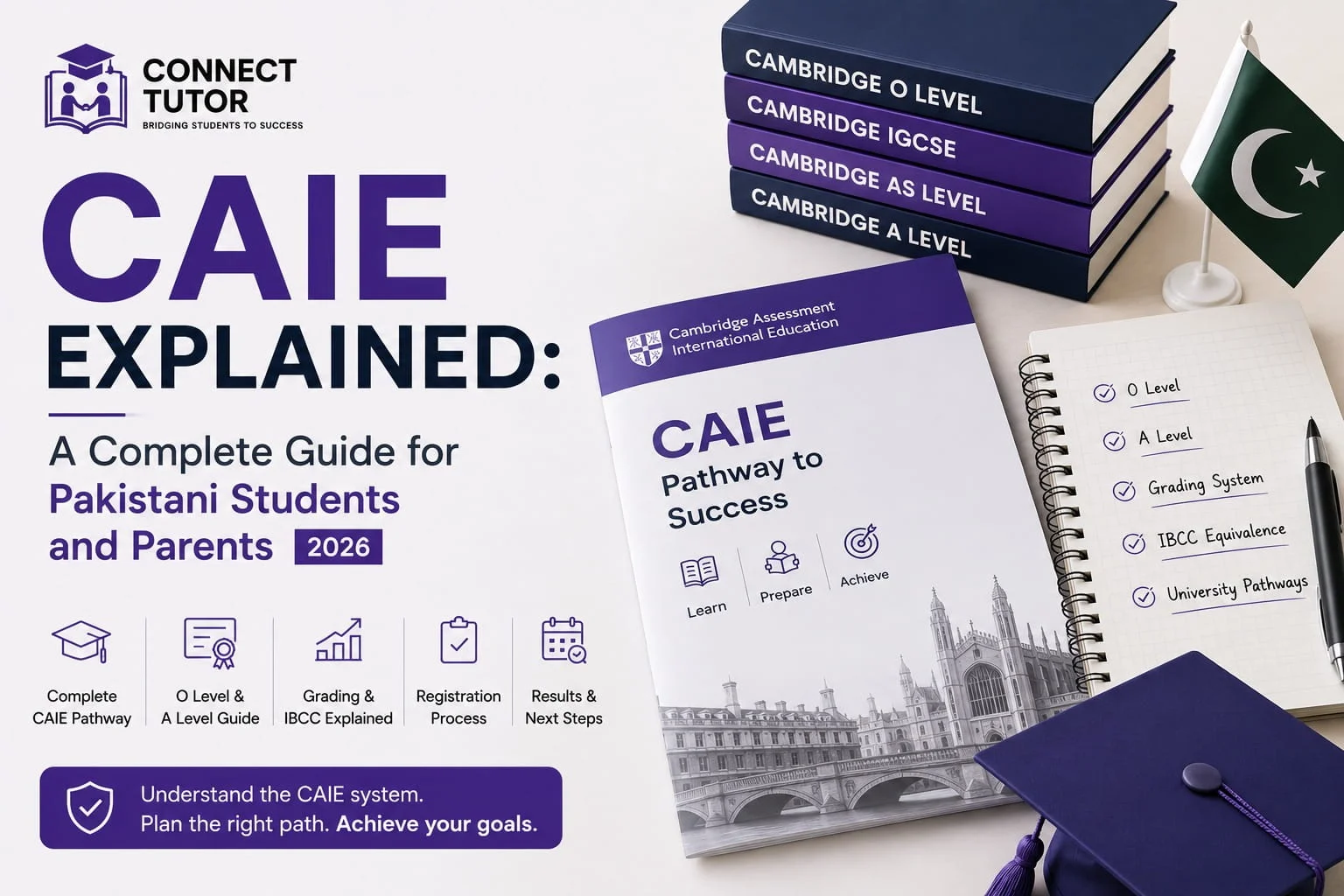
This guide gives you the complete picture of CAIE in Pakistan: what it is, how it works, what qualifications it offers, how it compares to other systems, and what the complete pathway looks like from primary school to university.
What Is CAIE?
CAIE stands for Cambridge Assessment International Education. It is a division of the University of Cambridge and one of the world’s leading international examination boards. CAIE develops syllabuses, sets exam papers, trains examiners, and awards grades for students in more than 160 countries.
In Pakistan, CAIE is the dominant international examination system. When Pakistani parents talk about O Levels or A Levels, they are referring to CAIE qualifications — specifically the Cambridge O Level and Cambridge International A Level programmes.
CAIE is not the same as the University of Cambridge itself, it is assessments division. When a student’s Cambridge certificate says ‘Cambridge Assessment International Education’, it is issued by this body, which is globally recognized by universities, employers, and governments.
Pakistan recorded over 1.6 million CAIE examination entries in 2024, one of the highest in the world outside the UK. The country has approximately 800 CAIE-registered schools, with the highest concentration in Karachi, Lahore, and Islamabad.
The Complete Cambridge Qualification Pathway
CAIE offers a progression of qualifications from primary school through to pre-university level. Understanding the full pathway helps parents make informed decisions at each transition point.
| Stage | Cambridge Qualification | Equivalent Pakistani Level | Ages (approx.) | IBCC Recognition |
| Primary | Cambridge Primary | Classes 1–5 | 5–11 years | N/A — not examined for equivalence |
| Lower Secondary | Cambridge Lower Secondary + Checkpoint | Classes 6–8 | 11–14 years | N/A — assessment only |
| Secondary | Cambridge O Level / IGCSE | SSC (Matric) — Classes 9–10 | 14–16 years | Yes — SSC Equivalence Certificate |
| Post-Secondary | Cambridge AS & A Level | HSSC (Intermediate) — Classes 11–12 | 16–18 years | Yes — HSSC Equivalence Certificate |
| Pre-University | Cambridge Pre-U | Post-HSSC / Foundation level | 17–19 years | Limited — check with IBCC |
For most Pakistani families, the relevant stages are O Level (ages 14–16) and A Level (ages 16–18). These are the qualifications that require IBCC equivalence and that determine university admission in Pakistan and abroad.
O Level vs IGCSE: What Is the Difference?
This is one of the most common questions Pakistani parents ask — and one of the most consistently poorly answered. Both O Level and IGCSE are CAIE qualifications at exactly the same academic level. Both are accepted by IBCC as equivalent to the Pakistani SSC (Matric). Both are externally marked by Cambridge. The differences are in structure, subject options, and historical context.
| Factor | Cambridge O Level | Cambridge IGCSE |
| Full name | Cambridge O Level | Cambridge International General Certificate of Secondary Education |
| Subject codes | 4-digit codes: 5054 (Physics), 5070 (Chemistry), 4024 (Maths) | 4-digit codes starting with 0: 0625 (Physics), 0620 (Chemistry), 0580 (Maths) |
| Grading scale | A* to G (E is minimum pass; F and G are very low passes not accepted by IBCC) | A* to U — same scale |
| Paper variants | Pakistan sits Variant 2 papers (Zone 4) | Pakistan sits Variant 2 papers (Zone 4). Same zone |
| Subject range | Narrower subject range; designed for international markets outside UK | Broader subject range; includes some subjects not available in O Level |
| IBCC recognition | Yes — SSC equivalent | Yes — SSC equivalent (treated identically) |
| Which Pakistani schools use it | Most established Pakistani O Level schools (KGS, LGS, Beaconhouse) | Some schools offer IGCSE for specific subjects not available in O Level format |
Practical answer: For most Pakistani students, the distinction is irrelevant — IBCC treats both identically, universities accept both, and the exam experience is essentially the same. If your school offers O Level 5054 Physics, that is what you sit. If it offers IGCSE 0625 Physics, that is what you sit. Either works.
How CAIE Grades Work in Pakistan
CAIE uses a letter-based grading system that is not fixed to a percentage — it adjusts each exam session based on paper difficulty. This is one of the most misunderstood aspects of the system.
The Grading Scale
| Grade | Standard Description | IBCC Equivalent (%) | Accepted by IBCC? |
| A* | Outstanding | 90–95% (varies by subject and session) | Yes |
| A | Excellent | 85% | Yes |
| B | Very Good | 75% | Yes |
| C | Good | 65% | Yes |
| D | Satisfactory | 55% | Yes |
| E | Acceptable — minimum pass | 45% | Yes — minimum IBCC accepts |
| F | Very Low Pass | 0% | No — IBCC does not accept |
| G | Minimum Pass | 0% | No — IBCC does not accept |
| U | Ungraded (Fail) | 0% | No |
How Grade Thresholds Are Set
CAIE does not set grade boundaries before the exam. They are determined after every exam session, based on the difficulty of that specific paper and statistical analysis of the entire cohort’s performance. A harder paper will have lower thresholds — meaning fewer raw marks are needed for an A.
This ensures that achieving a grade represents the same level of performance year after year, regardless of whether a particular paper was harder or easier. Grade threshold tables for every subject and session are published at cambridgeinternational.org after results are released and are worth downloading alongside every past paper you practice.
CAIE vs IB vs Edexcel: Which Is Right for Pakistan?
Some Pakistani families, particularly those considering overseas education, encounter alternatives to CAIE. Here is an honest comparison for the Pakistani context:
| Factor | CAIE (O & A Level) | IB Diploma Programme | Edexcel (Pearson) |
| Availability in Pakistan | Widest — 800+ registered schools | Very limited — fewer than 30 IB schools in Pakistan | Limited — fewer schools than CAIE |
| IBCC recognition | Full recognition — SSC and HSSC equivalence | Full recognition — IBCC issues equivalence | Full recognition — IBCC issues equivalence |
| University recognition (Pakistan) | Universal — accepted by all Pakistani universities | Accepted but requires IBCC equivalence | Accepted but less common |
| UK university recognition | Excellent — Cambridge qualification recognised universally | Excellent — IB widely respected by UK universities | Good — Pearson/Edexcel recognised |
| Cost | High but widest school choice | Highest — IB schools in Pakistan are premium institutions | Similar to CAIE |
| Exam structure | Subject-by-subject; external assessment by Cambridge | Holistic 6-subject programme with internal assessment and Extended Essay | Similar to CAIE; Pearson marks externally |
| Best for | Most Pakistani students — widest access, universal recognition, proven pathway | Students targeting top UK/US universities who have access to an IB school | Students whose school offers Edexcel; functionally similar to CAIE |
For the vast majority of Pakistani families, CAIE is the practical choice not because it is objectively superior to IB, but because it is the system with 800 registered schools, universal IBCC recognition, and the clearest pathway to Pakistani universities. The IB is an excellent qualification but is simply not accessible to most Pakistani students.
How to Register for CAIE Exams in Pakistan
Registration for CAIE exams in Pakistan works through two channels, depending on whether you are a school candidate or a private candidate.
School Candidates
If you are enrolled at a CAIE-registered school, your school handles all registration on your behalf. The school is a registered Cambridge Centre with a unique Centre Number. Your school’s Exams Officer submits entries to Cambridge by the registration deadline typically January for May/June exams and July for October/November exams.
Your responsibility as a school candidate: confirm with your school which subjects and which papers you are entered for, and collect your Statement of Entry before the exam period begins. The Statement of Entry is your proof of registration and contains your candidate number.
Private Candidates
Students who are not enrolled at a CAIE-registered school can register as private candidates through the British Council. The British Council operates CAIE exam centres in Karachi, Lahore, and Islamabad.
- Contact your nearest British Council office in January (for May/June) or June (for October/November) to begin the registration process
- Bring: your CNIC or B-Form, two passport photos, and the registration fee
- British Council will provide your candidate number and Statement of Entry
- Exam fees for private candidates are higher than school-route fees, confirm current rates directly with British Council
Verify your school: Before enrolling in any school that claims to offer CAIE, verify their registration at cambridgeinternational.org/find-a-school. Unregistered schools cannot legally enter students for Cambridge examinations regardless of what their marketing materials say.
CAIE Results Dates and What Happens After
When Results Are Released
| Series | O Level / IGCSE Results | AS & A Level Results | Pakistan Time (approx.) |
| May/June 2025 | 19 August 2025 | 12 August 2025 | ~10:00 AM PKT |
| May/June 2026 | 11 August 2026 | 11 August 2026 | ~10:00 AM PKT (06:00 BST) |
| Oct/Nov 2025 | 15 January 2026 | 9 January 2026 | ~11:00 AM PKT |
Results are accessed through the CAIE MyResults portal at myresults.cie.org.uk using candidate credentials provided by your school or British Council before results day.
The Immediate Priority After Results: IBCC Equivalence
Cambridge grades are internationally recognized, but for Pakistani universities, employment, and further education, they must first be converted to a Pakistani equivalence certificate through IBCC. This is not automatic and must be applied for.
- Apply for O Level SSC Equivalence at services.ibcc.edu.pk on results day or within 1–2 days
- IBCC uses a specific formula: each grade converts to marks (A*=90–95, A=80, B=70, C=60, D=50, E=40), the best 8 subjects are summed and scaled to 1050
- Normal processing takes 15–20 working days; urgent processing costs more but is faster
- A Level HSSC Equivalence requires the SSC Equivalence Certificate first, apply for O Level equivalence before A Level equivalence
Why Pakistani Families Choose CAIE
The growth of Cambridge education in Pakistan from a small elite system to over 800 registered schools and 1.6 million exam entries reflects specific advantages that have made it the dominant international qualification system in the country.
- Global university recognition: Cambridge qualifications are accepted by universities in Pakistan, the UK, the US, Canada, Australia, and across the Gulf. A student with CAIE A Levels can apply to LUMS, NUST, Oxford, and McGill using the same results.
- Meritocratic assessment: CAIE papers are set and marked in the UK against a consistent standard. Unlike provincial board exams in Pakistan, results are not susceptible to local variations in marking quality or standards.
- IBCC integration: CAIE is fully integrated into Pakistan’s university admission system through IBCC equivalence. Pakistani universities from NUST to Aga Khan accept CAIE qualifications with IBCC certificates.
- Resit flexibility: Individual subjects can be retaken in the next available exam series without repeating the entire year, a significant advantage over the FSc/Matric system where a poor result typically requires full-year repetition.
- Skill-based assessment: CAIE papers test understanding and application alongside recall. This preparation is consistently valued by employers and universities who work with graduates of both CAIE and Matric backgrounds.
CAIE in Pakistan: The System Is Larger Than Most People Realise
Pakistan is not a minor participant in the Cambridge system. With over 1.6 million exam entries in 2024 and 800+ registered schools, Pakistan is one of CAIE’s most significant markets globally. The system is established, recognised, and deeply integrated into the country’s university admission and professional credentialing infrastructure.
For parents deciding between CAIE and Matric for their child, the practical question is not which system is better in the abstract it is whether your child will have access to a good CAIE-registered school, whether the family can sustain the cost difference, and whether the international recognition is relevant to your child’s likely future.
For students already in the CAIE system, the most important thing to understand is that Cambridge qualifications are not self-explanatory, the grading system, the threshold mechanism, the IBCC equivalence process, and the exam technique requirements all need to be actively learned. The students who perform best in CAIE are not just the ones who work hardest. They are the ones who understand the system they are working within.
Whether you’re just starting O Level, stuck in the middle, or sitting your papers in a few months, Connect Tutor matches you with tutors who understand the CAIE system, know how examiners think, and know exactly what it takes to move your grade up. Not just any tutor. The right one.