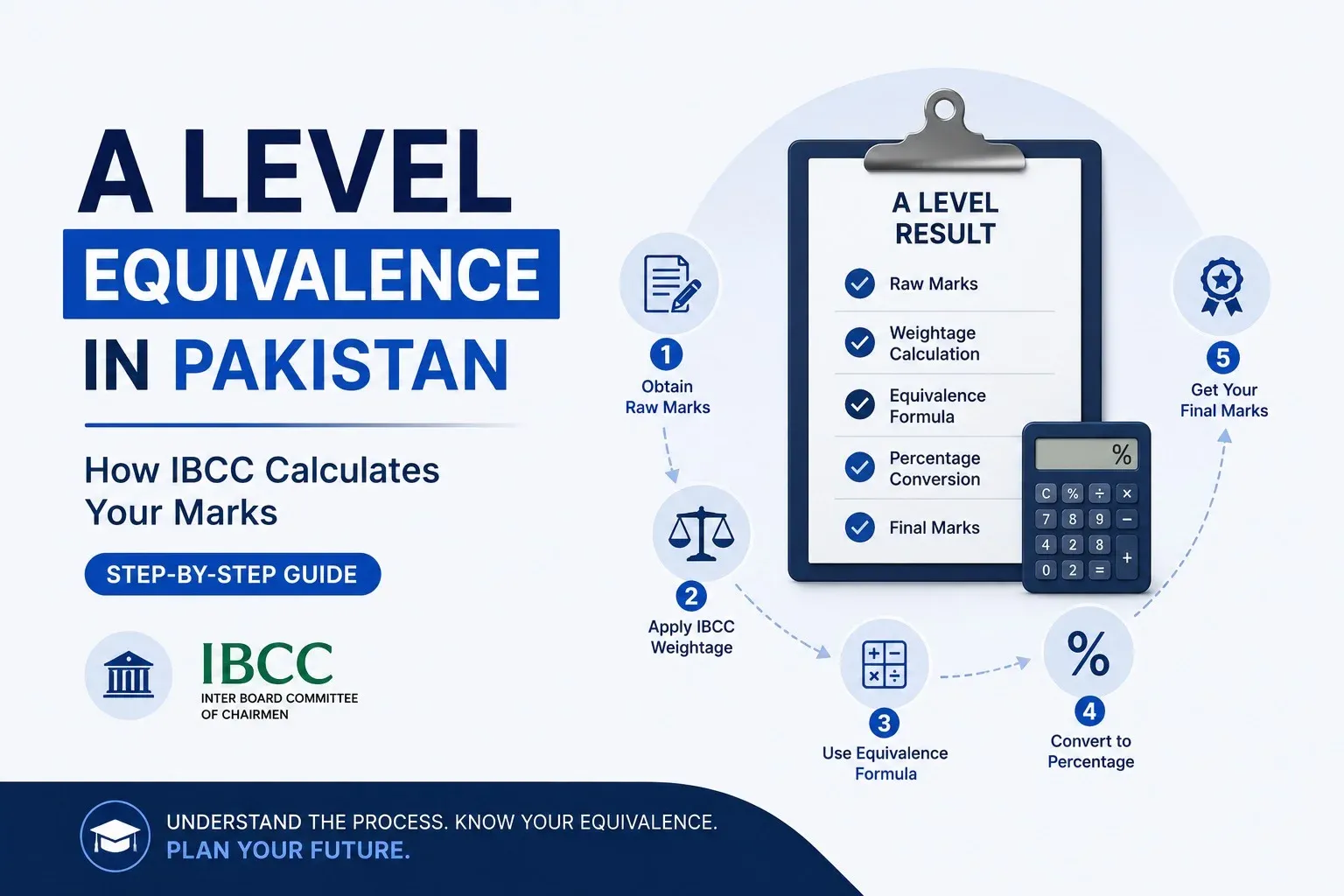
Every A Level student in Pakistan faces the same moment of confusion: results are out, Cambridge grades are in hand, but Pakistani universities want an IBCC equivalence percentage a single number calculated through a formula almost nobody fully explains.
What does your A* in Physics actually translate to in Pakistani marks? How does IBCC combine your O Level and A Level results into one figure? What documents do you need, and how long does it take?
This guide answers all of it step by step using data sourced directly from IBCC’s official website (ibcc.edu.pk), No guesswork.
What Is IBCC A Level Equivalence?
IBCC the Inter Board Committee of Chairmen is the government body under Pakistan’s Ministry of Federal Education and Professional Training that converts international qualifications into Pakistani-equivalent marks and certificates.
For A Level students, IBCC issues an HSSC (Higher Secondary School Certificate) Equivalence Certificate the document that makes your A Level results readable by Pakistani universities, scholarship bodies, government employers, and competitive exam authorities (MDCAT, ECAT, NTS, CSS).
Without this certificate, Pakistani universities cannot place you on a merit list. The equivalence is not optional it is a mandatory step between A Level results and any Pakistani university application.
| Your Qualification | Equivalent To | Issued By | Required For |
| O Level (8 subjects, min Grade E) | Matriculation (SSC) | IBCC | College admissions, FSc/ICS entry, MDCAT/ECAT eligibility, scholarship applications |
| A Level (3 subjects, min Grade E) | Intermediate (HSSC) | IBCC | University admissions, MDCAT/ECAT, CSS/PMS, government jobs requiring Intermediate |
The Prerequisite Most Students Miss: O Level Equivalence Must Come First
Critical rule: IBCC will not process your A Level equivalence application unless your O Level SSC Equivalence Certificate has already been issued. This is a hard requirement — not optional.
This is the single most common delay in the A Level equivalence process in Pakistan. Students receive their A Level results, rush to apply for HSSC equivalence, and discover they never applied for SSC (O Level) equivalence. IBCC returns the application until the SSC certificate is in hand.
From the IBCC official process: For A levels, attested copy of earlier O level/SSC equivalence certificate issued by IBCC is a mandatory document in the A Level equivalence application.
The sequence is fixed and cannot be reversed:
| Step | Action | Certificate Issued |
| Step 1 | Apply for O Level IBCC Equivalence (8 subjects, including 5 compulsory) | SSC Equivalence Certificate |
| Step 2 | Only after SSC certificate is received: Apply for A Level IBCC Equivalence (3 subjects in correct group) | HSSC Equivalence Certificate |
| Step 3 | Submit both IBCC certificates to Pakistani university with application | Eligible for merit list placement |
Subject Requirements for A Level IBCC Equivalence
IBCC issues A Level equivalence in four groups, each requiring specific subject combinations. The group you qualify for determines which university programmes you can apply to. From IBCC’s official British System page (ibcc.edu.pk) and confirmed by Maqsad Blog (2025):
| IBCC HSSC Group | Required A Level Subjects | Minimum Grade | Who This Covers |
| Pre-Medical | Physics + Chemistry + Biology | E in each | Medical, dental, pharmacy, nursing, biotechnology programmes |
| Pre-Engineering | Physics + Chemistry + Mathematics | E in each | All engineering programmes; architecture; physical sciences |
| Computer Science | Physics + Mathematics + Computer Science | E in each | Software engineering, IT, data science, computing programmes |
| Humanities | Any 3 A Level academic subjects | E in each | Business, economics, law, social sciences, arts, languages |
Important: A student who takes Biology + Economics + Business Studies gets Humanities equivalence only not pre-medical. The subject combination at A Level determines your IBCC group permanently. This cannot be changed retroactively.
Additional rules on compulsory subjects:
- Pakistani students sitting exams from Pakistan must have passed Urdu, Islamiyat, and Pakistan Studies at O Level these are checked before IBCC issues A Level equivalence
- Pakistani students who sat both O Level and A Level abroad are exempt from the Urdu, Islamiyat, and Pakistan Studies requirement
- Dual-nationality holders with qualifying abroad status may also be exempted — IBCC rules apply case-by-case
The IBCC Grade-to-Marks Conversion Formula: Fully Explained
This is the section most Pakistani students cannot find explained clearly anywhere. Here is exactly how IBCC converts your A Level letter grades into Pakistani marks — based on IBCC’s official conversion table (ibcc.edu.pk/conversion-for-equivalence/).
Step 1: Grade-to-Marks Conversion Table
Each A Level subject is scored out of 200 marks in the IBCC system. Your Cambridge letter grade is converted to a specific mark value using this table:
| Cambridge A Level Grade | IBCC Marks Assigned (out of 200) | Percentage Equivalent | Accepted for Equivalence? |
| A* | Varies by subject, set annually (always 90%+ equivalent — typically 185–200) | 90%+ | Yes |
| A | 170 (85% of 200) | 85% | Yes |
| B | 150 (75% of 200) | 75% | Yes |
| C | 130 (65% of 200) | 65% | Yes |
| D | 110 (55% of 200) | 55% | Yes |
| E | 90 (45% of 200) | 45% — minimum accepted | Yes — minimum pass |
| U (Ungraded) | 0 | 0% | No — not accepted by IBCC |
Important note on A*: IBCC revises the A* mark equivalent each year for each subject separately, based on the average performance in that exam session. The mark is always at or above 90% equivalent (185+ out of 200). The exact values for 2023 and 2024 exam sessions are published on ibcc.edu.pk/conversion-for-equivalence/. Check this page directly for the most current year’s A* conversion values, as they differ by subject
Step 2: Calculate Your Total A Level Marks
IBCC takes your best 3 A Level subjects and converts each to marks out of 200 using the table above. The maximum possible from 3 subjects is 600 marks (3 × 200).
Formula: A Level Total = Subject 1 marks (out of 200) + Subject 2 marks (out of 200) + Subject 3 marks (out of 200)
| Example Student | A Level Grade | Marks Assigned (out of 200) |
| Physics | A* | 190 (IBCC A* value for Physics 2024 session) |
| Mathematics | A | 170 |
| Chemistry | B | 150 |
| Total A Level Marks | 510 out of 600 |
Step 3: Combine with O Level Marks
IBCC does not calculate A Level equivalence in isolation. Your final HSSC equivalence percentage is calculated using both your O Level Equivalence and A Level marks combined a fact many students are not aware of until they receive their certificate.
For O Level equivalence: IBCC uses your best 8 subjects, each scored out of 100, giving a maximum of 800 marks out of 900 total for the SSC. (The extra 100 marks represent the practical/oral component not applicable to Cambridge students.)
Add your obtained O-Level marks (out of 800) to the sum of the converted A-Level subject marks.
Final Combined Formula: Total IBCC Marks = O Level marks (out of 800) + A Level marks (out of 600)
| Component | Marks Earned | Maximum Possible |
| O Level (8 subjects, from previous SSC equivalence) | 680 | 800 |
| A Level (3 subjects, from Step 2 above) | 510 | 600 |
| Combined Total | 1,190 | 1,400 |
| IBCC Equivalent Percentage | 1,190 ÷ 1,400 × 100 = 85% |
Note: The exact denominator and formula may be adjusted by IBCC for specific subject groups. The example above represents the standard calculation methodology. For the precise figure, the IBCC portal calculates it automatically when you submit your application.
Step 4: Worked Examples — Three Real Student Scenarios
Scenario A: Pre-Medical Student (A*, A, A in Physics, Chemistry, Biology)
| Subject | A Level Grade | Marks (out of 200) |
| Physics | A* | 190 |
| Chemistry | A | 170 |
| Biology | A | 170 |
| A Level Total | 530 / 600 | |
| O Level (8 subjects, all As and Bs — approx) | 660 / 800 (example) | |
| Combined IBCC Total | 1,190 / 1,400 = 85% |
Scenario B: Pre-Engineering Student (A, B, C in Physics, Maths, Chemistry)
| Subject | A Level Grade | Marks (out of 200) |
| Physics | A | 170 |
| Mathematics | B | 150 |
| Chemistry | C | 130 |
| A Level Total | 450 / 600 | |
| O Level (8 subjects, mix of As and Bs — approx) | 620 / 800 (example) | |
| Combined IBCC Total | 1,070 / 1,400 = 76.4% |
Scenario C: Humanities Student (B, C, C in Economics, Business, English Literature)
| Subject | A Level Grade | Marks (out of 200) |
| Economics | B | 150 |
| Business Studies | C | 130 |
| English Literature | C | 130 |
| A Level Total | 410 / 600 | |
| O Level (8 subjects, mostly Bs and Cs — approx) | 560 / 800 (example) | |
| Combined IBCC Total | 970 / 1,400 = 69.3% |
These examples demonstrate why A Level grades matter so much: moving from C to A in a single subject adds 40 marks (130 to 170), which adds 2.9 percentage points to your final IBCC equivalent. Moving from B to A* adds 40 marks as well. In a merit list where the cut-off is 85%, every percentage point is consequential.
Why the IBCC Equivalence Percentage Matters So Much
Your IBCC equivalence percentage is not just a formality. It directly determines:
| Use | How IBCC % Is Applied | Why It Matters |
| Pakistani University Merit Lists | Universities calculate aggregate = IBCC % (weighted) + Entry test score (weighted) | NUST aggregate = 10% Matric + 15% A Level IBCC + 75% NET score |
| MDCAT Eligibility (Medical) | Minimum 60% IBCC equivalence required to sit MDCAT (National Medical Authority rule) | Students below 60% cannot appear in MDCAT regardless of A Level grades |
| ECAT Eligibility (Engineering) | Minimum 60% IBCC equivalence required for UET ECAT and most engineering entry tests | Same threshold as MDCAT applies |
| Scholarship Applications | Government and HEC scholarships compare IBCC % for merit ranking | A 1% difference in IBCC % can determine scholarship award at competitive cut-offs |
| Government Jobs | Federal and provincial government jobs use IBCC % to verify Intermediate-level qualification | Required for CSS, NTS, and all federal government advertised posts requiring Intermediate |
| HEC Recognition | HEC requires IBCC HSSC equivalence for recognition of any degree earned after A Level in Pakistan | Without it, your Pakistani degree may not be HEC-recognised |
Documents Required for A Level IBCC Equivalence Application
| # | Document Required | Notes |
| 1 | Original A Level Cambridge Certificate | Must be original — NOT laminated or plastic-coated; IBCC returns laminated certificates |
| 2 | Two sets of attested photocopies of A Level certificate | Back-to-back photocopies; attested by a gazetted officer or notary |
| 3 | Original IBCC O Level (SSC) Equivalence Certificate | Mandatory prerequisite — application rejected without this |
| 4 | Attested copy of O Level IBCC Equivalence Certificate | One attested copy alongside original |
| 5 | Attested copy of Applicant’s CNIC / Smart Card / B-Form | Must be NADRA-issued; name and date of birth must match all certificates exactly |
| 6 | Attested copy of Parent or Guardian’s CNIC | Required for all applications |
| 7 | Original A Level Statement of Result (if certificate not yet issued) | Valid for 6 months only — after 6 months, original certificate is mandatory |
| 8 | British Council Verification Letter (if certificate is 5+ years old) | Certificates older than 5 years must first be verified by British Council before IBCC accepts them |
| 9 | IBCC Application Form (completed online or downloaded) | Available at ibcc.edu.pk or via services.ibcc.edu.pk portal |
| 10 | Proof of fee payment (bank draft or online payment confirmation) | Fee: PKR 6,000 (normal); PKR 12,000 (urgent service) — EduMap.blog / Maqsad, 2025 |
| 11 | Passport copies + visa copies (if student studied abroad) | Only for overseas students; domestic Pakistan-based students are exempt |
Document warning from IBCC: “Fake documents will be confiscated and referred to the relevant authorities.” Applicants who submit fraudulent certificates face criminal referral. This warning is published directly on IBCC.
How to Apply: Step-by-Step Application Process
There are two routes: online submission (faster, preferred) and walk-in / courier (physical submission to regional office). Both are valid.
Online Application (Recommended)
| Step | Action |
| 1 | Register or log in at the IBCC online portal: services.ibcc.edu.pk |
| 2 | Select ‘A Level (GCE) Equivalence’ from the application type menu |
| 3 | Fill in your personal details — ensure name and date of birth match exactly with your CNIC and all certificates |
| 4 | Enter your A Level subjects and grades |
| 5 | Upload scanned copies of all required documents (clear, legible scans) |
| 6 | Pay the equivalence fee online: PKR 6,000 (normal) or PKR 12,000 (urgent) |
| 7 | Submit the application and save your application reference number |
| 8 | Send original documents via courier to IBCC Head Office or drop at nearest Regional Office |
| 9 | Track application status on services.ibcc.edu.pk using your reference number |
| 10 | Collect your HSSC Equivalence Certificate from the IBCC office or via courier |
Route 2: Walk-In / Courier Submission
Download the application form from ibcc.edu.pk, fill it manually, attach all documents, and submit in person or by courier to the relevant IBCC Regional Office:
| City | IBCC Office Address | Contact |
| Islamabad (HQ) | Plot No. 25, Street No. 38, Sector G-10/4, Islamabad 44000 | +92-51-111114222 |
| Karachi | Plot No. ST-2, National Stadium Road, Karachi 74200 | +92-21-99230583 |
| Lahore | Queen Plaza, 13-A Durand Road, Lahore 54000 | +92-42-99200172 |
| Peshawar | 69/C Sahibzada Abdul Qayyum Road, University Town, Peshawar | +92-91-9216088 |
| Quetta | Akhtar Plaza, Spiny Road, Near RBC, Quetta 87300 | +92-81-2873633 |
| Bahawalpur | D-5/5, Aziz Bhatti Road, Model Town-A, Bahawalpur 63100 | +92-62-9255601 |
Fees and Processing Time
| Service Type | Fee (PKR) | Processing Time | Best For |
| Normal Processing | PKR 6,000 | 15–20 working days | Students applying well in advance of university deadlines |
| Urgent Processing | PKR 12,000 | Faster — exact timeline confirmed at time of application | Students with imminent university application or entry test deadlines |
| HEC Attestation (if required additionally) | PKR 5,000 | Separate process after IBCC certificate is issued | Required for postgraduate admissions and some international university verifications |
Apply for O Level IBCC equivalence immediately after results are out in August. Do not wait until A Level is complete. Having SSC equivalence ready by August of Grade 11 means you can apply for HSSC equivalence the moment A Level results arrive in August of Grade 12 before university deadlines close.
How Universities Use Your IBCC Percentage in Their Aggregate Formula
Your IBCC % is only one component of a university’s final aggregate. Each university weights it differently. Here are the verified aggregate formulas for Pakistan’s top universities:
| University | Aggregate Formula | Minimum IBCC % Required |
| NUST | 10% Matric/SSC IBCC + 15% A Level/FSc IBCC + 75% NET (NUST Entry Test) | 60% for all subjects |
| UET Lahore | 25% Matric + 25% FSc/A Level IBCC + 50% ECAT | 60% IBCC for ECAT eligibility |
| Aga Khan University | A Level grades + AKU Aptitude Test + Interview (no fixed IBCC formula published) | No fixed minimum — A Level grades assessed directly |
| LUMS | SAT/LCAT + A Level grades (LUMS does not use IBCC % directly for most programmes) | No fixed IBCC minimum — A Level grades + test score |
| IBA Karachi | IBA Aptitude Test + Interview (A Level grades assessed directly, not IBCC %) | No published minimum IBCC % |
| MDCAT Eligibility | Minimum 60% IBCC (Pre-Medical) required to sit MDCAT; test score then determines admission | 60% mandatory |
| ECAT Eligibility | Minimum 60% IBCC (Pre-Engineering) required to sit UET ECAT | 60% mandatory |
Key insight: Universities like LUMS, IBA, and Aga Khan assess your A Level grades directly not always through the IBCC % formula. But you still need the IBCC certificate as a formal credential document even if the grade assessment is done directly. Always apply for IBCC equivalence regardless of which university you are targeting.
6 Mistakes Students Make with IBCC A Level Equivalence
- Applying for A Level equivalence without O Level equivalence in hand.
This is the most common and most costly mistake. IBCC rejects the application immediately. Apply for SSC equivalence as soon as O Level results are released.
- Submitting a laminated certificate.
IBCC explicitly states laminated and plastic-coated certificates are not accepted. If your Cambridge certificate is laminated, you must submit the original Statement of Result (valid 6 months) or a British Council-verified copy.
- Assuming Statement of Result is valid indefinitely.
The Statement of Result is valid for only 6 months from the date of issue. Many students who gap-year or delay their university application return to find their Statement of Result is expired and IBCC now requires the original certificate.
- Name or date of birth mismatch across documents.
IBCC checks that the name and date of birth match exactly across the CNIC/B-Form, O Level certificate, A Level certificate, and equivalence application. Any mismatch even a spelling difference in a name result in application rejection. Resolve discrepancies with NADRA before applying.
- Not checking IBCC group requirements before choosing A Level subjects.
A student who takes the wrong combination for their intended career cannot retroactively get the IBCC group they need. Biology + Economics + Business = Humanities group, not pre-medical. This error closes off medicine permanently. Check IBCC group requirements before finalizing A Level subjects.
- Applying too late — after university deadlines have passed.
Normal IBCC processing takes 15–20 working days. Most Pakistani university applications close in September–October. A Level results arrive in August. This leaves a very narrow window. Apply for IBCC equivalence on the day A Level results are released — not weeks later.
Frequently Asked Questions
How long does IBCC A Level equivalence take in Pakistan?
Normal processing takes approximately 15 to 20 working days from the date IBCC receives your complete application with all correct documents. Urgent processing is faster but costs PKR 12,000 instead of PKR 6,000. If documents have discrepancies (name mismatch, laminated certificate, missing O Level equivalence), the application is returned and the clock restarts from when corrected documents are resubmitted.
Can I get A Level equivalence for only 2 subjects?
No. IBCC requires a minimum of 3 full A Level subjects for HSSC equivalence. AS Level alone (the Grade 11 component) is not sufficient. You need the complete A Level (AS + A2 combined result) in at least 3 subjects. A student who has passed only 2 full A Level subjects does not qualify for HSSC equivalence.
Do AS Level results count for IBCC equivalence?
Only if they combine to form a full A Level. AS Level alone is not accepted as a standalone A Level qualification for IBCC purposes. IBCC recognises the full A Level (AS + A2 combined result) as one subject. A student with only AS Level in a subject and A2 Level in different subjects may face complications IBCC case-by-case. If you are in this situation, contact IBCC directly via services.ibcc.edu.pk before submitting.
What if I passed a Grade F or G in one of my A Level subjects?
Grades F and G do not exist in the A Level grading scale (A Level goes from A* to E, then U). Grade U (Ungraded) is the fail grade at A Level, and IBCC does not accept it. If you have a U in one of your 3 subjects, that subject cannot be counted for equivalence. You would need to retake it in the next session or — if you have a 4th A Level subject with a passing grade — substitute it. IBCC uses the best 3 qualifying subjects.
Is IBCC equivalence valid permanently?
Yes. Once issued, an IBCC equivalence certificate does not expire. It is a permanent government-issued document. However, some individual universities or scholarship bodies may request documents to be attested or re-verified after a certain period for their own institutional processes. The IBCC certificate itself has no expiry date.
Can I apply for IBCC equivalence from abroad?
Yes. Pakistani students studying or living abroad can submit their equivalence application online via services.ibcc.edu.pk and courier original documents to the IBCC Head Office in Islamabad. For students who sat their O Level and A Level exams abroad, note that Urdu, Islamiyat, and Pakistan Studies are exempted from the compulsory subject requirements only English and Mathematics are required at O Level.
Final Word
The IBCC A Level equivalence process is not complicated once you understand its structure — but it has enough rules, sequences, and document requirements to trip up even well-organised students.
The three things that matter most: (1) Get your O Level SSC equivalence immediately after results do not delay. (2) Choose A Level subjects that match the IBCC group you need for your intended career, before you start studying them. (3) Apply for A Level HSSC equivalence on the day your results are released in August not weeks later.
If your child is preparing for A Level exams and needs targeted subject support whether to push a C to a B or a B to an A* working with a verified, CAIE-experienced tutor in the months before the exam can make a direct and measurable difference to the IBCC percentage they ultimately receive.

1 thought on “A Level Equivalence in Pakistan: How IBCC Calculates Your Marks (Step-by-Step)”
Pingback: A Level Means Which Class in Pakistan? Full Guide 2026