
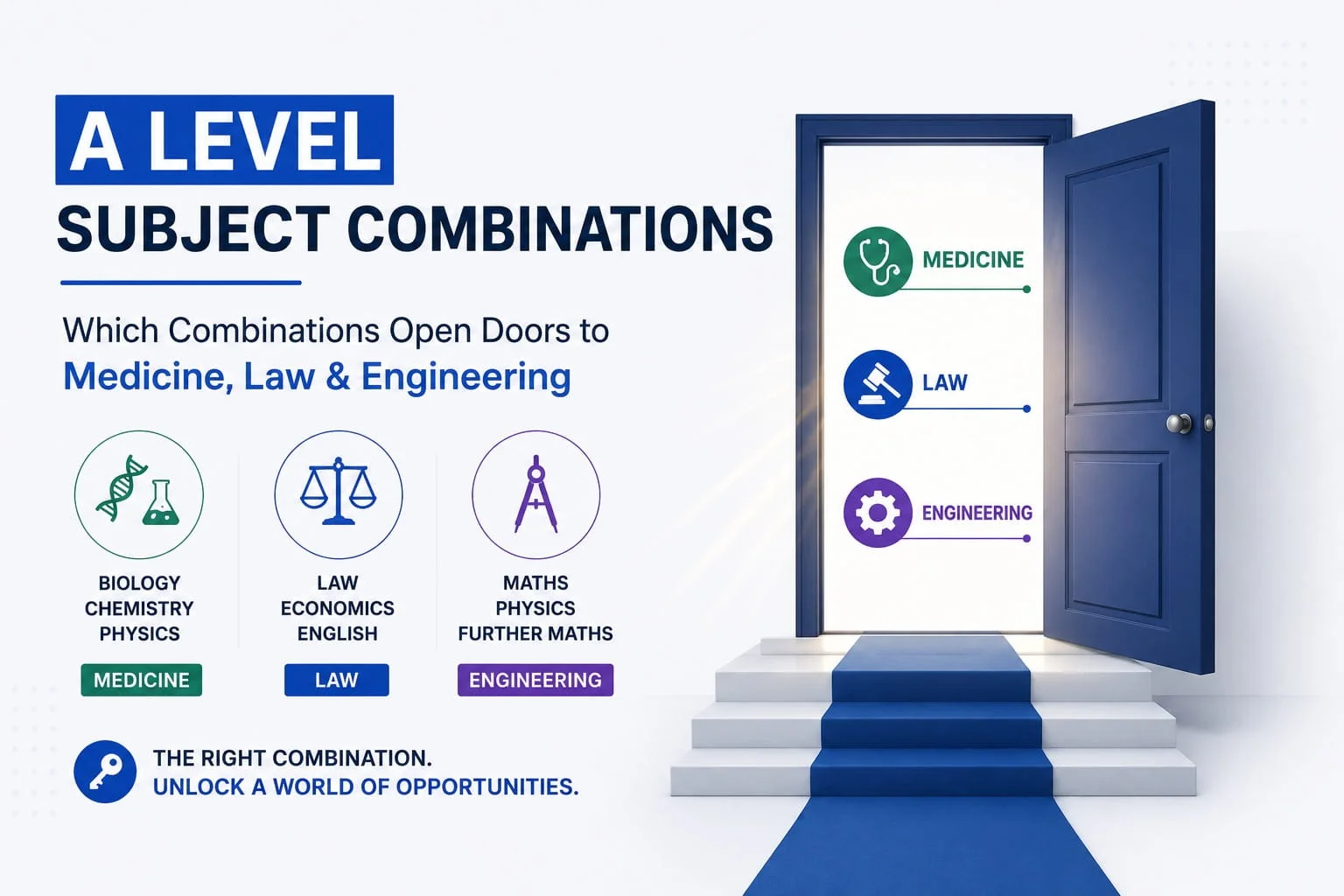
Most A Level students in Pakistan make one of two mistakes when choosing subjects: they either pick what their friends choose, or they pick what sounds impressive without checking whether it actually meets university entry requirements.
Both mistakes can cost a student their preferred university programme sometimes permanently. A student who drops Chemistry at A Level cannot apply to medical school in Pakistan. A student who skips Mathematics cannot apply to most engineering, economics, or computer science programmes at LUMS, NUST, or IBA.
This guide gives you the complete A Level subjects list available in Pakistan, explains what each group is for, and then maps out proven subject combinations by career pathway sourced directly from the LGS Subject Combinations Guide 2024–26, NUST’s official eligibility page, IBA Karachi’s admission requirements, and IBCC’s official equivalence rules.
How Many Subjects Do You Take at A Level?
A Level is fundamentally different from O Level in structure. At O Level, students study 8–9 subjects across multiple disciplines. At A Level, the focus narrows sharply: most students take 3 to 4 subjects studied in great depth over two years.
| Number of Subjects | Who Takes This | Rationale |
| 3 subjects | Most students globally and in Pakistan | Minimum for the vast majority of UK, US, and Pakistani university programmes |
| 4 subjects | Stronger students; those keeping options open | For students targeting competitive universities; provides backup if one subject underperforms |
| 5 subjects | Exceptional students only | Rarely recommended; quality of grades matters far more than number of subjects |
The Complete A Level Subjects List Available in Pakistan
Cambridge (CAIE) offers over 80 A Level subjects globally. In Pakistan, most registered schools offer between 25 and 40 of these, depending on staffing and student demand. The following is the full list available in the Pakistani Cambridge system, organized by group:
Group 1 — Mathematics
| Subject | CAIE Code | University Value | Key Notes |
| Mathematics | 9709 | Extremely high required for most STEM and business degrees | “Mathematics is considered one of the most valuable A Level subjects by universities” |
| Further Mathematics | 9231 | Very high — for top engineering, CS, and pure maths degrees | For students targeting competitive math’s or engineering programmes; taken alongside regular Math’s |
| Statistics | 9709 (component) | High | Often studied as part of the mathematics syllabus; data science and economics pathway |
Group 2 — Sciences
| Subject | CAIE Code | Career Pathway | Why It Matters |
| Physics | 9702 | Engineering (all types), architecture, physical sciences, computing | Most popular A Level subject in Pakistan 2024 (CAIE data); mandatory for pre-engineering |
| Chemistry | 9701 | Medicine, dentistry, pharmacy, chemical engineering | Mandatory for pre-medical; dropped to 4th most popular in 2024 after years in top 3 |
| Biology | 9700 | Medicine, dentistry, biotechnology, nursing, environmental science | Mandatory for Pre-Medical IBCC group; required by all Pakistani medical colleges |
| Environmental Management | 8291 | Environmental science, development, sustainability | AS Level only — LGS notes it should be taken as a 4th/5th subject only, not a primary subject |
| Marine Science | 9693 | Marine biology, oceanography | Offered at limited schools |
Group 3 — Commerce & Business
| Subject | CAIE Code | Career Pathway | Why It Matters |
| Business Studies | 9609 | Business, management, MBA, entrepreneurship | 3rd most popular A Level subject in Pakistan 2024 — overtook Chemistry for first time (CAIE data) |
| Economics | 9708 | Economics, finance, banking, public policy, investment | LGS: most universities require A Level Math’s alongside Economics for business degrees |
| Accounting | 9706 | Accounting, finance, CA/ACCA/CPA, audit | Strong foundation for professional accounting qualifications; IBA and LUMS Finance accept it |
Group 4 — Technology & Computing
| Subject | CAIE Code | Career Pathway | Why It Matters |
| Computer Science | 9618 | Software engineering, data science, AI, cybersecurity | Entered Pakistan’s A Level top 5 in 2024, replacing Economics (CAIE/Geo.tv); growing rapidly |
| Information Technology (IT) | 9626 | IT support, systems administration, digital media | Less analytical than CS; stronger for applied IT roles than pure software engineering |
| Media Studies | 9607 | Journalism, media, PR, digital marketing | Soft subject — LGS notes not always accepted as a primary subject by competitive universities |
Group 5 — Humanities & Social Sciences
| Subject | CAIE Code | Career Pathway | Why It Matters |
| English Language | 9093 | Journalism, media, English teaching, communications | Develops writing mechanics and language analysis; different from Literature |
| English Literature | 9695 | Law, journalism, academia, social sciences | Builds critical analysis and essay writing; highly valued by top universities globally |
| History | 9489 | Law, political science, civil service, academia | Strong analytical subject; valued for essay-based university programmes |
| Politics | 9557 | Political science, law, public policy, international relations | Newer subject; growing in popularity in Pakistan |
| Sociology | 9699 | Social work, media, development studies, public policy | Considered a softer subject; useful as a supporting 4th subject |
| Psychology | 9990 | Clinical psychology, medicine (some routes), human resources | Growing popularity; valued by UK and US universities for medicine-adjacent programmes |
| Law | 9084 | Law (LLB), public policy, compliance | LGS notes: not recommended for students applying to universities in the USA |
| Global Perspectives & Research | 9239 | Research, social sciences, international studies | Highly interdisciplinary; valued for critical thinking development |
| Urdu | 9686 | Urdu language teaching, literature, media | Accepted by most Pakistani universities; LGS notes it may not be accepted as a primary subject at competitive UK universities |
Group 6 — Creative & Applied
| Subject | CAIE Code | Career Pathway | Why It Matters |
| Art & Design | 9479 | Architecture, fashion, graphic design, fine arts | Portfolio submission alongside A Level grade; required by NCA and design schools |
| Travel & Tourism | 9395 | Hospitality, hotel management, tourism industry | Vocational; accepted by limited university programmes |
What Are “Facilitating Subjects”?
The LGS guide uses the term “facilitating subjects” throughout. This is a concept borrowed from UK UCAS guidance and widely used by Pakistani A Level schools:
Facilitating subjects are those that do not limit your university options. They are valued by admissions offices because they demonstrate academic rigour and keep doors open. The core facilitating subjects are:
| Facilitating Subject | Why Universities Value It |
| Mathematics | Required or preferred by engineering, economics, computer science, physics, chemistry, and most STEM programmes globally |
| Physics | Required for all engineering; highly valued for physical sciences and architecture |
| Chemistry | Required for medicine, dentistry, pharmacy, and most biomedical programmes |
| Biology | Required for medicine, dentistry, nursing, biotechnology |
| Economics | Valued for business, finance, and social science programmes |
| English Literature | Valued for law, social sciences, humanities, and writing-intensive programmes |
| History | Valued for law, political science, and humanities programmes |
| Modern Languages (Urdu, etc.) | Valued for language studies; note LGS caveat on UK recognition |
Non-facilitating (“soft”) subjects such as Media Studies, Environmental Management, Sociology, and Global Perspectives are not necessarily bad choices. But taking all three of your A Level subjects from this list significantly limits university options and can result in rejection from competitive programmes even with high grades.
Subject Combinations That Actually Open University Doors
The following combinations are best for student opening wide doors for student, NUST and IBA’s official eligibility criteria. Each combination maps to a specific career and university pathway.
Combination 1: Medicine, Dentistry, Pharmacy
| Subject | CAIE Code | IBCC Group | Status |
| Physics | 9702 | Pre-Medical | Required |
| Chemistry | 9701 | Pre-Medical | Required |
| Biology | 9700 | Pre-Medical | Required |
| Mathematics (optional 4th) | 9709 | — | Strongly recommended; increases options |
IBCC rule: “Three subjects i.e. Physics, Chemistry and Biology with minimum E grade at A levels will be required.”
MDCAT note: Pakistan’s Medical and Dental College Admission Test (MDCAT) is the primary filter for government and private medical colleges. A Level student with Physics, Chemistry, Biology are eligible to sit MDCAT after obtaining IBCC HSSC Pre-Medical equivalence.
Best for: AKU, NUMS, Agha Khan, RMC, CMH, CMC, FJMC, all PMC-affiliated medical colleges
Combination 2: Engineering (Electrical, Mechanical, Civil, Chemical, Software)
| Subject | CAIE Code | IBCC Group | Status |
| Physics | 9702 | Pre-Engineering | Required |
| Chemistry | 9701 | Pre-Engineering | Required |
| Mathematics | 9709 | Pre-Engineering | Required |
| Biology OR Computer Science (4th) | 9700 / 9618 | — | Adds breadth; CS recommended for Software/Computer Engineering |
NUST official eligibility “All non FSc stream candidates must have equivalence certificate duly obtained from IBCC, Pakistan in relevant groups/subjects and with minimum 60% marks.
“For almost all engineering courses the most important A Level subjects to study are Mathematics and Physics along with either Biology and or Chemistry depending on the type of engineering you want to pursue.”
Best for: NUST, UET, GIKI, NED, FAST-NUCES, PIEAS, COMSATS Engineering
Combination 3: Computer Science, Software Engineering, Data Science
| Subject | CAIE Code | IBCC Group | Status |
| Mathematics | 9709 | Computer Science | Required |
| Physics | 9702 | Computer Science | Required |
| Computer Science | 9618 | Computer Science | Strongly recommended |
| Further Mathematics (4th) | 9231 | — | Recommended for top CS degrees globally |
IBA Karachi CS requirement: “Minimum of 1 B and 2 Cs in 3 principal subjects including Mathematics,
Combination 4: Business, Finance, Economics, Accounting
| Subject | CAIE Code | IBCC Group | Status |
| Mathematics | 9709 | Humanities | Strongly required |
| Economics | 9708 | Humanities | Core |
| Business Studies | 9609 | Humanities | Core |
| Accounting (4th option) | 9706 | — | Adds CA/ACCA pathway; recommended for Finance track |
“To pursue a degree in Business or Economics most universities require A Level Mathematics.” This applies in Pakistan (IBA, LUMS SDSB), the UK, and Canada equally.
IBA Karachi BBA requirement: “A Level: Minimum of 1 B and 2 Cs in 3 principal subjects including Mathematics.”
LUMS SDSB: Requires at least 2 Bs and 1 C in three principal subjects for Accounting & Finance and Management Sciences programmes.
Combination 5: Law, Political Science, Social Sciences
| Subject | CAIE Code | IBCC Group | Status |
| English Literature | 9695 | Humanities | Strongly recommended |
| History | 9489 | Humanities | Strongly recommended |
| Politics | 9557 | Humanities | Recommended |
| Sociology / Psychology / Economics (4th) | 9699 / 9990 / 9708 | — | Adds social science depth |
“There are no prerequisites to pursue Humanities, Liberal Arts, or Law at the undergraduate level in local institutions.” This means local law schools do not mandate specific A Level subjects but English Literature + History + Politics is the combination most valued for analytical writing and critical reasoning.
For UK law (LLB at UCL, LSE, King’s): English Literature is highly recommended. History is valued. Law A Level itself is not required and some UK universities actually prefer students who have not studied it.
“A Level Law is not recommended for students applying to universities in the USA.”
Best for: LUMS SAHSL Law & Policy, University of London LLB, UK law schools (UCL, LSE, King’s), SZABIST, UCP Law, PU Law
Combination 6: Architecture & Design
| Subject | CAIE Code | IBCC Group | Status |
| Mathematics | 9709 | Pre-Engineering | Required for most architecture schools |
| Physics | 9702 | Pre-Engineering | Required (structural elements) |
| Art & Design | 9479 | Humanities | Required for NCA and design-track programmes |
| Chemistry OR Further Maths (4th) | 9701 / 9231 | — | Chemistry for chemical engineering route; Further Maths for competitive programmes |
“Universities often expect Math and Physics, plus Art or portfolio-related subjects.” Architecture sits at the intersection of engineering and creative arts a portfolio submission alongside A Level resuts is required by most leading architecture schools globally.
Best for: NCA Lahore, NUST Architecture, Dawood University, NED Architecture, UK RIBA-accredited schools
Combination 7: Keep All Options Open
LGS identifies one combination that keeps every career pathway available.
“Biology, Chemistry, Mathematics, Physics is the ONLY combination which will keep all your options open for Medicine, Dentistry, all Engineering fields, Computer Science, Humanities, Social Sciences and the Arts.
| Subject | CAIE Code | Why Included |
| Physics | 9702 | Required for Pre-Engineering AND Pre-Medical (Pakistan); keeps all STEM pathways open |
| Chemistry | 9701 | Required for Pre-Medical AND Pre-Engineering; non-negotiable for medicine and chemical engineering |
| Biology | 9700 | Required for Pre-Medical; adds life sciences option |
| Mathematics | 9709 | Required or preferred for engineering, CS, economics, business; one of the most universally valued subjects |
Important caveat: Taking 4 subjects significantly increases workload. Only choose this combination if you are academically strong across all four and your school recommends it.
What Pakistan’s Top Universities Actually Require from A Level Students
Here is the verified entry data from Pakistan’s most competitive universities — sourced directly from official pages:
| University | Programme | Minimum A Level Requirement | Entry Test |
| NUST | Engineering | Physics + Chemistry + Mathematics (IBCC Pre-Engineering) — minimum 60% equivalence | NET (NUST Entry Test) — 75% of merit |
| NUST | Computer Science | Physics + Computer + Mathematics (IBCC CS Group) | NET — 75% of merit |
| IBA Karachi | BBA / BS Economics | Min 1 B + 2 Cs in 3 principal subjects including Mathematics | IBA Aptitude Test + Interview |
| IBA Karachi | BS Computer Science | Min 1 B + 2 Cs in 3 principal subjects including Mathematics | IBA Aptitude Test + Interview |
| LUMS | All UG Programmes | Min 2 Bs + 1 C in 3 principal subjects (competitive programmes expect higher) | LSAT/SAT/ACT or LCAT (LUMS own test) |
| LUMS SBASSE | Engineering / CS / Sciences | Mathematics required; Physics/Chemistry depending on programme | LSAT / SAT Math |
Key pattern across all top Pakistani universities: Mathematics is the single most consistently required subject. Students who do not take A Level Mathematics are ineligible for engineering, CS, economics, and most business programmes at NUST, LUMS, IBA, and FAST.
5 Mistakes Pakistani A Level Students Make With Subject Choices
- Dropping Mathematics thinking it is optional.
Mathematics is described as “one of the most valuable A Level subjects by universities” in the LGS guide. For Pakistan’s top universities, it is effectively mandatory. Students who avoid it because it is challenging cut off more career doors than any other single decision.
- Taking three soft subjects to get high grades.
Subjects like Media Studies, Sociology, and Environmental Management are not bad — but taking all three as your primary subjects signals weak academic ambition to selective universities.
IBCC has specific subject requirements per group (Pre-Medical, Pre-Engineering, CS, Humanities). A student who takes Biology + Economics + English Literature gets Humanities equivalence only — not pre-medical. This closes off medicine and engineering even if the student later realizes they want those careers.
- Choosing 4 subjects without the academic capacity to score well in all of them.
Grades matter far more than subject count. A student with AAA in 3 subjects will always outperform a student with ABCD in 4 subjects for the vast majority of university programmes. Take 4 only if your school recommends it based on your O Level performance.
- Not verifying what your school actually offers.
CAIE may list a subject, but your specific school may not offer it due to staffing. LGS offers 111 combinations from approximately 30 subjects. Smaller or newer schools may offer only 15–20 subjects. Always confirm your school’s available list before planning.
Frequently Asked Questions
What are the most popular A Level subjects in Pakistan in 2024?
According to CAIE’s official results data, the top 5 most popular A Level subjects in Pakistan for the 2024 May/June series were: Physics, Mathematics, Business Studies, Chemistry, and Computer Science. Business overtook Chemistry for the first time, and Computer Science replaced Economics in the top 5 reflecting a significant shift toward technology and business careers among Pakistani A Level students.
Is Mathematics compulsory for A Level in Pakistan?
Not technically compulsory at A Level there are no Cambridge-mandated compulsory subjects at A Level (unlike O Level, where English, Maths, Urdu, Islamiyat, and Pakistan Studies are required). However, Mathematics is practically essential for almost all STEM and business programmes at NUST, LUMS, IBA, and FAST. Students who skip Mathematics at A Level are ineligible for engineering, computer science, economics, and most finance programmes at Pakistan’s top universities.
Can I do A Level Biology without Chemistry?
Yes, you can study Biology without Chemistry at A Level. However, for Pre-Medical IBCC equivalence, both Physics AND Chemistry AND Biology are required (all three). Taking Biology without Chemistry means you will not qualify for the Pre-Medical IBCC group, making you ineligible for MDCAT and government medical college admissions. For overseas universities, most UK medical schools also require Chemistry.
Is Further Mathematics worth taking in Pakistan?
Further Mathematics is highly valuable for students targeting competitive engineering, pure mathematics, or computer science programmes particularly at UK universities (Cambridge, Imperial, UCL) and elite US programmes. In Pakistan, it is appreciated by LUMS SBASSE and NUST for highly competitive programmes but is not formally required by most local universities. LGS recommends it as an optional 4th or 5th subject alongside regular Mathematics for strong students.
How do A Level subject choices affect UK university admissions?
UK universities are very specific about facilitating subjects. For medicine: Chemistry is non-negotiable, Biology is almost always required, and Physics or Mathematics is the standard third subject (University of Cambridge, Imperial, UCL, King’s all follow this). For engineering: Mathematics and Physics are universally required. For economics at LSE, Oxford, or Cambridge: Mathematics is required or very strongly preferred. LGS explicitly notes: “If you plan to apply to top-tier schools [in the USA], it is recommended you choose at least four facilitating subjects comprising both the sciences and the arts.”
Can a student change A Level subjects’ mid-way?
Technically possible but practically difficult and usually not recommended. Subject changes mid-way involve catching up on significant syllabus content, finding teaching for the new subject, and may require school approval. The most common scenario in Pakistan is dropping one subject during AS Level (Grade 11) before proceeding to the full A2 year in Grade 12.
Final Word: Choose Subjects That Match a Destination, Not a Trend
A Level subject selection is one of the highest-stakes academic decisions a student makes and it is almost always made at age 15 or 16, before most students have a clear picture of what they want to study at university.
The best way to approach it is backwards: start with 2–3 realistic university programmes you want to apply to, look up their official subject requirements, and then build your A Level combination from those requirements not from what your friends are taking or what sounds impressive.
The LGS 2024–26 Subject Combinations Guide contains 111 combinations for a reason every student’s situation is different. But across all combinations, one thread runs consistently: Mathematics is the most universally valuable subject, and facilitating subjects open more doors than soft ones regardless of which university or country you are targeting.
If your child is currently studying A Level and is uncertain about subject performance or if they chose a combination that now needs to be supported with targeted tutoring working with a CAIE-experienced subject specialist early in the A Level year can make a material difference to both grades and confidence before exams.

1 thought on “A Level Subjects List: Which Combinations Open Doors to Medicine, Law & Engineering”
Pingback: A Level Equivalence in Pakistan: IBCC Calculator Guide 2026