“A Level means which class?” is one of the most searched education questions in Pakistan typed into Google over 4,400 times every month by students and parents trying to understand where A Level fits in the Pakistani education system.
The confusion is legitimate. Pakistan has two parallel secondary-to-university pathways running simultaneously: the national SSC/HSSC system and the Cambridge O Level/A Level system. They cover the same age range but use completely different terminology, grading, and structures.
This guide gives you the definitive answer.
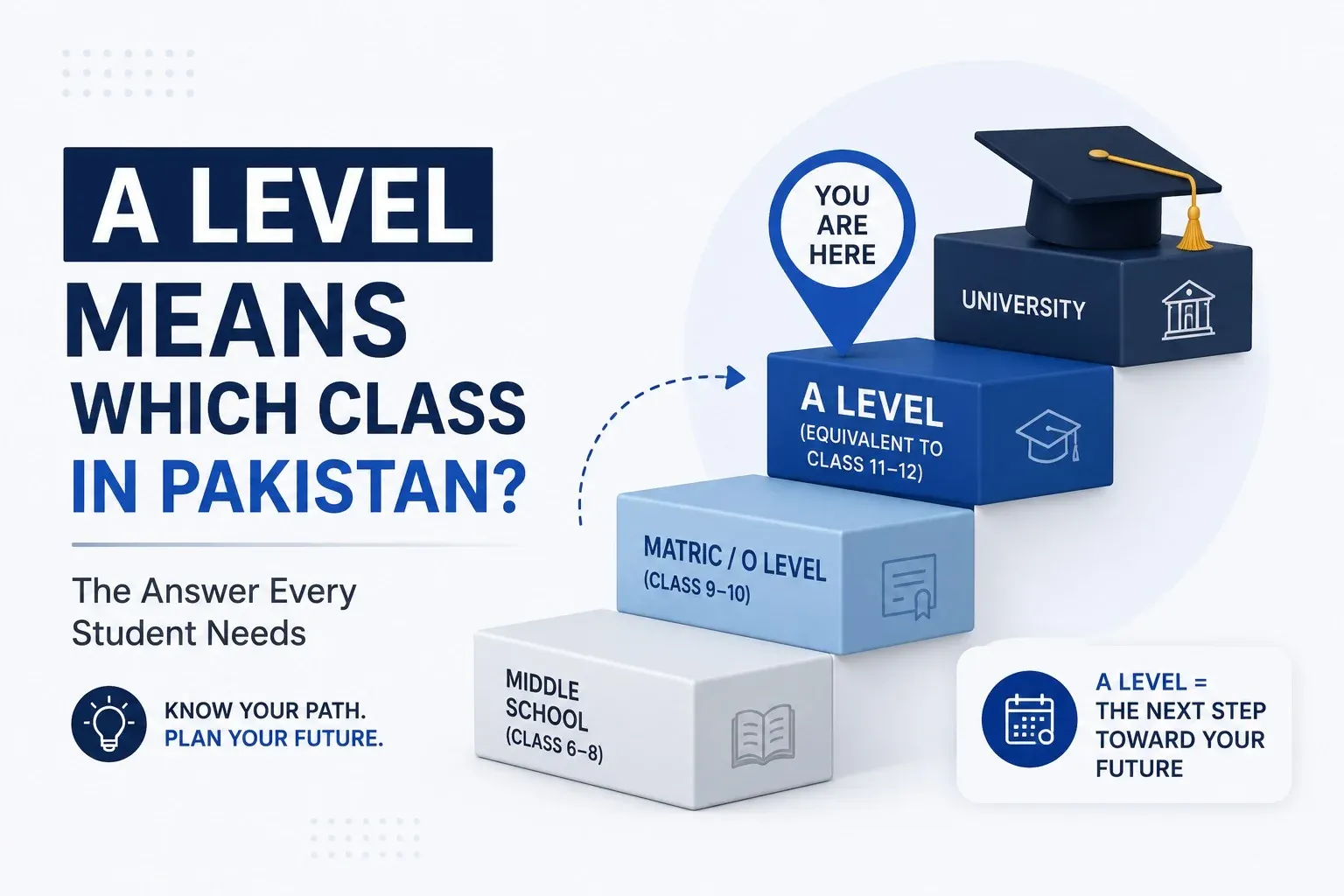
The Direct Answer: A Level Is Grade 11 and Grade 12
A Level corresponds to Grades 11 and 12 in the Pakistani school system — the same two years that Intermediate students spend completing their Higher Secondary School Certificate (HSSC), also known as Intermediate or FSc/FA/ICS/ICom.
The IBCC website states directly:
“GCE ‘A’ levels are considered equivalent to the Higher Secondary School Certificate (HSSC), subject to the completion of SSC-level qualifications and meeting the specified requirements for a particular study group.” — IBCC Official Website
In Pakistan’s national structure, HSSC (Intermediate) is the qualification awarded after completing Grades 11 and 12. A Level occupies exactly the same academic position in the education ladder.
Where A Level Sits in Pakistan’s Full Education Ladder
To see the complete picture, here is how the national (Matric/FSc) pathway and the Cambridge (O Level/A Level) pathway run side by side.
| Grade | Age (Approx.) | National Pathway (SSC/HSSC) | Cambridge Pathway (CAIE) | Qualification Awarded |
| Grade 9 | 14–15 | Matric / SSC Part I | O Level (Year 1) | (Mid-programme) |
| Grade 10 | 15–16 | Matric / SSC Part II | O Level (Year 2) O Level (Year 3) | SSC / O Level Certificate |
| Grade 11 | 16–17 | Intermediate / HSSC Part I (First Year) | A Level (Year 1) — AS Level | (Mid-programme) |
| Grade 12 | 17–18 | Intermediate / HSSC Part II (Second Year) | A Level (Year 2) — A2 / Full A Level | HSSC / A Level Certificate |
| Post-Grade 12 | 18+ | University (after HSSC) | University (after A Level + IBCC equivalence) | Bachelor’s Degree (4 years) |
A Level = Grade 11 and Grade 12 = HSSC/Intermediate level. This equivalence is fixed by the Government of Pakistan through IBCC and does not vary by school, city, or institution.
AS Level vs A2 Level: What Is the Difference?
A Level in Pakistan is typically studied over two years and consists of two components:
| Component | When Taken | What It Is | Equivalent To |
| AS Level | Grade 11 (Year 1) | Advanced Subsidiary: the first half of the full A Level. Can be a standalone qualification or count toward the full A Level. | HSSC Part I (First Year / 11th class) |
| A2 Level | Grade 12 (Year 2) | The second and final half of the full A Level. Combined with AS results to produce the final A Level grade. | HSSC Part II (Second Year / 12th class) |
| Full A Level (AS + A2) | Grades 11–12 combined | The complete Cambridge A Level qualification recognised globally and by IBCC. | Full HSSC (Intermediate) certificate |
Most Pakistani A Level students complete both AS and A2 as a single two-year programme and receive their full A Level grades at the end of Grade 12. Some students take AS Level as a standalone qualification at the end of Grade 11 — particularly those who plan to switch tracks or take a gap year.
How Many Students Do A Level in Pakistan?
| Year | A Level / AS Entries (Pakistan) | Year-on-Year Change |
| 2023 (May/June) | ~107,000+ entries | — |
| 2024 (May/June) | 118,000+ entries | +10% vs 2023 |
| 2025(May/June) | 125,000+ entries | +6% vs 2024 |
These 125,000+ A Level entries in 2024 came from students across 683 schools registered with Cambridge in Pakistan. Combined with the 226,000+ O Level and IGCSE entries in the same year, Pakistan recorded over 1.6 million total Cambridge exam entries in 2024, a 9% increase over the previous year.
A Level was first introduced in Pakistan in the 1960s, facilitated through the British Council. Over the following six decades, it grew from a handful of elite schools to over 750 registered institutions nationwide.
IBCC A Level Equivalence: The Official Requirements
To obtain an IBCC HSSC Equivalence Certificate based on A Level results, students must meet specific subject requirements depending on which university programme they wish to pursue. The following is taken verbatim from the IBCC.
| HSSC Equivalent Group | Required A Level Subjects (from Pakistan) | Required O Level Foundation | Notes |
| Pre-Medical | Physics, Chemistry, and Biology — minimum Grade E each | 8 O Level subjects including 5 compulsory + Physics, Chemistry & Biology as electives | Biology mandatory for medicine; O Level Biology also required at SSC level |
| Pre-Engineering | Physics, Chemistry, and Mathematics — minimum Grade E each | 8 O Level subjects including 5 compulsory + Physics, Chemistry & Biology/Computer as electives | Physics and Maths non-negotiable for all engineering streams |
| Computer Science | Physics, Computer Science, and Mathematics — minimum Grade E each | 8 O Level subjects including 5 compulsory + Physics, Chemistry & Biology/Computer | Computer Science at both O and A Level strongly recommended |
| Humanities | Any three academic subjects — minimum Grade E each | 8 O Level subjects including 5 compulsory + any 3 elective subjects | No science restriction; broadest flexibility of all groups |
A Level equivalence is only granted AFTER O Level equivalence is in place. The two qualifications are linked you cannot skip O Level and go straight to A Level equivalence.
How A Level Grading Works in Pakistan
A Level uses a different grading scale compared to O Level. This is one of the most commonly misunderstood aspects of the Cambridge system.
| A Level Grade | O Level Equivalent | IBCC Percentage (Approx.) | What It Means |
| A* | A* (same) | 90%+ | Outstanding — highest achievable; introduced at A Level globally in 2010 |
| A | A | 85% | Excellent performance |
| B | B | 75% | Very good |
| C | C | 65% | Good — minimum for most competitive university programmes |
| D | D | 55% | Satisfactory |
| E | E | 45% | Minimum pass — IBCC minimum accepted grade |
| U | U | Not accepted | Ungraded / Fail — not accepted by IBCC |
Key difference from O Level grading: O Level grades run from A* to U (with F being very low passes). A Level grades run from A* to U. Grade E is the minimum pass. Grade U (Ungraded) is a failure and is not accepted by IBCC.
What Subjects Are Available at A Level in Pakistan?
Most students in Pakistan take 3 to 4 A Level subjects. This is a fundamental shift from O Level, where students study 8 or 9 subjects. At A Level, the focus narrows sharply students choose subjects aligned to their intended university degree and career path.
The five most popular A Level subjects in Pakistan for the 2025 May/June series were:
| Rank | Subject | Career Pathway It Supports | Notable 2024 Trend |
| 1 | Physics | Engineering, architecture, physical sciences, computing | Consistently the most popular science subject |
| 2 | Mathematics | Engineering, economics, computer science, actuarial science | Required for virtually all STEM degrees |
| 3 | Business Studies | Business, management, MBA, entrepreneurship | Overtook Chemistry in 2024 — significant shift |
| 4 | Chemistry | Medicine, pharmacy, chemical engineering, dentistry | Dropped to 4th; previously in top 3 for years |
| 5 | Computer Science | Software engineering, data science, IT, AI | Entered top 5 in 2024, replacing Economics |
The rise of Business Studies to third place and Computer Science entering the top 5 for the first time reflects a measurable shift in Pakistani student career aspirations away from the traditionally dominant pre-medical and pre-engineering tracks toward business and technology careers.
Subject Combinations by Career Track
One of the most authoritative subject guidance available for Pakistani A Level students here are the recommended combinations by career pathway:
| Career Goal | Recommended A Level Subjects | Note from LGS Guide |
| Medicine / Dentistry | Biology + Chemistry + Physics or Mathematics | “Chemistry, Biology and at least Mathematics or Physics will keep all medical school options open” |
| Engineering (all types) | Mathematics + Physics + Chemistry | “For almost all engineering courses the most important subjects are Mathematics and Physics” |
| Computer Science / Software Engineering | Mathematics + Physics + Computer Science | Strong Maths foundation is critical for CS degree programmes |
| Business / Economics / Finance | Mathematics + Economics + Business Studies or Accounting | “To pursue a degree in Business or Economics, most universities require A Level Mathematics” |
| Law / Social Sciences / PPE | English Literature + History + Politics or Sociology | Analytical writing and critical reasoning subjects prioritised |
| Architecture / Design | Mathematics + Physics + Art & Design | “Universities often expect Math and Physics, plus Art or portfolio-related subjects” |
| Further Mathematics / Pure Mathematics | Mathematics + Further Mathematics + Physics | “Competitive universities prefer and at times require A Level Further Mathematics” |
How to Get A Level IBCC Equivalence: Step-by-Step
Once a student has completed A Level and received their Cambridge certificate, they must apply for IBCC HSSC Equivalence before any Pakistani university will process their application. The process is as follows (sourced from ibcc.edu.pk/equivalence-application-process/):
| Step | Action |
| 1 | Register on the IBCC portal at services.ibcc.edu.pk |
| 2 | Ensure your O Level IBCC SSC Equivalence Certificate is already issued (mandatory prerequisite) |
| 3 | Complete the online A Level equivalence application form |
| 4 | Pay the required fee through the official challan system |
| 5 | Prepare original A Level certificates + two sets of back-to-back attested photocopies |
| 6 | Attach your existing O Level IBCC Equivalence Certificate and its attested copy |
| 7 | Prepare attested copy of CNIC / B-Form / Passport (NADRA-issued) |
| 8 | Submit to IBCC Head Office (Islamabad) or Regional Offices (Karachi, Lahore, Peshawar, Quetta, Bahawalpur) |
| 9 | IBCC verifies via Cambridge online system or British Council (if certificate is 5+ years old) |
| 10 | IBCC issues the HSSC Equivalence Certificate |
Important document rules from IBCC:
- Statement of Result is valid for only 6 months — after that, the original certificate is required
- Certificates older than 5 years must be verified by British Council before IBCC will process them
- Laminated or plastic-coated certificates are not accepted
- Name and Date of Birth must match exactly across all certificates and CNIC/Passport
- Fake documents will be confiscated and referred to authorities — IBCC is explicit on this point
What Comes After A Level? University Pathways Explained
A Level is a pre-university qualification. After completing A Level, students have the following main pathways:
| Pathway | Description | Who It’s For |
| Pakistani University (LUMS, NUST, IBA, FAST, etc.) | Apply directly with A Level grades + IBCC HSSC Equivalence Certificate. Merit lists may use IBCC percentage or A Level grades depending on the university. | Students planning to study and work in Pakistan |
| UK University | Apply through UCAS with A Level grades. No equivalence needed. UK universities directly understand A Level grades. Typical offer: 3 A Level grades (e.g. AAB for Law at UCL). | Students targeting UK universities |
| US / Canadian University | Apply directly. A Level is well understood by US/Canadian admissions offices. SAT or ACT may also be required by some US colleges. Some students do both A Level + SAT. | Students targeting North America |
| Australian / UAE University | Accepted directly. Australia and UAE universities are very familiar with the Cambridge system and frequently recruit Pakistani A Level graduates. | Students considering Australia, UAE, or Gulf region |
| Gap Year + Foundation Programme | Some students complete A Level and then do a 1-year foundation or diploma before entering university. Common at UCL, Warwick, and some Pakistani universities. | Students who need more time before committing to a degree |
Frequently Asked Questions
A Level is equivalent to which class in Pakistan — 11th or 12th?
Both. A Level is a two-year programme covering Grade 11 (AS Level year) and Grade 12 (A2 Level year). IBCC treats the complete A Level qualification as equivalent to the full HSSC — both parts combined. If you pass AS Level only (the Grade 11 component), that is not sufficient for IBCC HSSC equivalence — you need the full A Level.
Can a Matric student do A Level without doing O Level?
Yes. IBCC explicitly states: “A student who has completed the Secondary School Certificate (Matric) can pursue A Levels, as SSC is considered an equivalent qualification to O Levels.” The student must still meet the A Level college’s own entry requirements (typically minimum 60% in SSC), and will need to note that Urdu, Islamiyat, and Pakistan Studies from their Matric results will satisfy the IBCC compulsory subject requirement for A Level equivalence.
How many A Level subjects are required for IBCC equivalence?
Exactly 3 A Level subjects with a minimum grade of E, in the appropriate combination for the chosen HSSC group (Pre-Medical, Pre-Engineering, Computer Science, or Humanities). The specific subjects required differ by group — see the IBCC requirements table above for the exact combination needed.
Is A Level harder than FSc / Intermediate?
A Level is generally considered more demanding in terms of the type of thinking required. FSc covers more subjects but relies more heavily on structured, marks-based examination. A Level requires fewer subjects but demands deeper analytical understanding of each. Students who thrive in conceptual learning tend to find A Level more engaging. Students who prefer a broader, more structured curriculum sometimes find FSc more manageable. The practical difference in career outcomes depends heavily on the student’s effort, the school’s quality, and whether sufficient tutoring support is in place.
Does A Level expire in Pakistan?
No Cambridge certificates do not expire. However, for IBCC processing, IBCC accepts the Statement of Result for only 6 months after which the original certificate is required. If a student’s A Level certificate is more than 5 years old, it must first be verified by the British Council before IBCC will process the equivalence application.
What is the difference between CAIE A Level and Edexcel A Level in Pakistan?
Both are UK-based A Level qualifications. Cambridge (CAIE) is by far the more common in Pakistan the majority of 125,000+ A Level students in Pakistan sit Cambridge papers. Edexcel (Pearson) A Level is offered at a smaller number of schools and is equally accepted by IBCC and Pakistani universities. Internationally, both are recognized identically by UK, US, and other global universities.
Final Word
A Level means Grade 11 and Grade 12 in Pakistan equivalent to the Intermediate / HSSC level. This is the official, government-defined equivalence set by IBCC under the Ministry of Federal Education and Professional Training, and it has been consistent throughout A Level’s history in Pakistan.
With over 125,000 students sitting A Level exams in Pakistan in 2024 alone a figure that has grown consistently at 6–10% per year A Level is now far more than an elite niche qualification. It is a mainstream pre-university pathway for urban Pakistani students with global academic and career ambitions.
If your child is in A Level and needs targeted support whether in a science, mathematics, or business subject working with a verified, CAIE-experienced tutor who understands both the Cambridge syllabus and Pakistan’s university entry requirements can make a measurable difference to both grades and confidence.

3 thoughts on “A Level Means Which Class in Pakistan? The Answer Every Student Needs”
Pingback: What is O Level? Complete Guide for Pakistani Students
Pingback: A Level Subjects List: Best Combinations for Students!
Pingback: How to Check Your O Level Result Online: CAIE 2026 Guide.