
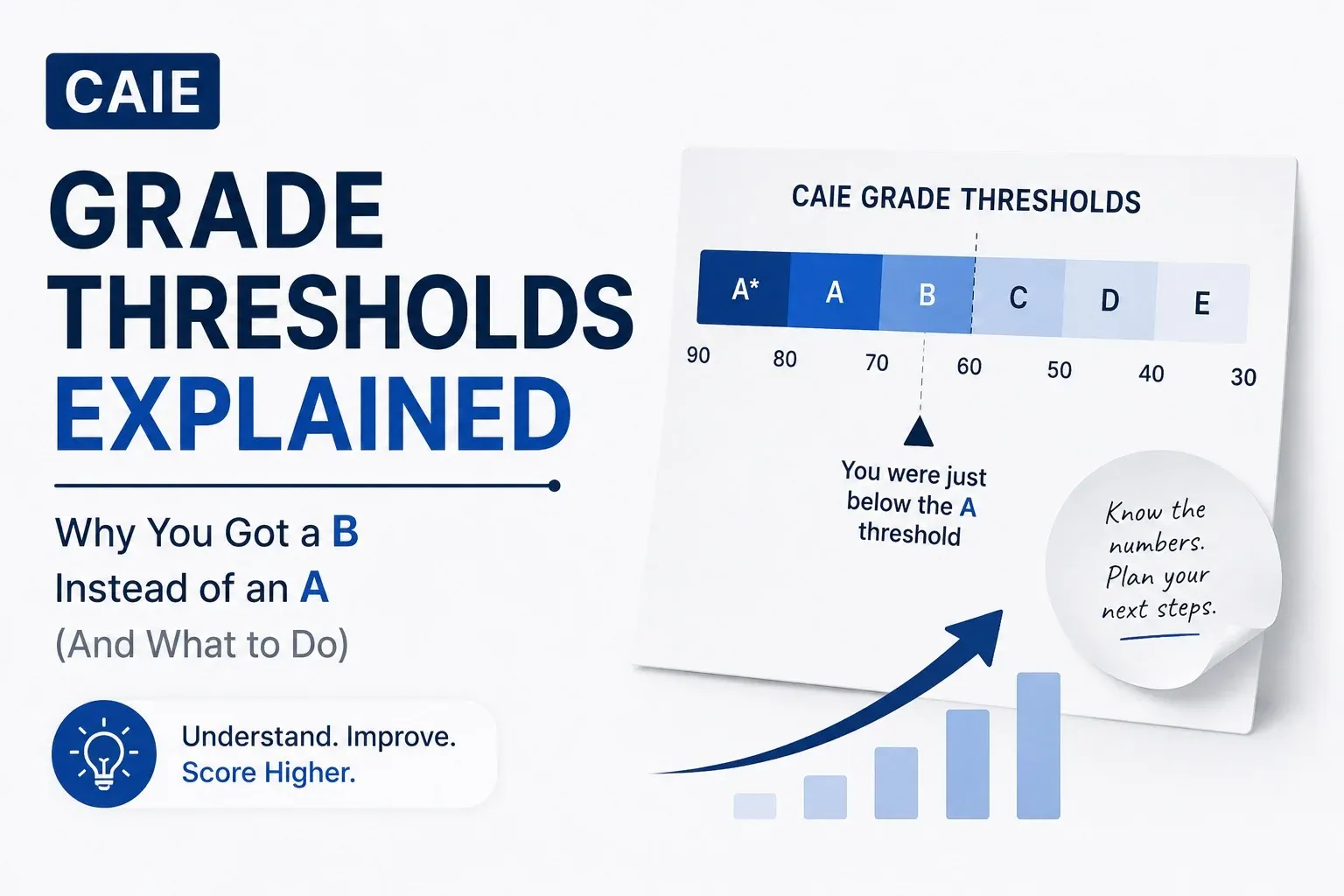
Results day. The grades appear on the screen. And somewhere, a student stares at a B and wonders: ‘I was so close. Why wasn’t it an A?’
The answer is almost always the same: they did not know how CAIE grade thresholds work. They revised hard, they sat the exams, and then they were surprised by a grade that did not reflect the effort they put in. Not because the system was unfair but because they did not understand it.
CAIE grade thresholds are one of the most misunderstood aspects of the O Level and A Level system in Pakistan. This guide explains exactly what a grade threshold is, how CAIE sets them, why they change every session, and most importantly what a student who received a B instead of an A can do about it.
What Is a Grade Threshold?
A grade threshold is the minimum number of raw marks a candidate must score to be awarded a specific grade in a CAIE examination.
‘A grade threshold is the minimum number of marks that a candidate needs to obtain a particular grade in a paper or in a subject.’
Grade thresholds are different for every subject, every paper, and every exam session. They are set AFTER the exams are marked not before. This is one of the most important facts about the CAIE system that students and parents do not realize.
| Term | Definition | Example |
| Grade Threshold | Minimum raw marks to achieve a specific grade for a specific paper or overall qualification | In O Level Pakistan Studies (2059), June 2025: A threshold overall = 109/150 |
| Grade Boundary | Often used interchangeably with threshold; the boundary mark between two adjacent grades | The boundary between A and B in Physics Paper 2 might be 58/80 |
| Raw Mark | The actual marks scored by a candidate on a specific paper before any weighting | A student scores 62/80 on Paper 2 — that is their raw mark for that paper |
| Weighted Mark | Raw marks adjusted to account for different paper weightings in the overall qualification | Some subjects weight different papers differently before combining into a total |
| Maximum Available Mark | The total marks possible in a paper or qualification | Physics 5054: 40 (Paper 1) + 80 (Paper 2) + 40 (Paper 6) = 160 total |
How Does CAIE Actually Set Grade Thresholds?
This is what most people — including many teachers — do not fully understand. Grade thresholds are not set in advance. They are determined after every exam session, through a process that combines statistical analysis, expert examiner judgment, and year-on-year consistency standards.
From the CAIE official grade threshold documentation and confirmed by grading system guide: the threshold-setting process works as follows:
| Step | What Happens | Why It Matters |
| 1. Exams are sat and scripts collected | Students sit papers in April–June (May/June series) or October–November (Oct/Nov series) | All marks are raw at this point — no thresholds yet |
| 2. Scripts are marked | Most written papers are scanned and marked digitally by trained CAIE examiners. MCQ papers are machine-marked. Senior examiners mark a sample first to calibrate standards across the marking team. | Ensures consistent marking standards before grade boundaries are set |
| 3. Statistical analysis | CAIE analyses the raw mark distribution for every paper and subject — comparing it to previous years’ distributions to understand relative paper difficulty | A harder paper naturally produces lower raw scores — this is factored in before setting boundaries |
| 4. Expert examiner judgment | Senior examiners review specific mark ranges (e.g., ‘scripts around the expected A/B boundary’) to confirm that the quality of work in those scripts genuinely reflects the target grade | Prevents purely statistical thresholds that might be misaligned with actual student performance |
| 5. Thresholds are set | The minimum mark for A*, A, B, C, D, and E is fixed for each paper and for the overall subject combination | Grade thresholds differ by subject, paper, and session — always published on CAIE’s website after results |
| 6. Grades are awarded | Every candidate’s raw marks are compared to the thresholds. Marks at or above the threshold earn the grade; marks below fall to the next grade down. | This is the moment your grade is determined |
| 7. Thresholds are published | CAIE publishes the grade threshold tables for every subject and every session at cambridgeinternational.org/grade-threshold-tables | Publicly available after results day; anyone can verify their grades |
The CAIE Grading Scale: What Each Grade Means
CAIE O Level and A Level both use a letter-based grading scale. The approximate percentage ranges below are based on verified grading system guide, Note that these are approximate guides actual thresholds vary by subject and session.
O Level Grading Scale (A* to U)
| Grade | Approximate Percentage | What It Means | IBCC Equivalence |
| A* | ~90%+ | Outstanding — highest achievable; top performance nationally and globally | 90%+ in IBCC equivalence (revised per subject annually) |
| A | ~80–89% | Excellent performance; strong command of subject content and examination technique | 85% in IBCC equivalence |
| B | ~70–79% | Very good; solid performance with some gaps in technique or content | 75% in IBCC equivalence |
| C | ~60–69% | Good; acceptable standard; common minimum for university admissions | 65% in IBCC equivalence |
| D | ~50–59% | Satisfactory; meets minimum standard; IBCC accepts D grades | 55% in IBCC equivalence |
| E | ~40–49% | Acceptable pass; IBCC minimum accepted grade | 45% in IBCC equivalence |
| F | ~30–39% | Below standard pass; IBCC does NOT accept Grade F | Not accepted by IBCC |
| G | ~20–29% | Minimum pass; IBCC does NOT accept Grade G | Not accepted by IBCC |
| U | Below 20% | Ungraded — fail | Not accepted by IBCC |
O Level vs A Level grading: O Level grades run from A* to U. A Level grades run from A* to E only — there is no F or G grade at A Level. Grade U (Ungraded) is the only fail at A Level. Students who receive Grade U at O Level are below the IBCC minimum accepted standard; IBCC explicitly states it does not accept F or G grades for equivalence.
A Level Grading Scale
| Grade | Approximate Percentage | IBCC HSSC Equivalence | Notes |
| A* | ~90%+ | 90%+ (revised annually per subject) | Introduced globally in 2010; requires exceptional performance in A2 component |
| A | ~80–89% | 85% | Excellent performance across both AS and A2 components |
| B | ~70–79% | 75% | Good performance; minimum for most competitive UK university programmes |
| C | ~60–69% | 65% | Acceptable; minimum for many local and international university programmes |
| D | ~50–59% | 55% | Satisfactory; IBCC accepts Grade D |
| E | ~40–49% | 45% — IBCC minimum accepted | Minimum A Level pass; IBCC requires minimum Grade E for HSSC equivalence |
| U | Below 40% | Not accepted by IBCC | Fail; no grade awarded; not included in any certificate |
Why Grade Thresholds Change Every Session
This is the most common source of confusion after results day. A student who scored 58/80 on Physics Paper 2 in May/June 2024 received an A. A student who scored the same 58/80 in October/November 2024 received a B. Same mark. Different grade. Why?
The answer is paper difficulty. When a paper is harder than usual, the raw mark distribution shifts downward most students scoreless. CAIE adjusts the grade thresholds downward to compensate, so that achieving a specific grade requires proportionally the same level of performance relative to the cohort. When a paper is easier, thresholds move upward.
| Paper Difficulty | Effect on Raw Marks | Effect on Grade Thresholds | Example |
| Harder than average paper | Overall lower scores across all candidates | Thresholds set LOWER — fewer marks needed for each grade | Physics Paper 2 Oct/Nov 2023: A threshold = 50/80 (harder paper) |
| Average difficulty paper | Typical score distribution | Thresholds set at historical average level | Physics Paper 2 M/J 2024: A threshold = 55/80 (typical) |
| Easier than average paper | Overall higher scores across all candidates | Thresholds set HIGHER — more marks needed for each grade | Physics Paper 2 M/J 2023: A threshold = 60/80 (easier paper) |
‘The grade threshold for CAIE O Level exams is flexible. It’s a dynamic target that shifts with each passing year. A blend of student performance, statistical analysis, and expert insight moulds these thresholds. The O Levels grading system levels the playing field by ensuring that obtaining a grade is neither more nor less demanding than in the previous year.
| Session | Component | Max Marks | A Threshold | B Threshold | C Threshold | Overall A* (combined) |
| June 2023 | Component 01 | 75 | 45 | 37 | 29 | – |
| June 2023 | Component 02 | 75 | 46 | 37 | 28 | – |
| June 2023 Overall | 01 + 02 | 150 | 91 | 74 | 57 | 108 |
| November 2023 | Component 01 | 75 | 46 | 37 | 28 | – |
| November 2023 | Component 02 | 75 | 45 | 36 | 27 | – |
| November 2023 Overall | 01 + 02 | 150 | 91 | 73 | 55 | 109 |
| June 2025 | Component 01 | 75 | 44 | 36 | 29 | – |
| June 2025 | Component 02 | 75 | 48 | 39 | 30 | – |
| June 2025 Overall | 01 + 02 | 150 | 92 | 75 | 59 | 109 |
What this real data shows: The overall A threshold for Pakistan Studies 2059 moved from 91/150 (June 2023) to 92/150 (June 2025) a difference of just 1 mark. The A* threshold moved from 108 to 109. These are very small movements, confirming that CAIE’s stated aim of year-on-year consistency is real. Thresholds do not jump dramatically between sessions for the same subject.
How to Read a CAIE Grade Threshold Table
CAIE publishes grade threshold tables for every subject and every session. They are publicly available at cambridgeinternational.org/grade-threshold-tables. Here is how to read one, using the confirmed Pakistan Studies June 2025 data as the example:
| Maximum Raw Mark | A | B | C | D | E | |
| Component 01 | 75 | 44 | 36 | 29 | 23 | 18 |
| Component 02 | 75 | 48 | 39 | 30 | 25 | 20 |
| Note: ‘Grade A* does not exist at the level of an individual component.’ |
Then the overall combined table:
| Option | Maximum Mark (after weighting) | A* | A | B | C | D | E |
| Combination: 01, 02 | 150 | 109 | 92 | 75 | 59 | — | — |
How to interpret this:
- A student who scored 44/75 on Component 01 and 48/75 on Component 02 scored 92/150 total — which is exactly the A threshold. They receive an A.
- A student who scored 43/75 on Component 01 and 48/75 on Component 02 scored 91/150 total — which is 1 mark below the A threshold. They receive a B.
- The A* threshold overall is 109/150. A student must score 109 or more combined to receive an A*.
- Grade A* does not appear at the individual component level — only at the combined total level.
- The threshold for individual components (A, B, C, D, E) applies per paper. The combined overall threshold determines the final grade.
The 1-mark lesson: The B student above scored 91/150 — just 1 mark below the A threshold. That 1 mark could have come from: adding one more correct answer in Paper 1 MCQ, completing a calculation that was left half-done, or using causal language in one ‘explain’ question they described instead. This is why exam technique matters more than students realise — the B/A boundary is often 1–3 marks.
Why Did You Get a B Instead of an A? The Real Reasons
A student who expected an A but received a B is not always a student who ‘didn’t study enough.’ In most cases, the gap between their mark and the A threshold is explained by a small number of specific, identifiable issues.
| Reason | How Many Marks It Typically Costs | How to Fix It Next Time |
| Command word misinterpretation | 5–15 marks per paper | Practice ‘explain’ vs ‘describe’ distinction in every past paper. Add ‘because’ to every explanation. Check command words in CAIE’s published definitions. |
| Missing method steps in calculations | 5–10 marks | Always write formula → substitute → calculate → state answer with units. Never skip steps. M marks protect you even when the final answer is wrong. |
| No units on final answers | 2–5 marks | Check every calculation answer for correct units before moving on. |
| Time mismanagement | 5–15 marks | Practice under strict exam conditions. Allocate time by marks: ~1 minute per mark for most papers. |
| Vague responses instead of precise vocabulary | 3–10 marks | Use the exact scientific/mathematical terminology the mark scheme uses. ‘Particles have more energy’ is vague. ‘Particles have greater kinetic energy than the activation energy’ is precise. |
| Choosing weak Section B questions | 5–10 marks (Chemistry/Physics Paper 2) | Read ALL Section B options before choosing. Select based on past paper performance, not topic preference. |
| Arithmetic errors in non-calculator papers | 3–8 marks | Allow 10 minutes at end of Paper 1 to re-check calculations. Estimate answers before calculating to catch large errors. |
| Graph drawing errors | 3–7 marks | Use a ruler for all straight lines. Plot carefully. Draw smooth curves through all points. Label axes with quantity AND unit. |
The combined recoverable marks from fixing these issues: typically, 20–45 marks per subject. The gap between B and A is usually 10–20 marks. This means that in most cases the difference between B and A is entirely within a student’s control, and fixable before the next exam series.
How Grade Thresholds Affect Your IBCC Equivalence
Pakistani students sitting O Level or A Level face a direct financial and academic consequence of grade thresholds: IBCC converts grades into percentage marks for university admissions. Each grade change has a fixed IBCC impact.
| Grade Change | IBCC Percentage Impact | University Merit List Impact (Example) |
| U (non-accepted to accepted) | Not applicable — Grade U not accepted by IBCC | Becoming eligible vs. not eligible for IBCC equivalence at all |
| E → D | 45% → 55% = +10 percentage points | Significant improvement; brings student closer to competitive merit lists |
| D → C | 55% → 65% = +10 percentage points | Often the difference between meeting and not meeting university minimum requirements |
| C → B | 65% → 75% = +10 percentage points | Major improvement in IBCC aggregate; pushes merit ranking upward significantly |
| B → A | 75% → 85% = +10 percentage points | One of the most impactful single grade improvements for merit-list competitiveness |
| A → A* | 85% → 90%+ = +5–10 percentage points | Highest impact; determines NUST/IBA/LUMS merit positioning |
Concrete example: A student with 8 O Level subjects — if they improve one subject from B (75%) to A (85%), their IBCC combined percentage increases by approximately 1.25 percentage points overall (10% ÷ 8 subjects). In a NUST merit list where the cut-off moves by fractions of a percentage, this is the difference between an offer and a rejection.
You Got a B. What Now? Your Options After Results
If a student received an unexpected B (or C) in a CAIE exam, there are several official options available. These are post-results Services — a set of formal processes CAIE offers after results are released.
| Option | What It Is | Cost (Approx.) | Who Should Use It | Deadline |
| Script (Answer Paper) Return | Request a copy of your marked answer script so you can see what the examiner wrote and where marks were awarded | Varies by centre; check with school | Any student who wants to understand their grade in detail; essential before requesting a review | Typically, 3–4 weeks after results |
| Clerical Re-Check | CAIE checks that all marks were correctly totalled and transferred to the grade calculation; no re-marking of answers | Lower cost than full review | If you believe a totalling error was made (rare but possible) | Same deadline as above |
| Review of Marking | A senior examiner re-marks your script to check whether the original examiner awarded marks correctly | Higher cost; refunded if grade changes | If you or your teacher believe your answers were under-marked relative to the mark scheme | Same deadline as above |
| Re-Sit in Next Series | Sit the same paper in the next exam session (Oct/Nov for May/June; May/June for Oct/Nov); CAIE uses the best component combination | Exam entry fee + centre fee | Most practical option if the gap to the next grade was more than a few marks | Registration by your school before the next series |
Important: Post-Results Services have strict deadlines — typically 3–4 weeks after results day. For May/June 2026 results (11 August 2026), the deadline for requesting a script or review would be approximately early September 2026. Check your school’s deadline as they coordinate requests with CAIE.
When a Review of Marking changes a grade, the fee is fully refunded. If the grade does not change, the fee is not refunded. Request a script return first this lets you see the marked script and assess whether a review is likely to succeed before spending on the review fee.
If You Are Re-Sitting: How to Close the Gap
A student re-sitting a subject has a significant advantage over their first attempt: they know exactly where they lost marks. The grade threshold table tells them the target. The script return shows them where they fell short. This is more actionable data than most first-time candidates have.
| Step | Action | Timeline |
| 1 | Download your script (if available). Compare your answers to the mark scheme for every question you lost marks on. Write down the exact reason for each lost mark (wrong command word, missing unit, incomplete working, etc.). | Within 1 week of results |
| 2 | Categorize lost marks: are they from content gaps (topics you did not know) or technique gaps (topics you knew but did not express correctly)? Most re-sit students have more technique gaps than content gaps. | Week 1–2 |
| 3 | For technique gaps: focus intensely on past paper practice with strict marking mark every answer against the mark scheme word by word. Read examiner reports for each session practiced. | Weeks 2–6 |
| 4 | For content gaps: revise those specific topics from the syllabus, then practice topical past paper questions. Do not revise topics where you were already strong. | Weeks 2–6 |
| 5 | In the final 4 weeks: do full past papers under strict timed conditions. Use the grade threshold tables to assess your scores against the actual session thresholds, not just raw percentages. | Weeks 7–10 |
Frequently Asked Questions
Can I see the grade threshold for my specific exam?
Yes. Grade threshold tables are published by CAIE after every exam series at cambridgeinternational.org/grade-threshold-tables. They are free to download. Search by syllabus code (e.g. 5054 for Physics) and select your session (May/June or Oct/Nov) and year. The table shows the minimum marks required for each grade in every component and the combined overall grade.
Is it possible to get an A* overall without getting A* on each individual paper?
Yes. CAIE grade thresholds operate at two levels: per component (individual papers) and overall (combined qualification). Grade A* does not exist at the individual component level — it only exists at the overall combined level. This means a student can score A on Paper 1 and Paper 2, but still achieve A* overall if their combined mark meets the A* threshold. This is confirmed explicitly in the Pakistan Studies grade threshold table (June 2025): ‘Grade A* does not exist at the level of an individual component.’
Does CAIE curve grades?
Not in the traditional sense. CAIE does not apply a bell curve or rank students relative to each other. Instead, it adjusts grade thresholds based on paper difficulty and year-on-year consistency standards. The goal is that a given grade (e.g. B) represents the same level of achievement every year, regardless of whether a particular paper was harder or easier. This is different from relative grading (where a fixed percentage of candidates always get an A). In principle, every student can get an A* if they all meet the A* threshold.
How close to the threshold do most grade B students fall?
Based on CAIE’s published statistics, the distribution of marks around grade boundaries is typically dense many students cluster near grade thresholds. A student who received a B is statistically more likely to be within 1–5 marks of the A threshold than 15–20 marks away. This is why targeted exam technique improvement (not just more content revision) is often the most effective intervention for students aiming to cross a grade boundary.
Final Word
Grade thresholds are not arbitrary. They are mathematically calculated, expert-verified, and adjusted specifically to ensure fairness across years and sessions. If you received a B when you expected an A, the gap to the A threshold was almost certainly in single digits and almost certainly recoverable.
The most useful thing a student can do after results is: download their grade threshold table, download their script (if available), compare their answers to the mark scheme, and identify exactly which marks were lost and why. That analysis turns a disappointing result into a specific, actionable revision plan.
The difference between a B and an A in CAIE O Level or A Level is rarely a question of intelligence or how hard a student worked. It is almost always a question of technique: command words, working display, unit accuracy, time management, and examiner language. All of these are teachable and learnable often within a few focused weeks of targeted preparation.
If your child received an unexpected grade and is planning a re-sit, working with a CAIE-experienced tutor who understands both the mark scheme requirements and the threshold patterns for your specific subject can identify and close those gaps before the next exam series.







1 thought on “CAIE Grade Thresholds Explained: Why You Got a B Instead of an A (And What to Do)”
Pingback: O Level Means Which Class in Pakistan? Fully Explained 2026.