Chemistry is the O Level subject where language matters as much as knowledge. A student who understands the chemistry perfectly but writes a vague answer loses marks. A student who writes precisely using exact chemical vocabulary and matching the command word earns full marks even with a slightly incomplete understanding.
This is not an observation. It is stated directly in the CAIE O Level Chemistry 5070 Specimen Paper 2 Answers document, which notes question by question what candidates wrote, what the mark scheme required, and where the gap between the two cost marks. The pattern is consistent: vague language, wrong vocabulary, and command word misinterpretation are the three dominant sources of mark loss.
This guide covers the complete paper structure of O Level Chemistry 5070, the 14-topic syllabus, where to download past papers, subject-specific strategy for each paper, the most common examiner-identified errors, and a revision schedule built on past paper practice.
O Level Chemistry 5070: Complete Paper Structure
| Paper | Title | Duration | Marks | Weightage | Pakistan Variant | Format |
| Paper 1 | Multiple Choice | 1 hour | 40 marks | 30% | Variant 2 (5070_s24_qp_12) | 40 four-option MCQ questions covering the full syllabus |
| Paper 2 | Theory | 1 hour 45 minutes | 80 marks | 50% | Variant 2 (5070_s24_qp_22) | Short-answer and structured questions; all compulsory |
| Paper 4 | Alternative to Practical | 1 hour | 40 marks | 20% | Variant 2 (5070_s24_qp_42) | Written paper testing experimental skills: observations, data analysis, experimental design |
Total marks: 160 (Paper 1: 40 + Paper 2: 80 + Paper 4: 40). Paper 2 dominates at 50% of the total grade. A student who scores 70/80 in Paper 2 is already very close to an A or A* regardless of Paper 1 performance. Paper 2 is where Chemistry is won or lost.
The 14 Syllabus Topics: Complete Coverage Map
The O Level Chemistry 5070 syllabus has 14 core topics, the syllabus is structured around 14 core topics that build upon each other, creating a logical progression from basic concepts to more complex chemical principles.” All 14 are examinable across Papers 1, 2, and 4.
| # | Topic | Key Content | Paper 1 Frequency | Paper 2 Frequency | Priority |
| 1 | States of Matter | Kinetic particle theory; gases, liquids, solids; diffusion; changes of state | Medium | Medium | High — kinetic theory explanations appear in most papers |
| 2 | Atoms, Elements, Compounds | Atomic structure; electrons, protons, neutrons; isotopes; electronic configuration; elements vs compounds vs mixtures | Medium | High | High — isotope and atomic structure questions are consistent |
| 3 | Stoichiometry | Mole concept; molar mass; Avogadro’s number; reacting masses; molar gas volume; concentration; percentage yield; limiting reagent | High | Very High — calculation-heavy; highest mark-loss topic | Very High — moles is the biggest mark-loss area in the subject |
| 4 | Electrochemistry | Electrolysis; electrode reactions; products at electrodes; Faraday calculations; electroplating; applications | High | High | Very High — second highest mark-loss topic |
| 5 | Chemical Energetics | Exothermic and endothermic reactions; bond breaking/making; activation energy; energy profile diagrams | Medium | High | High |
| 6 | Chemical Reactions | Rate of reaction; factors affecting rate (temperature, concentration, surface area, catalyst); collision theory; reversible reactions; equilibrium; Le Chatelier’s principle | High | High | High — equilibrium and rates are consistently tested |
| 7 | Acids, Bases and Salts | pH; acids and bases; neutralisation; salt preparation methods; titration; indicators | High | High | Very High — appears in every paper; salt preparation is frequent |
| 8 | The Periodic Table | Groups and periods; trends in Group I, Group VII, Group 0; Transition metals; metallic and non-metallic properties | Medium | Medium | High — Group I and Group VII trends tested frequently |
| 9 | Metals | Reactivity series; reactions of metals; extraction of metals (blast furnace, electrolysis); uses of metals; corrosion | Medium | High | High — reactivity series questions appear in most papers |
| 10 | Air and Water | Composition of air; pollution (SO₂, CO, NO, particulates); water treatment; hard and soft water; nitrogen cycle; fertilisers | Medium | Medium | Medium |
| 11 | Sulfur | Properties of sulfur; Contact Process (SO₂ to SO₃); uses of sulfuric acid | Low | Medium | Medium — Contact Process steps are pure recall |
| 12 | Carbonates | Properties of carbonates; thermal decomposition; reactions with acids | Low | Low | Lower priority — short questions only |
| 13 | Organic Chemistry 1 (Hydrocarbons) | Alkanes; alkenes; crude oil and fractional distillation; cracking; addition reactions; polymerisation | High | Very High — organic chemistry is the highest-mark topic in Paper 2 | Very High — most common source of mark loss after moles |
| 14 | Organic Chemistry 2 (Compounds) | Alcohols; carboxylic acids; esters; ethanoic acid; condensation polymers; nylon; polyesters; amino acids | High | High | High — naming conventions and reactions require precise recall |
Command Words in Chemistry: Why This Is Where Most Marks Are Lost
The CAIE Specimen Paper 2 Answers document (2023) is explicit on this point: command word misinterpretation is the primary source of mark loss in Paper 2. The examiner notes after multiple questions state that candidates ‘described’ when they were asked to ‘explain’, or ‘stated’ when they were asked to ‘suggest’.
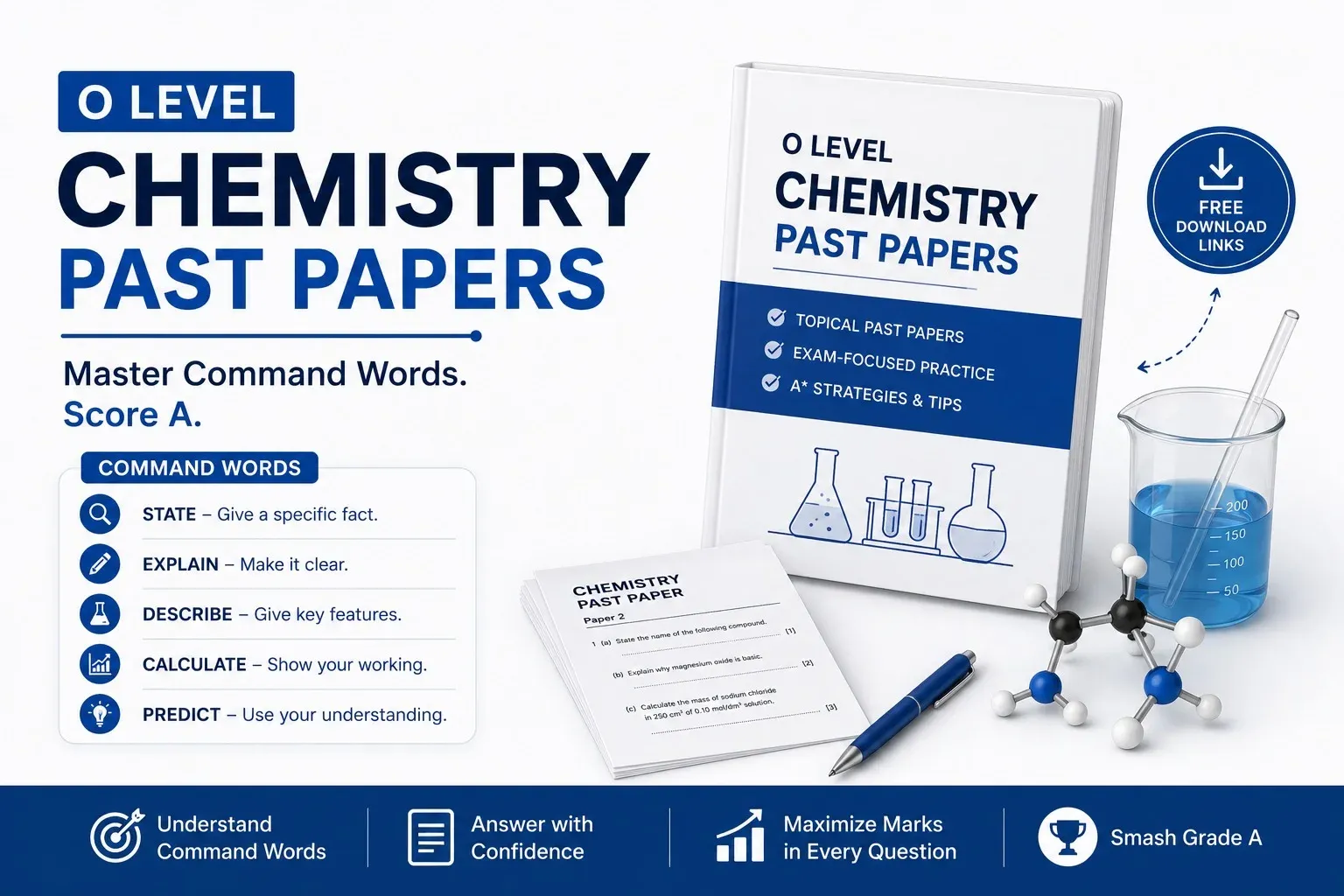
Chemistry command words have very precise meanings that are specific to the subject. Here is the complete command word guide for O Level Chemistry 5070 with chemistry-specific examples:
| Command Word | What Chemistry Examiners Require | Chemistry-Specific Example | Most Common Error |
| State | A brief, precise answer. One or two words or a short sentence. No reasoning needed. | State the type of bonding in sodium chloride. [Answer: ionic bonding] | Writing a full explanation: ‘Sodium chloride has ionic bonding because sodium gives an electron to chlorine’ — this earns the mark but wastes 2 minutes |
| Define | A precise formal definition, often requiring specific chemical terminology. | Define the term ‘mole’. [Answer: the amount of substance containing 6.02 × 10²³ particles] | Using casual language: ‘a mole is a unit of measurement in chemistry’ earns 0 marks |
| Describe | What happens — the sequence of events, observations, or changes. No causes needed. | Describe what is observed when sodium is added to water. [Answer: sodium floats, moves rapidly, melts into a ball, fizzes, eventually disappears] | Adding ‘because’ statements which are not asked for; or being too vague: ‘it reacts vigorously’ without specific observations |
| Explain | What happens AND why. Must include causal language. In Chemistry this typically means referencing particles, bonds, or chemical principles. | Explain why the rate of reaction increases when temperature rises. [Answer: particles have more kinetic energy, collide more frequently and with greater energy, more collisions exceed activation energy] | Describing without cause: ‘the rate increases because the reaction is faster’ earns 0 marks for an explain question |
| Suggest | Apply chemical knowledge to an unfamiliar context. More than one answer may be acceptable. | Suggest why this catalyst is used in this industrial process. [Requires applying principles of catalysis, selectivity, cost] | Treating it as a recall question: writing a memorised definition instead of applying logic to the specific context given |
| Calculate | Show full working: formula, substitution, calculation, answer with units. | Calculate the mass of copper deposited when 0.5 A flows for 30 minutes. [Must show: moles = It/F — then molar mass — then mass] | Writing only the final answer: loses method marks even if the number is correct |
| Deduce | Reach a logical conclusion from given data or information. | Deduce the formula of the compound from the mass spectrum data provided. | Ignoring the given data and writing a memorised answer instead of reading from the data |
| Identify | Name or give the identity of a substance, ion, or compound. | Identify the gas produced at the cathode during electrolysis of copper sulfate solution. [Answer: hydrogen] | Giving a vague answer: ‘a gas’ instead of the specific gas name |
| Predict | Use chemical knowledge or trends to give an expected result. | Predict the products of the reaction between potassium and water. | Not applying the expected trend: treating potassium as if it behaves differently from sodium without justification |
| Write | Produce a specific item: equation, formula, name, structural formula. | Write the balanced symbol equation for the combustion of methane. | Unbalanced equations; missing state symbols when asked; incorrect chemical formulae |
Paper 1: Multiple Choice — How to Score Full Marks
Paper 1 is 40 questions in 60 minutes: 90 seconds per question, 30% of your total grade. Paper 1 rewards pace and precision. Each question is worth 1 mark and arithmetic errors and unit confusion cost the most.’
The highest-frequency MCQ topics based on past paper analysis across 2019–2024 sessions:
| Topic Area | Approximate MCQs per Paper | Most Common Question Type |
| Stoichiometry | 5–6 | Mole calculations; reacting masses; concentration; percentage yield |
| Organic Chemistry | 5–6 | Naming alkanes/alkenes; identifying products of reactions; addition vs substitution; polymer type identification |
| Acids, Bases & Salts | 4–5 | pH identification; neutralisation products; salt preparation method selection |
| Electrochemistry | 4–5 | Electrode product identification; electrolysis of specified solutions; electroplating |
| Chemical Reactions (Rate & Equilibrium) | 3–4 | Factors affecting rate; Le Chatelier’s principle applications |
| Atomic Structure & Periodic Table | 3–4 | Isotope identification; electronic configuration; group trends |
| Metals & Reactivity | 2–3 | Reactivity series order; displacement reactions; metal extraction method selection |
| States of Matter & Bonding | 2–3 | Particle arrangement; intermolecular forces; ionic vs covalent distinction |
MCQ Strategy for Chemistry
- Read every option fully before selecting. Chemistry MCQs frequently have two plausible options that differ by one word (‘more’/‘fewer’; ‘increases’/‘decreases’; ‘cathode’/‘anode’). Reading all four prevents the trap of selecting the first familiar-looking option.
- For calculation MCQs: calculate your answer before looking at the options. This prevents option B from looking ‘right’ because it contains a familiar number.
- Eliminate obviously wrong options first. If two options can be confidently eliminated, you are choosing between two — much better odds than four.
- Stoichiometry MCQs: always check your unit. Moles, grams, dm³, and mol/dm³ are all different. Selecting the right numerical value but wrong unit is a complete mark loss.
- Never leave a blank. There is no negative marking in CAIE Chemistry MCQs. An educated guess is always better than no answer.
Timing for Paper 1: Complete the paper once in full (aim for 50 minutes). Flag any question that takes more than 90 seconds. Return to flagged questions in the remaining 10 minutes. Do not spend 5 minutes on a single 1-mark question while easier marks go unAttempted.
Paper 2: Theory — The Paper That Decides Your Grade
Paper 2 is 80 marks in 105 minutes — approximately 79 seconds per mark. It is worth 50% of your total Chemistry grade. This is the paper that, as CambridgeClassroom.com states, ‘distinguishes the B students from the A* students.’
Theory paper: link content within long-answer questions. Paper 2’s 5–6-mark questions reward linked chemistry answers that explain why something happens with reasoning, not just stating what. The mark scheme typically lists 4–6 distinct points and rewards the answer that makes the linkage explicit.
Topic-by-Topic Paper 2 Strategy
Stoichiometry and Mole Calculations (Highest Mark-Loss Area)
Identifies mole confusion as the single biggest source of stoichiometry errors: ‘Mistaking moles of atoms for moles of molecules, or moles of an ion for moles of a salt. The CAIE Specimen Paper 2 Answers (2023) confirms: ‘A common mistake candidates make is to forget the stoichiometry and miss the step of dividing by two.’
- Always write the mole formula before substituting: n = m/Mr for solids; n = cV for solutions; n = V/24 for gases at RTP.
- After calculating moles of one substance, always check the molar ratio from the balanced equation before calculating moles of the next substance. This is where the stoichiometry step is missed.
- State symbols: (aq) means dissolved in water, not just ‘soluble’. The CAIE specimen notes: ‘Candidates will often mistake (aq) for meaning soluble in water, rather than a solution in water.’
- Percentage yield: (actual yield / theoretical yield) × 100. Show both values clearly before dividing.
- Limiting reagent: convert both reactants to moles, divide each by its stoichiometric coefficient, the smaller value indicates the limiting reagent.
Organic Chemistry (Most Mark-Loss After Moles)
CambridgeClassroom.com (November 2025) identifies organic chemistry as one of the two hardest topics alongside moles. The CAIE examiner notes in the specimen: This question requires recall of the formation of ethanoic acid by the oxidation of ethanol oxygen is also a correct reagent answer.
- Naming: use the correct IUPAC prefix (meth-, eth-, prop-, but-) and correct suffix (-ane for alkanes, -ene for alkenes, -ol for alcohols, -anoic acid for carboxylic acids). Systematic naming is not optional — trivial names are not accepted unless explicitly asked.
- Isomers: the specimen paper notes three isomers of butan-1-ol. When asked for isomers, draw structural formulae clearly. The definition: ‘same molecular formula, different arrangement of atoms.’ State this definition when asked.
- Reaction conditions: reagents and conditions are often required alongside the product. For oxidation of ethanol to ethanoic acid: reagent = acidified potassium manganate (VII) or oxygen. For addition of HBr to an alkene: no catalyst needed. For substitution of alkane with chlorine: UV light required.
- Polymerization: addition polymerization (alkene monomers; double bond opens; no small molecule released). Condensation polymerization (different functional groups; water or HCl released; forms nylon or polyester). Identify which type from the monomer structure.
Electrochemistry (Second Highest Mark-Loss)
- Cathode = negative electrode. Reduction occurs at cathode. Anode = positive electrode. Oxidation occurs at anode. OILRIG: Oxidation Is Loss, Reduction Is Gain of electrons.
- Products at electrodes depend on: (1) what is in solution, (2) concentration, (3) electrode material. For dilute copper sulfate: cathode = copper, anode = oxygen. For concentrated copper sulfate with copper electrodes: cathode = copper deposited, anode = copper dissolves.
- Electrode equations: must be balanced for charge AND atoms. For cathode in CuSO₄: Cu²⁺ + 2e⁻ → Cu. For anode with inert electrode: 2H₂O → O₂ + 4H⁺ + 4e⁻.
- Faraday calculations: charge Q = I × t (in seconds, not minutes). Moles of electrons = Q ÷ F (F = 96500 C mol⁻¹). Then use stoichiometry of the electrode equation to find moles of product, then mass.
Acids, Bases, and Salts
- Salt preparation method depends on the acid AND the base type: (1) acid + insoluble base/carbonate = filter; (2) acid + alkali = titration then evaporate; (3) precipitation = mix two solutions, filter.
- When asked to ‘describe’ how to prepare a named salt, you must give the full method: name reagents, describe what to do (add excess solid, filter, evaporate), not just name the reaction type.
- pH scale: 0–7 acidic, 7 neutral, 7–14 alkaline. Strong acids have lower pH than weak acids of the same concentration. This is because strong acids fully dissociate; weak acids partially dissociate.
Chemical Energetics
- Exothermic: energy released to surroundings; temperature of surroundings increases; ΔH is negative. Endothermic: energy absorbed from surroundings; temperature decreases; ΔH is positive.
- Bond breaking requires energy (endothermic). Bond forming releases energy (exothermic). Net energy change: energy released in bond forming minus energy absorbed in bond breaking.
- Activation energy: minimum energy needed for reactants to react. A catalyst lowers activation energy but does not change ΔH. Show this on an energy profile diagram by drawing a lower peak with the catalyst present.
Chemical Reactions: Rate and Equilibrium
- Rate explanations always require collision theory: ‘particles collide more frequently’ and ‘collisions have greater energy than the activation energy.’ One without the other typically earns only partial marks.
- Le Chatelier’s Principle: ‘if a system at equilibrium is disturbed, the equilibrium shifts to oppose the change.’ State the principle, then apply it: increasing pressure shifts equilibrium to fewer moles of gas side. Increasing temperature shifts equilibrium in the endothermic direction.
- Industrial applications (Haber Process, Contact Process): know the conditions and the compromise between yield and rate. Higher temperature = faster rate but lower yield for exothermic reactions. The industrial condition is a compromise.
Paper 4: Alternative to Practical — How to Score Full Marks
Paper 4 is 40 marks in 60 minutes — 20% of your total grade. It is a written paper that tests practical skills without requiring you to perform experiments. Paper 3 (Practical) and Paper 4 (Alternative to Practical) reward precise method description, accurate observations during reactions (colour change, gas evolution, precipitate formation), and conclusions drawn from data.’
| Skill Tested in Paper 4 | What Is Required | Most Common Error |
| Observation descriptions | Precise, specific observations using chemical vocabulary: colour, state, gas production, precipitate formation | Vague answers: ‘the solution changes’ instead of ‘a white precipitate forms’ or ‘the solution turns blue’ |
| Identifying substances from tests | Given test results, identify the ion or gas present. Cation tests, anion tests, gas tests are all examinable. | Incorrect test identification; confusing NH₃ (pungent smell, turns moist red litmus blue) with CO₂ (turns limewater milky) |
| Experimental design | Suggest a method to investigate a given question; identify variables; state what to measure | Vague experimental design: must specify quantities, apparatus, and how to record results |
| Data analysis | Calculate values from given data; interpret tables and graphs; state relationships | Not showing calculations; stating relationship without referring to the data |
| Evaluation | Identify sources of error; suggest specific improvements with methods | Vague: ‘be more careful’ does not earn marks. Must state: ‘use a burette graduated to 0.05 cm³ to reduce reading error’ |
Chemical Tests You Must Know for Paper 4
These tests appear repeatedly in Paper 4 questions. Precise recall of reagent, method, and observation is required:
| What to Test For | Reagent/Test | Positive Result |
| Carbonate ion (CO₃²⁻) | Add dilute hydrochloric acid | Effervescence; gas produced turns limewater milky (CO₂) |
| Chloride ion (Cl⁻) | Add dilute nitric acid, then silver nitrate solution | White precipitate of silver chloride; insoluble in dilute nitric acid |
| Sulfate ion (SO₄²⁻) | Add dilute hydrochloric acid, then barium chloride solution | White precipitate of barium sulfate; insoluble in dilute hydrochloric acid |
| Ammonium ion (NH₄⁺) | Add sodium hydroxide solution, warm gently | Pungent gas (ammonia) produced; turns moist red litmus paper blue |
| Iron(II) ion (Fe²⁺) | Add sodium hydroxide solution | Green precipitate of iron(II) hydroxide |
| Iron(III) ion (Fe³⁺) | Add sodium hydroxide solution | Brown/orange precipitate of iron(III) hydroxide |
| Copper(II) ion (Cu²⁺) | Add sodium hydroxide solution | Blue precipitate of copper(II) hydroxide |
| Carbon dioxide (CO₂) | Bubble through limewater | Limewater turns milky/cloudy |
| Hydrogen (H₂) | Apply burning splint to gas | Burns with a squeaky pop |
| Oxygen (O₂) | Apply glowing splint to gas | Glowing splint relights |
| Chlorine (Cl₂) | Expose moist litmus paper to gas | Litmus paper bleached/decolourised |
| Ammonia (NH₃) | Expose moist red litmus paper to gas | Red litmus turns blue; pungent smell |
| Starch | Add iodine solution | Blue-black colour |
| Reducing sugar (glucose) | Add Benedict’s/Fehling’s solution, heat | Brick-red precipitate |
Grade Thresholds: How Many Marks Do You Need?
Cambridge sets grade thresholds after each exam session based on paper difficulty. The thresholds are published as raw marks out of the total available (160 marks) across all three papers.
| Grade | Typical % Range of Total Marks | Approximate Raw Marks (out of 160) | What It Means Practically |
| A* | ~80–85% | ~128–136 | Strong Paper 2 performance (60+/80) combined with good Papers 1 and 4 |
| A | ~68–74% | ~109–118 | Good Paper 2 (50+/80); consistent Papers 1 and 4 |
| B | ~58–64% | ~93–102 | Solid performance but Paper 2 likely in the 40–49/80 range |
| C | ~48–54% | ~77–86 | Acceptable; minimum for most university admissions with IBCC |
| D | ~38–44% | ~61–70 | Below average; IBCC accepts Grade E minimum |
| E (minimum pass) | ~28–34% | ~45–54 | Minimum CAIE pass; IBCC accepts Grade E for equivalence |
Strategic implication: Paper 2 is 50% of the total (80/160 marks). A student who scores 65/80 in Paper 2 alone already has 40.6% of the total grade from that single paper. Paper 1 and Paper 4 are then about extending from a strong base, not rescuing a weak one. Priorities Paper 2 preparation above all else.
10 Most Common Mark-Loss Errors in O Level Chemistry 5070
These are drawn from the CAIE Specimen Paper 2 Answers (2023), Tutopiya (April 2026), and
| # | Error | Paper | Fix |
| 1 | Forgetting to balance equations | Papers 1 & 2 | Always check: number of atoms of each element equal on both sides; charges equal on both sides for ionic equations. CAIE specimen explicitly flags this as ‘common mistake’. |
| 2 | Missing stoichiometry step in mole calculations | Paper 2 | After finding moles of one substance, check the ratio from the balanced equation before calculating moles of the next. CAIE specimen: ‘candidates miss the step of dividing by two.’ |
| 3 | Wrong units in calculations | Papers 1 & 2 | Time must be in seconds for Faraday calculations (not minutes). Volume in dm³ not cm³ for molar gas volume. Mass in grams not kilograms. |
| 4 | Describing instead of explaining | Paper 2 | If the command word is ‘explain’, include the cause. Add ‘because’, ‘therefore’, or ‘this means’. ‘The reaction is faster’ is description. ‘The reaction is faster because more particles have energy exceeding activation energy’ is explanation. |
| 5 | Vague observations in Paper 4 | Paper 4 | State exact colour, state, and type of change. ‘Something forms’ earns 0. ‘A white precipitate forms’ earns the mark. |
| 6 | Incorrect state symbols in equations | Paper 2 | (aq) = dissolved in water, not just soluble. (g) = gas. (l) = liquid. (s) = solid. The CAIE specimen explicitly notes: ‘candidates mistake (aq) for meaning soluble in water.’ |
| 7 | Organic chemistry naming errors | Papers 1 & 2 | Use IUPAC systematic names. ‘Ethyl alcohol’ is not acceptable when ‘ethanol’ is required. Prefixes: meth-(1C), eth-(2C), prop-(3C), but-(4C). |
| 8 | Confusion of cathode and anode | Papers 1 & 2 | Cathode = reduction = negative electrode = where cations are discharged. Anode = oxidation = positive electrode = where anions are discharged. |
| 9 | Incomplete salt preparation method description | Paper 2 | When asked to describe how to prepare a salt, include: name of reactants, what to do, how to isolate the product. ‘Mix acid and base’ is not sufficient. |
| 10 | Not reading the data given in ‘suggest’ or ‘deduce’ questions | Paper 2 | These questions require you to use the specific data or context provided. Writing a memorised answer that ignores the given information earns 0. Always read the question context before answering. |
Frequently Asked Questions
How difficult is O Level Chemistry compared to Biology and Physics?
O Level Chemistry is generally considered the most mathematically demanding of the three sciences due to stoichiometry and mole calculations. Biology relies more on precise recall and descriptions. Physics requires more formula-based problem-solving. Chemistry combines both: it requires precise recall (organic chemistry names, chemical tests, electrode reactions) AND mathematical calculation (moles, percentage yield, Faraday). Students who struggle with moles often find Chemistry harder than Physics; students who struggle with recall often find it harder than Physics but similar to Biology.
Is organic chemistry always in Paper 2?
Yes organic chemistry questions appear in both Paper 1 (MCQs on naming, reaction type identification, polymer classification) and Paper 2 (structured questions on reactions, conditions, mechanisms, and naming). Based on past paper analysis, organic chemistry typically accounts for 12–18 marks in Paper 2 — one of the highest single-topic allocations in the paper. It is the area that, along with stoichiometry, most reliably separates B-grade from A-grade students.
Do I need to memorize all chemical equations for O Level Chemistry?
Yes for key equations: combustion reactions, neutralisation, decomposition of carbonates, electrode reactions, and reactions of acids with metals/oxides/hydroxides. The CAIE examiner notes for the specimen paper confirm that equation recall is tested regularly and that balanced equations are required (not just the reactants and products).
What is the difference between Paper 3 and Paper 4 in Chemistry 5070?
Both are worth 40 marks and 20% of the total grade. Paper 3 is a supervised hands-on practical exam lasting 1 hour 30 minutes students actually perform experiments, record observations, and analyze results in a laboratory. Paper 4 is the Alternative to Practical — a 1-hour written paper that tests the same experimental skills (observation, analysis, design, evaluation) without physical experiments. Most schools in Pakistan use Paper 4 because it does not require laboratory facilities.
How do I practice chemical tests if I cannot do experiments at home?
Paper 4 is designed precisely for this situation all skills are assessed through written questions. To prepare: memorize the full chemical test table (reagent, observation, conclusion) and then practice using it in context by doing Paper 4 past papers under timed conditions. The questions follow predictable patterns: ‘A student added reagent X to solution Y. State what would be observed.’ Past papers are the primary preparation tool.
Final Word
O Level Chemistry 5070 rewards students who think precisely and write precisely. The chemistry content is learnable by any motivated student. What separates grades is almost always the language used to express that knowledge whether a student writes ‘explain’ answers with causal language, states observations with specific chemical vocabulary, and shows every step of every calculation.
The three habits that produce the fastest grade improvement in Chemistry: (1) practice mole calculations daily until they are automatic, (2) memorize the full chemical test table for Paper 4, and (3) read examiner comments in specimen paper answers to understand exactly how marks are awarded and what language is expected.
If your child is preparing for O Level Chemistry and is plateauing below their target grade, targeted tuition with a CAIE-experienced Chemistry specialist can identify the specific command word and calculation errors that are costing marks and close those gaps efficiently before the exam.