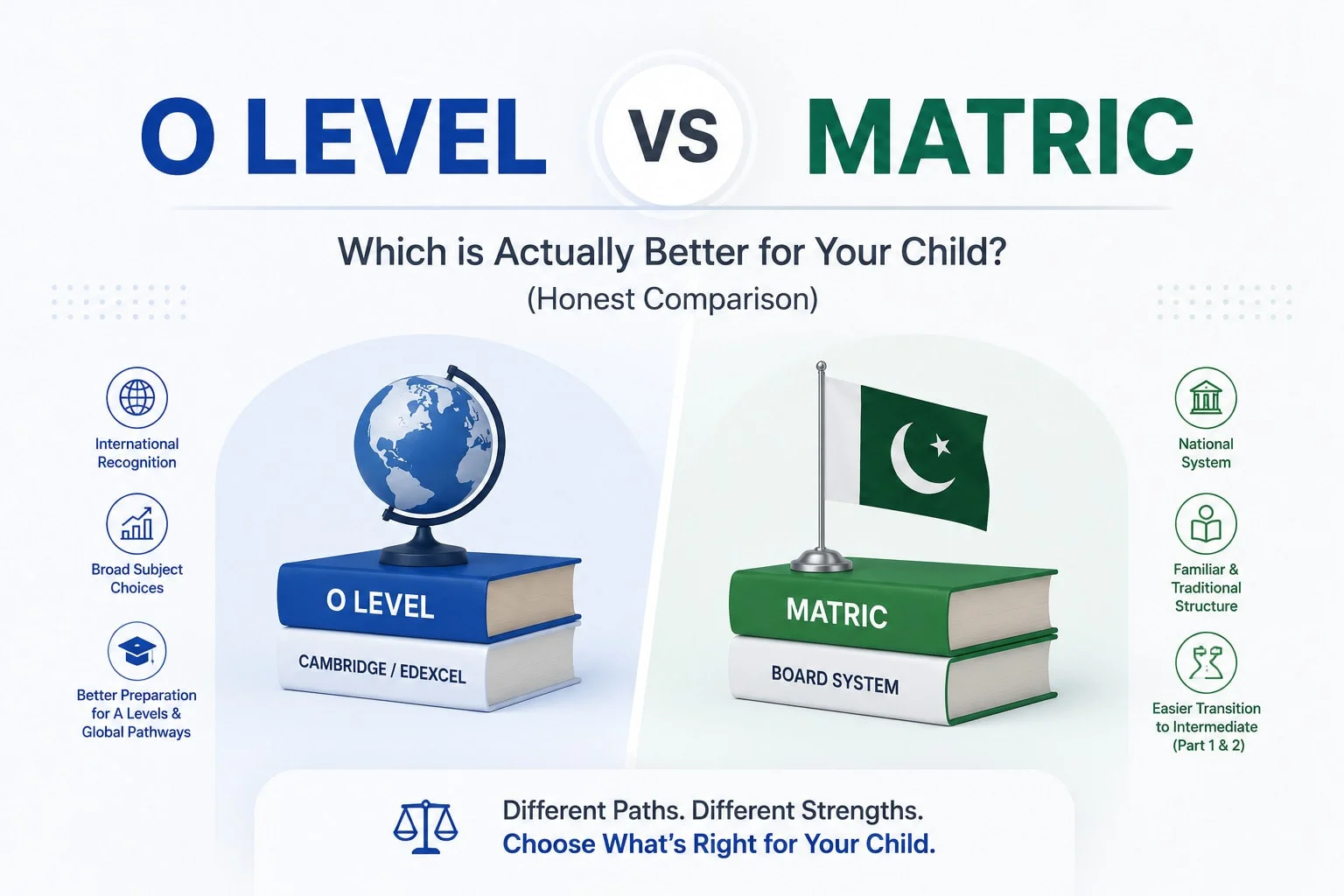
Every year, thousands of Pakistani parents face the same crossroads: O Level or Matric? And every year, they get pulled in two directions relatives who swear O Level is the only path to success, and teachers who say Matric students do just fine.
The honest answer is that both sides are partially right and both are missing important context. This article gives you the complete, honest comparison: costs, recognition, learning outcomes, university access, career implications, and the real trade-offs involved in choosing either system.
Quick Snapshot: The Two Systems at a Glance
| Factor | O Level (Cambridge / CAIE) | Matric (SSC / Pakistani Boards) |
| Academic Level | Grade 9, 10 and 11 | Grade 9 – 10 |
| Awarding Body | Cambridge Assessment International Education (CAIE) — UK | BISE boards: FBISE, BISE Lahore, BISE Karachi, etc. |
| Estimated Students (2024) | ~226,000 exam entries (CAIE Pakistan) | ~4.72 million enrolled (Economic Survey 2024–25) |
| Market Share (Secondary) | ~4.8% of secondary students | ~95%+ of secondary students |
| Language of Instruction | English (exclusively) | Urdu or English (board-dependent) |
| Assessment Style | Conceptual, analytical, source-based questions | Marks-based; historically exam/rote oriented |
| Grading System | A* to U (letter grades) | Percentage out of 1100 (10-point GPA from 2026 per IBCC) |
| Exam Flexibility | Two sessions/year; individual subjects retakeable | Annual exam; full subject repeat required |
| IBCC Equivalence Required? | Yes — mandatory before Pakistani university admission | No — SSC directly accepted |
| Annual Cost (approx.) | PKR 300,000 – 1,000,000+ total programme | PKR 30,000 – 200,000+ (private Matric school) |
| International Recognition | 160+ countries | Primarily Pakistan |
Cost — The Biggest Practical Difference
This is where most family conversations begin and end. Let’s put real numbers on it.
O Level: Full Cost Breakdown
O Level is significantly more expensive than Matric at every cost component.
| Cost Component | Lower Range (PKR) | Upper Range (PKR) | Notes |
| Annual school tuition — budget tier | 200,000 | 450,000 | Smaller/newer Cambridge schools (e.g. some BSS, City School campuses) |
| Annual school tuition — mid-tier | 550,000 | 950,000 | Established schools (e.g. LGS, Roots, KGS secondary) |
| Annual school tuition — premium | 1,100,000 | 2,500,000+ | Top-tier schools (e.g. International School of Islamabad, Karachi American School) |
| Cambridge exam fee (per subject) | 26,000 | 40,000 | British Council Pakistan, updated per session; sciences slightly higher |
| Books and study materials | 50,000 | 100,000 | Per year; official Cambridge textbooks + past papers |
| Private tuition (optional but common) | 25,000 | 100,000 | Per Month, per subject; PKR. |
Matric: Full Cost Breakdown
| Cost Component | Government School (PKR) | Private Matric School (PKR) | Notes |
| Annual school fees | Free to 10,000 | 30,000 – 200,000+ | Wide variation; government schools near-free |
| Board registration fee (per part) | 1,000 – 1,200 | 1,000 – 1,500 | Per BISE Punjab data |
| Textbooks | 2,000 – 8,000 | 5,000 – 20,000 | Punjab Curriculum and Textbook Board books are subsidised |
| Private tuition (optional) | 15,000 – 20,000 | Per Month |
Verdict on Cost: Matric wins decisively. A student can complete full Matric education at a government school for under PKR 50,000 total. The same three years in an O Level programme at a mid-tier school can cost PKR 1,000,000 or more. For the vast majority of Pakistani families, this difference is not marginal it is decisive.
Recognition Locally and Internationally
Inside Pakistan
Both qualifications are accepted for university admission in Pakistan. The key difference is process. Matric students apply directly with their SSC certificate. O Level students must first obtain an IBCC SSC Equivalence Certificate before Pakistani universities will consider their results.
According to IBCC’s official website (ibcc.edu.pk), this equivalence is granted when a student passes a minimum of 8 subjects including the 5 compulsory subjects (English, Mathematics, Urdu, Islamiyat, Pakistan Studies) with a minimum grade of E. Once obtained, the IBCC equivalence certificate is treated identically to an SSC certificate for admission purposes across all Pakistani universities.
For government medical and engineering universities, both Matric and O Level students compete on the same merit lists via MDCAT (medicine) and ECAT (engineering) entry tests. The test score matters far more than whether the student came from O Level or Matric.
Outside Pakistan
This is where the gap widens significantly. Cambridge O Level is recognized for university admissions in 160+ countries including the UK, USA, Canada, Australia, UAE, and most European institutions. International admissions offices understand O Level grades immediately, without needing conversion.
Matric, by contrast, requires extensive credential evaluation (such as World Education Services assessment) for international admissions and even then, many universities in the UK, USA, and Canada do not recognize it as a standalone secondary qualification.
Inside Pakistan effectively equal (with IBCC equivalence). Outside Pakistan, O Level wins clearly. If a family has any realistic possibility of international university applications or careers abroad, O Level provides a meaningful structural advantage.
Learning Quality — What the Research Actually Says
This is where the most heated debates happen. Here is what the academic evidence shows.
“The normally perceived view about O and A Level in Pakistan is that students of O and A Level are superior to other students studying in the local education system with respect to creativity, thinking, and better understanding of concepts.” — ERIC Journal, 2009
Critically, the same study also found that O Level institutions in Pakistan were consistently better equipped with computer labs, science labs, playgrounds, and qualified staff with positive student engagement. The Cambridge curriculum is externally designed to reward analytical thinking and application rather than reproduction of memorized text.
However, and this is the nuance most comparisons miss, recent analysis of Pakistan’s two-tiered education system makes clear that much of the perceived superiority of English-medium O Level education is correlated with socioeconomic background and school resources, not exclusively the Cambridge curriculum itself. An elite Matric school in Lahore with well-trained teachers and good facilities can produce students who outperform those from under-resourced O Level schools.
O Level’s curriculum is structurally stronger in developing analytical skills. But school quality, teacher competence, and student support matter far more than the examining board alone. A committed Matric student in a good school with good teaching can outperform an O Level student in a poor school with inadequate support.
Career Outcomes: Does It Actually Make a Difference to Earnings?
This is the question every parent ultimately wants answered.
A survey conducted by the Express Tribune and analyzed in research published by the Young Economist Initiative (2025) found that across graduates in Lahore, Islamabad, and Karachi:
| Graduate Type | Average Monthly Earnings (PKR) | Difference |
| English-medium school graduates | PKR 68,718 | Baseline |
| Urdu-medium school graduates | PKR 28,829 | 138% lower than English-medium graduates |
However, the research is careful to note that this earnings gap is driven primarily by English fluency and school resources not purely by whether the student sat O Level or Matric. An English-medium Matric school graduate and an O Level graduate may have very similar earnings trajectories. The divide is between English-medium and Urdu-medium education, which broadly (though not perfectly) maps onto the O Level vs Matric divide.
For specific high-stakes professional careers medicine (PMDC/MDCAT), engineering (PEC/ECAT), law (LLB), and civil service (CSS) both Matric and O Level graduates compete on the same entry tests. Neither qualification gives a structural advantage in test performance.
The earnings advantage associated with O Level-type education is real but it is primarily an English-fluency and school-quality advantage, not a pure O Level advantage. For multinational companies, international career paths, and overseas employment, O Level + A Level provides significantly stronger positioning.
The Uncomfortable Truth About Class and Access
No honest comparison of O Level and Matric in Pakistan can avoid this question.
A widely cited academic analysis published on Semantic Scholar on education and social class
“The private, A/O levels, English medium school catered to the elite; the private, Matric system, English medium school catered to the middle class; and the state Matric system, Urdu medium school catered to the working class. Hence, a Pakistani’s socioeconomic background determined, to a large extent, the kind of school he/she attended and consequently determined his/her future career.”
This context matters for parents making this decision. Choosing O Level is not just an academic decision in Pakistan’s social reality, it also carries significant signals about class identity, social networks, and access to certain professional and social environments. None of that makes O Level better or worse educationally. But it is part of how families actually weigh this decision, and it deserves honest acknowledgement.
Which Should You Choose?
A Scenario-by-Scenario Guide
Rather than declaring a winner, here is guidance based on your specific circumstances:
| Your Situation | Recommended Choice | Reason |
| Budget is tight; primary goal is a Pakistani university degree | Matric | Lower total cost; direct SSC recognition; same MDCAT/ECAT access |
| Child plans to apply to a UK, US, Canadian, or Australian university | O Level | Direct international recognition; A Level follows naturally; no credential evaluation needed |
| Goal is medicine at a Pakistani government medical college | Either — MDCAT decides | Both qualify for MDCAT; focus on biology and chemistry preparation regardless of board |
| Goal is engineering at NUST, UET, or similar | Either — ECAT decides | Both qualify; O Level physics/maths preparation often stronger for ECAT conceptual questions |
| Child is a strong English communicator and enjoys analytical subjects | O Level | O Level rewards analytical thinking; A Level + international university pathway suits this profile |
| Child struggles with English or prefers Urdu-medium instruction | Matric | O Level in English exclusively; Matric is available in Urdu and is a fairer environment |
| Family may relocate abroad within 5–10 years | O Level | O Level + A Level gives immediate international portability without credential evaluation |
| Genuinely uncertain; child is academically average | Matric | Lower stakes, lower cost; strong Matric result + FSc/ICS leads to same local opportunities |
| Child attends a school that only offers one option | Whatever the school offers | School quality and teaching matter more than the board; commit fully to the available system |
What Both Systems Will Not Tell You
There are three things that neither the O Level nor Matric framework addresses — and that matter enormously for actual outcomes:
1. Private tutoring is nearly universal in both systems
62% of secondary school students in Lahore receive private tuition. For O Level students, the rate is estimated to be even higher given that Cambridge exams are externally marked and carry high stakes. The subjects most commonly requiring tuition in O Level are Mathematics, Physics, Chemistry, and English which are precisely the subjects that carry the most weight in IBCC equivalence.
The quality and experience of a student’s tutor often matters as much as which board they are studying under.
2. Grades matter more than the board
A student with straight A*s in 8 O Level subjects gets an IBCC equivalent of approximately 90%. A student with straight As gets 85%. Moving from A to A* in a single subject adds 5 percentage points to IBCC equivalence which can determine whether a student makes a university’s merit list
A Matric student who achieves 85%+ in their SSC exams is in a stronger position for many Pakistani university merit lists than an O Level student with mostly Bs and Cs. Grade quality within either system matters more than the choice between systems.
3. The real differentiator is what comes after
O Level is a foundation not a destination. Its primary value is the pathway it opens to Cambridge A Level and thereby to international universities. A student who does O Level but then switches to FSc Intermediate is essentially converting the O Level advantage back into the Matric system’s pathway.
Similarly, Matric is a foundation. Its primary limitation is that FSc Intermediate what most Matric students proceed to is still not internationally portable. The choice between O Level and Matric is really a choice between two entire pathways: Cambridge + A Level on one side, and SSC + HSSC on the other.
Frequently Asked Questions
Is O Level harder than Matric?
Generally, yes in terms of the type of thinking required. O Level exams are application-based and analytical: students must apply knowledge to new scenarios, interpret data, evaluate sources, and construct arguments. Matric has historically been more memory and reproduction-based, though Pakistan’s ongoing curriculum reforms (Single National Curriculum, 2021–2025) are moving to reduce this gap.
Can an O Level student get into a government medical college in Pakistan?
Yes. MDCAT qualification requires passing O Level (or Matric) with Physics, Chemistry, and Biology, plus a minimum grade threshold. IBCC equivalence converts O Level grades into the IBCC percentage used for MDCAT eligibility. Once the equivalence certificate is obtained and MDCAT is cleared, O Level students compete on the same merit lists as Matric students.
If a student does Matric, can they switch to A Level afterwards?
Yes. IBCC explicitly confirms: “A student who has completed the Secondary School Certificate (Matric) can pursue A Levels, as SSC is considered an equivalent qualification to O Levels.” The student will need to meet the A Level college’s entry requirements (typically a minimum SSC percentage, usually 60% or above) and will be on a Cambridge pathway from A Level onward.
Is O Level recognized for government jobs in Pakistan?
Yes, with an IBCC SSC Equivalence Certificate. The equivalence certificate is legally recognized for employment and professional registration across Pakistan. O Level is treated identically to Matric for any public sector job that requires secondary school completion as a minimum qualification.
Which board has a higher pass rate?
Pass rates are not directly comparable because the grading systems are different. In O Level, Cambridge’s grade boundaries are adjusted per exam series based on difficulty, which means the proportion receiving passing grades (A*–E) is broadly consistent year to year. In Matric, provincial boards report pass rates annually these have varied widely, from below 50% in some sessions to above 80% in others, depending on the board and year. Neither system can be called definitively easier or harder to pass.
The Honest Verdict
Neither O Level nor Matric is objectively better. They serve different purposes, different budgets, and different futures. Here is the clearest summary:
| If your priority is… | Choose… |
| Affordability and local university access | Matric |
| International university applications | O Level |
| Conceptual, analytical learning environment | O Level |
| Access to government medical/engineering colleges | Either (MDCAT/ECAT decides) |
| English-medium instruction and global career options | O Level |
| Urdu-medium instruction or limited budget | Matric |
| Flexibility to retake individual subjects | O Level (two sessions/year) |
| Simplest route to Pakistani college admission | Matric (no IBCC step needed) |
What matters most in either system is the quality of teaching, the student’s effort, and the level of support they receive. A well-supported student in a strong Matric school with good teachers will outperform a struggling student in a mediocre O Level school every time.
The board is the framework. What fills that framework is what actually determines outcomes.



1 thought on “O Level vs Matric: Which is Actually Better for Your Child? (Honest Comparison)”
Pingback: O Level Means Which Class in Pakistan? Fully Explained 2026.