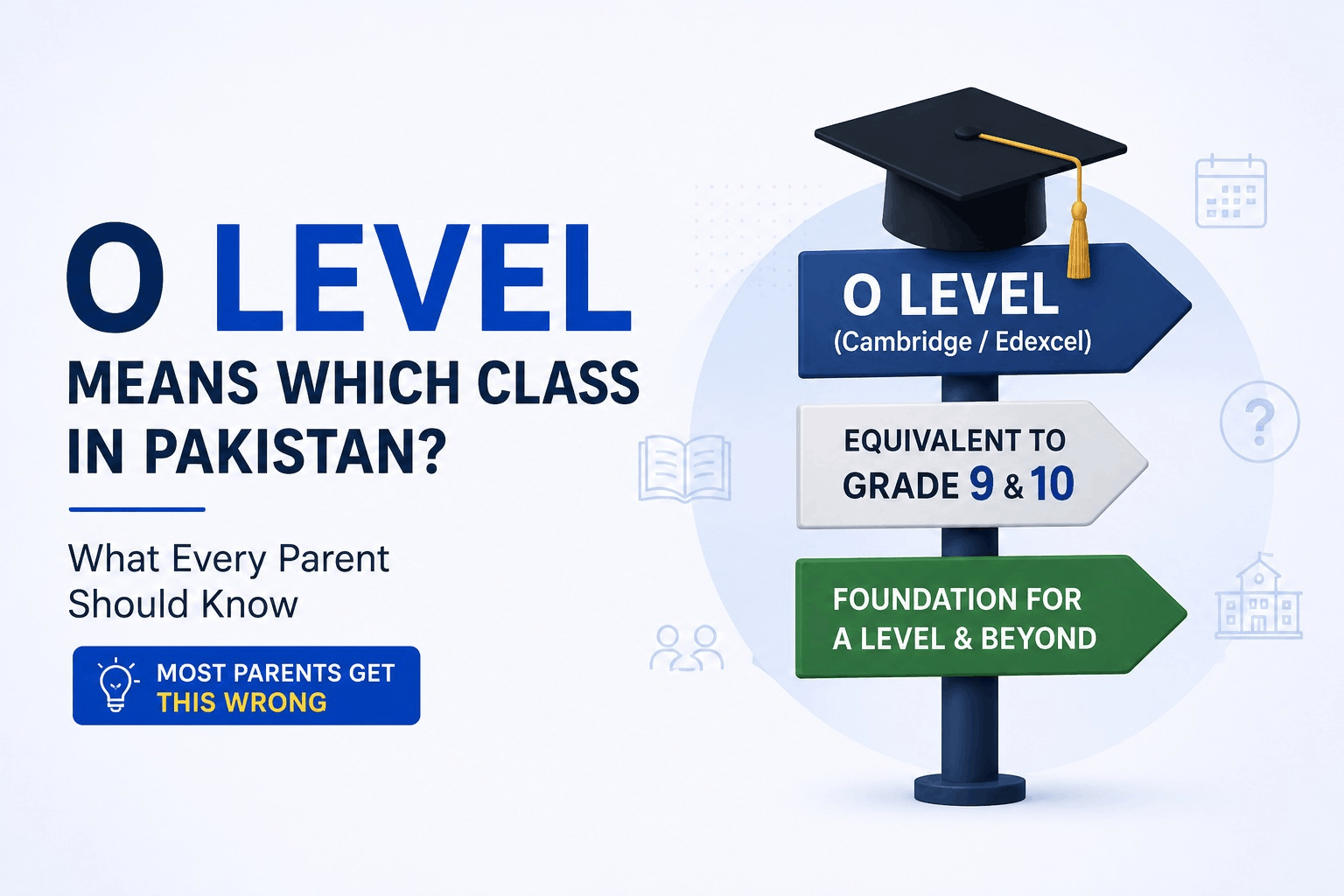
“O Level means which class?” is one of the most searched questions by Pakistani parents and it is also one of the most incorrectly answered.
The confusion is understandable. Pakistan runs two separate secondary education systems simultaneously: the national Matriculation (SSC) system and the Cambridge O Level system. They cover the same age range and the same academic years, but they are structured, assessed, and recognized very differently.
The Direct Answer: O Level Is Grade 9 and Grade 10
O Level corresponds to Grades 9 and 10 in the Pakistani school system the same two years that Matric students spend completing their Secondary School Certificate (SSC).
This is not an approximation. It is the official position of the Inter Board Committee of Chairmen (IBCC), Pakistan’s government body responsible for issuing equivalence certificates. The IBCC website states directly:
“GCE ‘O’ Level/GCSE is regarded as equivalent to the Secondary School Certificate (SSC) in Pakistan, provided that the requirements of the subjects or scheme of studies are met.”
In Pakistan’s national education structure, the SSC also called Matric is the qualification awarded after successfully completing Grades 9 and 10. O Level occupies exactly the same position in the academic ladder.
Understanding Pakistan’s Education Structure
To fully understand where O Level sits, you need to see the full structure of Pakistan’s national education system.
| Stage | Grades | Ages (Approx.) | Qualification Awarded |
| Primary | 1 – 5 | 5 – 10 years | Primary School Certificate (PSC) |
| Middle | 6 – 8 | 11 – 13 years | Middle School Certificate |
| Secondary | 9 – 10 | 14 – 16 years | Secondary School Certificate (SSC) / Matric |
| Higher Secondary | 11 – 12 | 17 – 19 years | Higher Secondary School Certificate (HSSC) / Intermediate |
| Undergraduate | 20+ years | Bachelor’s Degree (4 years) |
O Level sits at the Secondary stage (Grades 9–10). A Level sits at the Higher Secondary stage (Grades 11–12). This is a fixed, government-defined equivalence, not an estimate.
O Level vs Matric: Same Class, Different System
The key confusion most parents face is this: if O Level and Matric cover the same grades, what exactly is different between them? The answer is: almost everything except the academic level.
| Factor | O Level (Cambridge / CAIE) | Matric (SSC / National Boards) |
| Academic Level | Grade 9 – 10 | Grade 9 – 10 |
| Awarding Body | Cambridge Assessment International Education (CAIE) — UK | Board of Intermediate & Secondary Education (BISE) — Pakistan |
| Recognised By | 160+ countries internationally | Primarily Pakistan |
| Language of Instruction | English | Urdu or English (board-dependent) |
| Assessment Style | Conceptual, analytical, application-based papers | Marks-based; traditional format, partly rote-learning |
| Grading System | A* to G (letter grades, set by Cambridge) | Percentage out of 1100 marks (new 10-point GPA from 2026) |
| Exam Flexibility | Two sittings per year; individual subjects retakeable | One annual sitting; full subject repeat required |
| IBCC Equivalence Needed? | Yes — mandatory for Pakistani university admissions | No — SSC directly accepted |
What IBCC Says: The Official Equivalence Explained
The Inter Board Committee of Chairmen (IBCC) is the government authority operating under the Ministry of Federal Education and Professional Training that officially recognizes foreign qualifications in Pakistan
From the IBCC official website:
“GCSE/IGCSE/GCE ‘O’ Levels are considered equivalent to the Secondary School Certificate (SSC), provided that the following requirements of the scheme of studies are met: Appearance in examinations from Pakistan: Eight subjects are required including compulsory subjects of English, Mathematics, Urdu, Islamiyat, and Pakistan Studies, and three elective academic subjects with a minimum passing grade of E.” — IBCC British System.
This means O Level is officially SSC-equivalent but only if the student meets the IBCC subject requirements. Let us break down exactly what those are:
| IBCC Requirement | Detail |
| Minimum subjects for full equivalence | 8 subjects in total |
| Compulsory subjects (all 5 must be passed) | English, Mathematics, Urdu, Islamiyat, Pakistan Studies |
| Elective subjects required | 3 academic elective subjects of your choice |
| Minimum passing grade accepted | Grade E (IBCC does not accept Grades F or G) |
| Certificates older than 5 years | Must be verified by British Council before IBCC will process |
| Laminated/plastic-coated certificates | Not accepted by IBCC |
| Name and Date of Birth | Must match exactly across all certificates and CNIC/Passport |
Where Most Parents Get This Wrong
There are several common misconceptions about O Level class equivalence in Pakistan. Here are the most frequent ones, corrected with official references:
Misconception 1: “O Level is Grade 11 or Intermediate”
Wrong. O Level is Grade 9–10 (SSC level). Grade 11–12 is A Level, which is equivalent to Intermediate (HSSC). The confusion often arises because O Level students join A Level colleges after finishing O Level and parents sometimes think the college entry point is when O Level begins. It is not. O Level is completed before college entry.
Misconception 2: A student can skip O Level and go straight to A Level
According to IBCC rules: “The student must have SSC/equivalent qualification before applying for HSSC Equivalence.” This means a student must complete O Level (or Matric) before being eligible for A Level equivalence. However, IBCC also confirms: “Yes, a student who has completed the Secondary School Certificate (Matric) can pursue A Levels, as SSC is considered an equivalent qualification to O Levels.” So a Matric student can move to A Level but an O Level student cannot skip O Level to go directly to A Level.
Misconception 3: “O Level results are automatically recognized by Pakistani universities”
Incorrect. IBCC explicitly requires students to apply for an equivalence certificate before Pakistani universities will consider O Level results. Downloading a result or having it verified by the school is not sufficient. IBCC states: “Downloaded result is not acceptable for equivalence, even if result is attested/verified by school.” Students must submit original certificates and go through the IBCC application process.
Misconception 4: “Grade F in O Level still counts toward IBCC equivalence”
No. IBCC explicitly excludes Grades F and G: “Grades F and G indicate performance that did not meet the minimum threshold, as per the minimum marks required for a subject in Pakistan. Therefore, the IBCC does not accept grades F or G, and only grades A to E are considered for equivalence.”
How IBCC Converts O Level Grades into Pakistani Percentage
Once a student applies for IBCC equivalence, their O Level grades are converted into percentage-equivalent marks that align with Pakistan’s SSC marking system. The standard conversion formula is:
| Cambridge O Level Grade | IBCC Percentage Equivalent |
| A* | 90% (adjusted annually per IBCC; always 90+) |
| A | 85% |
| B | 75% |
| C | 65% |
| D | 55% |
| E | 45% |
| F / G | Not accepted by IBCC |
Note: The A* equivalent marks are revised by IBCC annually on a subject-by-subject basis. For the 2025 examination session, IBCC has published specific A* equivalent marks per subject on their website. The percentage for A* is always 90 or above.
Practical example: A student who achieves 8 O Level subjects — with 3× A*, 3× A, and 2× B — would receive an IBCC percentage calculation based on:
(3 × 90%) + (3 × 85%) + (2 × 75%) ÷ 8 = approximately 84.4% equivalent.
This figure is what Pakistani universities use for merit comparison with Matric students.
How to Apply for IBCC O Level Equivalence: Step-by-Step
Once a student has their O Level results or certificates, here is the official process to get IBCC equivalence.
| Step | Action Required |
| 1 | Register on the IBCC Equivalence portal at services.ibcc.edu.pk |
| 2 | Fill in the online equivalence application form with full personal and qualification details |
| 3 | Pay the required fee via the official challan system (available at services.ibcc.edu.pk) |
| 4 | Prepare original O Level certificates (two sets of attested photocopies, back-to-back, of each certificate) |
| 5 | Prepare attested copy of CNIC / Smart Card / B-Form / Birth Certificate (NADRA-issued) |
| 6 | Prepare attested copy of parent/guardian’s CNIC |
| 7 | Submit documents to IBCC Head Office (Islamabad) or Regional Office (Karachi, Lahore, Peshawar, Quetta, Bahawalpur) |
| 8 | IBCC verifies the qualification — online if available, or via British Council for older certificates |
| 9 | IBCC issues the SSC Equivalence Certificate |
Important 2025–2026 Update: Pakistan’s Matric Grading System Is Changing
This is highly relevant context for families comparing O Level grades with Matric. Pakistan’s SSC (Matric) grading system is undergoing a significant reform. According to the IBCC’s official FAQs on the New Grading System of SSC & HSSC.
“From 1st Annual Examination, 2026, IBCC’s new grading policy is being implemented by all examination boards of Pakistan in three phases and will be fully adopted by the year 2028.” — IBCC New Grading System FAQ
Key takeaway for O Level families: Cambridge’s A*–G grading scale is not affected by IBCC’s domestic grading reform. O Level grades will continue to be converted using the existing IBCC formula. However, from 2029, Pakistani universities will use CGPA for Matric students — which may make the comparison between O Level and Matric results more straightforward.
The Full Academic Pathway: O Level vs Matric Side by Side
| Year / Grade | Matric Path | Cambridge Path |
| Grade 9 (Year 1) | SSC Part I — board exams at end of year | O Level — studying selected subjects; Pak Studies, Islamiyat and Urdu |
| Grade 10 (Year 2) | SSC Part II — final Matric board exams; SSC certificate awarded | O Level — main May/June or Oct/Nov exam series; Cambridge certificate awarded |
| Grade 11 (Year 3) | Intermediate / FSc / FA — HSSC Part I | A Level — Year 1 (AS or full A Level subjects) |
| Grade 12 (Year 4) | HSSC Part II — final Intermediate exams; HSSC certificate awarded | A Level — Year 2; final Cambridge A Level exams; certificate awarded |
| Post-Grade 12 | University (after HSSC/Intermediate) | University (after A Level, with or without IBCC equivalence) |
Frequently Asked Questions
O Level is equivalent to which class in Pakistan — 9th or 10th?
Both. O Level covers both Grade 9 and Grade 10. Students typically begin O Level studies in Grade 9 and sit their final Cambridge exams at the end of Grade 11. The full three-year period is what IBCC considers equivalent to the complete SSC (Matric) qualification.
If O Level Equals Matric, can I get admission into a Pakistani college with just O Level?
Yes, but you must first obtain an IBCC SSC Equivalence Certificate. Without this document, most colleges and universities in Pakistan will not process your O Level results for admission. The application is made online at the IBCC portal (services.ibcc.edu.pk) and requires your original Cambridge certificates.
Does O Level or Matric lead to better university admissions in Pakistan?
Both qualify students for the same universities but the routes differ. Matric students need the HSSC (Intermediate) before most Pakistani university admissions. O Level students need A Level (plus IBCC equivalence for both). For top-tier international universities, O Level followed by A Level is the stronger pathway. For government medical and engineering institutions in Pakistan, MDCAT and ECAT entry tests are the primary filter both accessible via either route.
What is the difference between O Level, IGCSE, and GCSE?
All three are Grade 9–10 level qualifications from Cambridge or UK-based exam boards, and IBCC treats them the same for equivalence purposes. O Level is the traditional Cambridge qualification most commonly offered in Pakistan. IGCSE (International General Certificate of Secondary Education) is Cambridge’s updated, more widely internationalized version also common in Pakistan. GCSE is the UK domestic version, primarily taken by students studying abroad. For IBCC purposes, all three are “equivalent to SSC” and the same 8-subject rule applies.
Is O Level valid for government jobs in Pakistan?
Yes. With an IBCC SSC Equivalence Certificate, O Level is treated exactly as Matric for the purposes of government job applications that require secondary school completion. The IBCC equivalence certificate is legally recognized for employment and professional registration purposes across Pakistan.
Final Word
O Level means Grade 9, 10 and 11 the equivalent two years Matric. This is not a matter of interpretation. It is the official equivalence defined by IBCC under the Government of Pakistan, and it has been consistently applied since Cambridge qualifications were first formally recognized in Pakistan.
The confusion arises because the two systems look very different from the outside different schools, different grading, different subject names, different exam boards. But at the structural level, both Matric and O Level occupy exactly the same position in Pakistan’s academic ladder.
What matters most for a student in either system is not the label on the certificate it is the depth of subject understanding and the quality of exam preparation that determines grades, university options, and long-term outcomes.
If your child is in O Level and needs targeted support in any subject whether they’re in Grade 9 starting out or in Grade 10 preparing for Pak Studies and Islamiyat, working with a verified, CAIE-experienced subject specialist tutor is one of the most practical steps a family can take.

1 thought on “O Level Means Which Class in Pakistan? (Most Parents & Students Get This Wrong)”
Pingback: O Level vs Matric: Which is Better for Pakistani Students?