Most Pakistani O Level students do not fail because they are not intelligent. They struggle because they are sitting in classrooms of 30–40 students, covering a complex internationally-benchmarked syllabus, with no way to get answers to their specific questions and then they sit alone with past papers they do not know how to use.
This is precisely why private tutoring in Pakistan has become, as academic research confirms, close to standard practice rather than an exception for O Level students in urban areas.
The question for most families is not whether to hire a tutor, it is how to find the right one. A good tutor who understands the CAIE curriculum, knows what examiners look for, and can identify your child’s specific gaps can produce a measurable grade improvement in 6–8 weeks. A poor tutor can absorb your money and your child’s time while changing nothing.
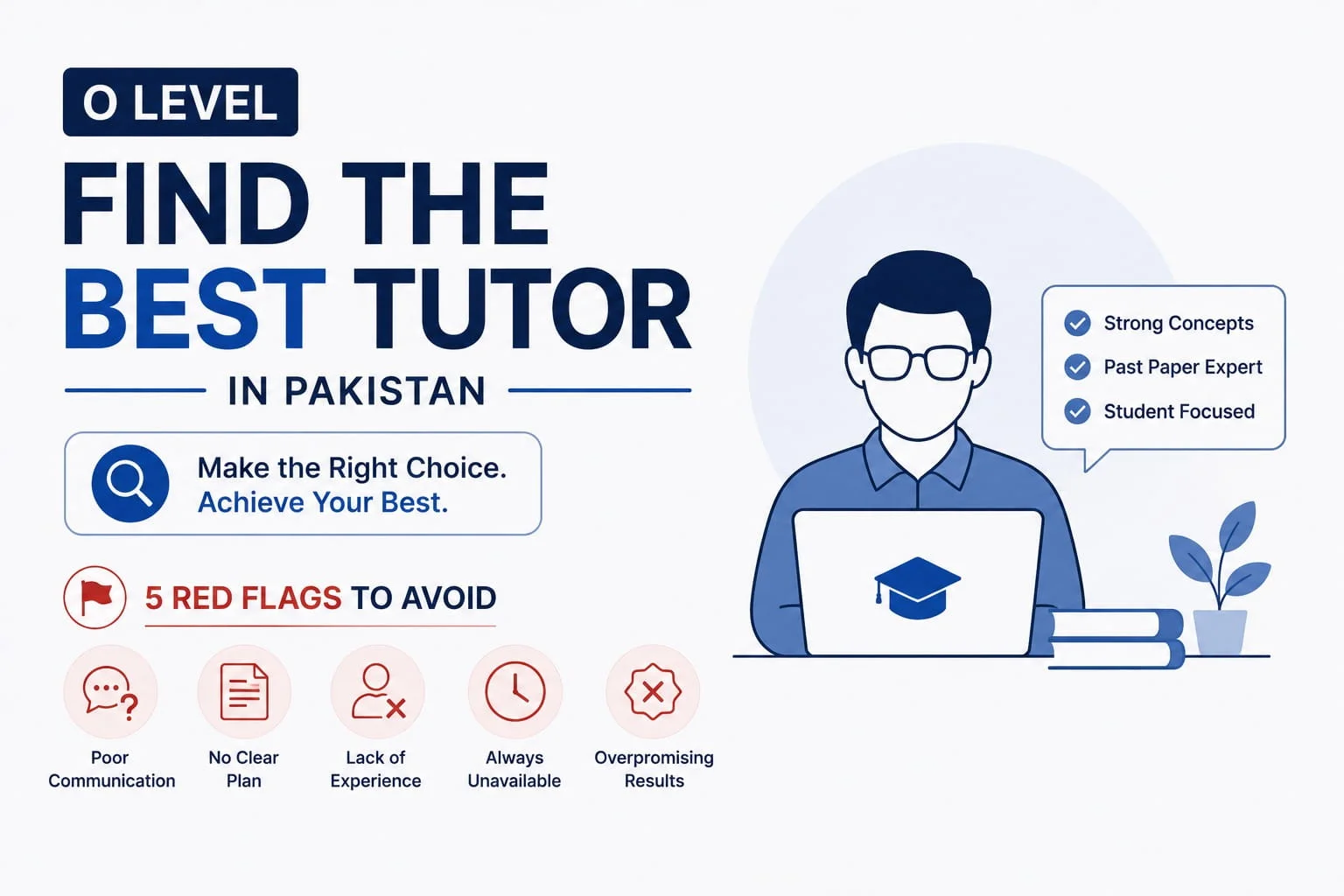
This guide gives parents and students a practical, step-by-step framework for finding, evaluating, and hiring the right O Level tutor in Pakistan and identifying the 5 red flags that signal you are about to make an expensive mistake.
Why O Level Tutoring Has Become Near-Universal in Pakistan
The demand for private tutoring is a global phenomenon, but Pakistan sits at the intersection of several factors that make it particularly acute:
| Factor | Impact on O Level Tutoring Demand in Pakistan |
| High-stakes exams | O Level grades directly determine IBCC equivalence percentage, university merit list position, MDCAT/ECAT eligibility, and A Level college admissions. A single grade boundary crossed can mean the difference between an offer and a rejection. |
| Large class sizes | Pakistani O Level schools typically have 25–40 students per class. Individualized attention is structurally impossible at this scale for complex subjects like Physics or Chemistry. |
| Cambridge’s external marking standard | O Level papers are marked in the UK against globally consistent mark schemes. School teaching that does not specifically address CAIE command words, mark scheme language, and examiner expectations will leave students under-prepared regardless of curriculum coverage. |
| Competitive university admissions | NUST requires 60%+ IBCC with 75% weight on NET. IBA requires min 1B+2C at A Level. LUMS requires min 2B+1C. The margin between competitive and non-competitive grades is narrow — and tutoring closes that margin. |
| Growing middle class | Rising household incomes and increased parental awareness of education quality have driven tutoring spend higher. The global private tutoring market reached USD 66.96 billion in 2025, growing at a CAGR of 10.42% (Fortune Business Insights, 2025), with Asia Pacific holding a 60.85% market share. |
The subjects most commonly requiring private tutoring for Pakistani O Level students is Mathematics, Physics, English, Chemistry Islamiyat and Pak Studies. These are also, not coincidentally, the subjects that carry the most weight in IBCC equivalence calculations and that are most likely to determine a student’s NUST or medical school eligibility.
Types of O Level Tutoring Available in Pakistan
Understanding the options before you start looking saves time and prevents mismatches between what you need and what you hire.
| Type | Format | Best For | Typical Cost (PKR/hour) | Key Consideration |
| 1-to-1 Home Tuition | Tutor visits the student’s home; fully personalized sessions | Students who need maximum individual attention; those with serious grade gaps; students in Grade 10 final year | PKR 3,000 – 8,000/hr depending on subject. | Travel limits tutor options to those in your area; Our Tutors are available across DHA, Bahria Town, Johar Town, and all major areas |
| Online 1-to-1 Tutoring | Video call (Zoom, Google Meet); shared whiteboard and screen; past papers shared digitally | Students who want access to the best available CAIE-specialist tutor regardless of location; students in cities with fewer specialist tutors | PKR 2,500 – 7,000/hr; often 10–20% lower than in-home | No travel; wider tutor selection; equally effective for theory and calculation subjects; Online tutoring is the fastest-growing mode globally |
| Group Tuition / Academy | Small groups of 3–10 students at a tuition centre or academy | Students who work well in peer environments; cost-sensitive families; exam technique workshops | PKR 500 – 2,000/hr per student | Less individualized than 1-to-1; quality varies enormously by academy; useful supplement but rarely a replacement for individual support in complex subjects |
| Intensive Exam Preparation | Short-term (4–8 week) focused programme before exams; daily or near-daily sessions | Grade 10 students 2–3 months before May/June exams; students with one or two weak subjects | Higher per-hour cost; often packaged | High return on investment if well-targeted; requires a tutor who knows the CAIE exam format well |
| Subject-specific Past Paper Sessions | Tutor and student work through past papers together; analyze mark schemes and examiner reports | Students who understand the content but consistently lose marks due to exam technique | PKR 2,000 – 5,000/hr | Often the highest-leverage type of tutoring for students already in the B grade who want to reach A |
What Makes a Good O Level Tutor: The 7 Non-Negotiables
This is the section that separates parents who find good tutors from those who waste money on mediocre ones. A good O Level tutor is not simply someone with good grades or a university degree. They are someone with a very specific combination of subject knowledge, CAIE system expertise, and teaching skill.
| Quality | Why It Matters | How to Verify It |
| 1. Subject-specialist — not a generalist | A tutor who teaches ‘all O Level subjects’ is unlikely to have the depth required in any single subject. Physics requires different expertise than Chemistry, which requires different expertise than Mathematics. The best tutors specialize. | Ask directly: ‘Which subjects do you primarily teach?’ A credible specialist will have one or two core subjects. Be wary of ‘I teach everything’ responses. |
| 2. CAIE-specific experience | O Level exams are set and marked by Cambridge in the UK. A tutor who has only experience with Matric or FSc will not understand CAIE command words, mark scheme language, or examiner expectations — regardless of how well they know the subject content. | Ask: ‘How long have you been teaching O Level specifically? Which exam board? Have you ever studied or reviewed a CAIE mark scheme?’ A good tutor will be able to explain what command word differences mean. |
| 3. Familiarity with past papers and mark schemes | The single most important study tool for O Level is the past paper + mark scheme combination. A tutor who does not use these systematically is not teaching to the exam. | Ask: ‘How do you incorporate past papers into your sessions? Do you use CAIE examiner reports?’ A strong answer includes specific paper references and explains how they use mark schemes. |
| 4. Ability to diagnose gaps, not just re-teach content | The best tutors do not simply re-explain what the school already taught. They identify which specific topics, command words, or calculation steps a student is losing marks on — and target those specifically. | In a trial session: bring a recently marked past paper. Ask the tutor to identify the pattern in the lost marks. A good tutor will immediately categorize the errors (technique, content, vocabulary, etc.). |
| 5. Clear communication with parents | Progress should be visible and communicated. Parents should know what was covered each session, what was identified as weak, and what the plan is for improvement. | Ask: ‘How do you communicate progress to parents? Do you send session summaries?’ Look for structured, proactive communication — not just ‘things went well’. |
| 6. Verifiable background | For in-home tutoring in particular, a tutor who enters your home should have a verifiable academic and professional background. This is basic safeguarding. | Ask: ‘Can you share your degree certificate and a reference from a previous student or parent?’ Legitimate tutors will not be offended. Those who are offended are a red flag. |
| 7. Consistent availability and reliability | A tutor who cancels frequently, arrives late, or is unresponsive between sessions is not providing value regardless of their expertise. Consistency matters more than any single session. | Ask about cancellation policy before hiring. Ask previous students or parents about reliability. Platforms like ConnectTutorPK that verify tutors manage this risk. |
The 5 Red Flags: When to Walk Away
These are the warning signs drawn from common patterns in Pakistan’s tutoring market that consistently predict a poor tutoring experience:
Red Flag 1: ‘I Guarantee an A*’
No honest, experienced tutor guarantees a specific grade. Grade outcomes depend on: the tutor’s quality AND the student’s effort AND the time available AND whether the student had foundational gaps going in. A tutor who guarantees a grade is either uninformed about how CAIE grade thresholds work, or is making a promise they know they cannot keep to secure a fee.
What a good tutor says instead: ‘Based on what I see in this student’s current work, I believe consistent 3–4 sessions per week over 8 weeks on these specific topics could move them from a B to an A. But that depends on the student putting in the work between sessions.’
Red Flag 2: No Trial Session or Resistance to a Demo
Every legitimate tutor should be willing to offer a trial or paid demo session before a longer commitment. This session allows both parties to assess compatibility, teaching style, and whether the tutor actually understands the subject at the required level.
A tutor who insists on a multi-month commitment upfront, or who is evasive about doing a trial, is protecting themselves from being evaluated. That is a problem.
What to do in a trial session: Bring a recently completed past paper that has already been marked. Ask the tutor to review the lost marks and explain why each mark was lost and what the student should have written. A genuinely knowledgeable tutor will immediately identify command word errors, missing method steps, and content gaps. A mediocre tutor will give vague feedback.
Red Flag 3: Unable to Explain the CAIE Mark Scheme
Ask any prospective O Level tutor: ‘What is the difference between an ‘explain’ and a ‘describe’ question in O Level Chemistry?’ or ‘How does CAIE award M marks and A marks in a calculation?’ These are fundamental aspects of the CAIE examination system that any genuinely experienced O Level tutor will be able to answer immediately and accurately.
If the tutor looks blank, gives a vague answer, or says ‘it depends on the question’ without explanation, they do not understand the examination system they are supposed to be preparing your child for. Move on.
Red Flag 4: Teaching to the Textbook, Not the Exam
The CAIE O Level exam tests specific learning objectives from the syllabus, using specific command words, and awards marks for specific types of responses. A tutor who explains concepts from a textbook without reference to how those concepts are tested in CAIE past papers is teaching content but not exam preparation.
Signs of this red flag: sessions never involve past papers; the tutor does not reference mark schemes; the student understands the theory but still scores poorly in papers. Ask directly after 3–4 sessions: ‘How much time have we spent on past papers?’ If the answer is less than 50% of session time by Week 4 onward, something is wrong.
Red Flag 5: No Subject Specialization
Pakistani O Level students most commonly require private tutoring for are Mathematics, Physics, English, and Chemistry. These are highly specific subjects with very different examination requirements. A tutor advertising proficiency in all of them — plus Biology, Economics, Computer Science, History, and Islamiyat almost certainly lacks the depth required in any of them.
Deep subject knowledge, combined with deep CAIE system knowledge, is what produces grade improvements. Breadth without depth produces reassurance without results.
The most expensive red flag: Continuing with a tutor for months when there is no grade improvement. If a student has been receiving tutoring for 6–8 weeks with no measurable improvement in past paper scores, the tutoring is not working. Change the tutor, change the approach, or change the session structure. Sunk cost is not a reason to continue.
The 10 Questions Every Parent Should Ask Before Hiring an O Level Tutor
Use these questions in a first conversation or trial session. A good tutor will welcome them. A poor tutor will become evasive or defensive.
| Question | What a Strong Answer Looks Like | Red Flag Answer |
| Which specific O Level subjects do you specialize in? | Names 1–2 subjects with specific CAIE codes (e.g. ‘Physics 5054, Mathematics 4024’). Explains why they specialize. | I teach all O Level subjects. |
| How long have you been teaching O Level specifically? | 3+ years of O Level tutoring experience; mentions specific student outcomes | I’m very familiar with the curriculum / I have a strong academic background |
| How do you use past papers in your sessions? | Explains specific approach: attempt under timed conditions, then mark against mark scheme, then examiner report review. References specific past paper years. | I use them when we finish the topic / I give them as homework |
| Can you explain what makes an ‘explain’ question different from a ‘describe’ question in this subject? | Clear, confident answer with a subject-specific example: ‘Explain requires you to state the cause using ‘because’ language; describe only requires what happens, not why.’ | Vague answer or ‘it depends on the question’ |
| How will you communicate progress to us as parents? | Clear system: weekly or bi-weekly update, session notes, specific topics covered and weak areas identified | We’ll discuss at each session / I’ll let you know if there’s an issue |
| Can you share a reference from a recent O Level student or parent? | Immediately provides contact or review with specific grade outcome mentioned | References are confidential / I don’t share that information |
| What is your cancellation policy? | Clear policy with reasonable notice period (24–48 hours); commitment to making up cancelled sessions | It’s flexible / we’ll figure it out / things come up |
| How do you identify what a specific student needs to work on? | Describes a diagnostic process: reviewing past papers, mark scheme analysis, conversation with student about weak topics | I follow the syllabus / I start from the beginning |
| What grade did your last 3 O Level students achieve in this subject? | Specific grades mentioned; honest acknowledgement that outcomes also depend on student effort | Very positive responses; no specific grades; claims all students improved significantly |
| Are you willing to do a trial session before we commit? | Yes, immediately and without hesitation | I prefer to commit to a full month to see results / trial sessions are not how I work |
Where to Find O Level Tutors in Pakistan
The Pakistani tutoring market ranges from informal word-of-mouth referrals to structured verified platforms. Here is an overview:
| Source | How It Works | Pros | Cons |
| Word of mouth (parents, school) | Ask other O Level parents at your child’s school; ask the school itself for recommended tutors | High trust — referral from someone who has seen results; often leads to genuinely strong tutors | Limited pool; recommendations are not always current; difficult to compare quality systematically |
| Connect Tutor | Verified, background-checked tutors matched to your subject, level, city, and preferred mode (online/in-person); profiles include qualifications and subject specialisations | Verified tutors; subject-specialist matching; both online and in-person options; covers Karachi, Lahore, Islamabad, and online Pakistan-wide | Structured Oversight. |
| Ustaad Academy | Karachi-based; CAIE, IGCSE, O Level, A Level, Matric, Intermediate; verified faculty | Karachi-focused; CAIE-specialised faculty; verified and trusted claim | Geographic limitation to Karachi |
| School-recommended tutors | Some Pakistani O Level schools maintain lists of approved tutors; ask your school’s exams officer or Head of Department | High credibility; tutor knows the school’s curriculum approach and may be familiar with the school’s marking style | Limited pool; may not be publicly advertised |
Online vs In-Person O Level Tutoring: Which Is Better?
This is one of the most common questions Pakistani O Level parents ask. The honest answer is: it depends on the subject and the student, not the format. Both online and in-person tutoring can be highly effective when done well.
| Factor | Online Tutoring | In-Person (Home) Tutoring |
| Tutor Selection | Access to the best specialist tutors in Pakistan regardless of city; a student in Faisalabad can access the top CAIE Physics tutor in Lahore | Limited to tutors who can physically travel to your area; quality depends on local availability |
| Effectiveness | Equally effective for theory-based subjects (Physics, Chemistry, Economics, English, Biology); digital whiteboard handles calculations well | Slightly preferred for subjects where physical resources help (lab practical’s, detailed geometry work) |
| Cost | Typically, 10–20% lower than in-person due to no travel time or cost for tutor | Higher tutor travel time is factored into fee; less competitive market in smaller areas |
| Flexibility | Higher sessions can be scheduled across time zones; recording is possible for review | Lower travel logistics limit scheduling flexibility |
| Concentration | Requires strong internet connection; some students find home environment distracting during online sessions | Physical presence of tutor may help some students focus; easier for tutor to see body language |
| Best For | Students in smaller cities; students wanting access to top-tier specialists; families who value scheduling flexibility | Students who struggle to focus during video calls; families in major cities with strong local tutor pools |
What to Expect: A Realistic Timeline for Grade Improvement
One of the most common sources of disappointment with tutoring is unrealistic expectations about timing. Parents sometimes expect immediate grade jumps. The reality is more structured:
| Weeks | What Should Be Happening | What You Should See |
| Weeks 1–2: Diagnosis | Good tutor reviews recent past paper performance; identifies specific error patterns (command word, working, content gaps); agrees a topic priority plan with student | Tutor provides a clear written or verbal assessment: ‘Your child loses most marks from X, Y, Z. We will focus on these first.’ |
| Weeks 3–5: Targeted Revision | Focused work on identified weak areas; combination of concept explanation AND past paper practice on those specific topics | Past paper scores on the targeted topics should begin improving. Not overall scores yet specific topic performance. |
| Weeks 6–8: Integration | Full past papers under timed conditions; tutor marks and analyses against mark scheme; student reads examiner reports | Overall past paper scores should show measurable improvement. Compare scores from Week 1 baseline to Week 8. |
| Weeks 9+: Refinement | Address remaining weaker areas; build exam technique under pressure; simulate exam day conditions | Scores should be consistently 5–15 marks higher than the Week 1 baseline. Student should be able to explain why each lost mark was lost. |
If there is no measurable improvement in past paper scores after 6–8 weeks of consistent tutoring (2–3 sessions per week), one of three things is happening: (1) the tutor is not the right fit; (2) the student is not putting in work between sessions; (3) the sessions are covering content but not exam technique. Identify which before spending more money.
O Level Tutoring Costs in Pakistan: What to Expect in 2026
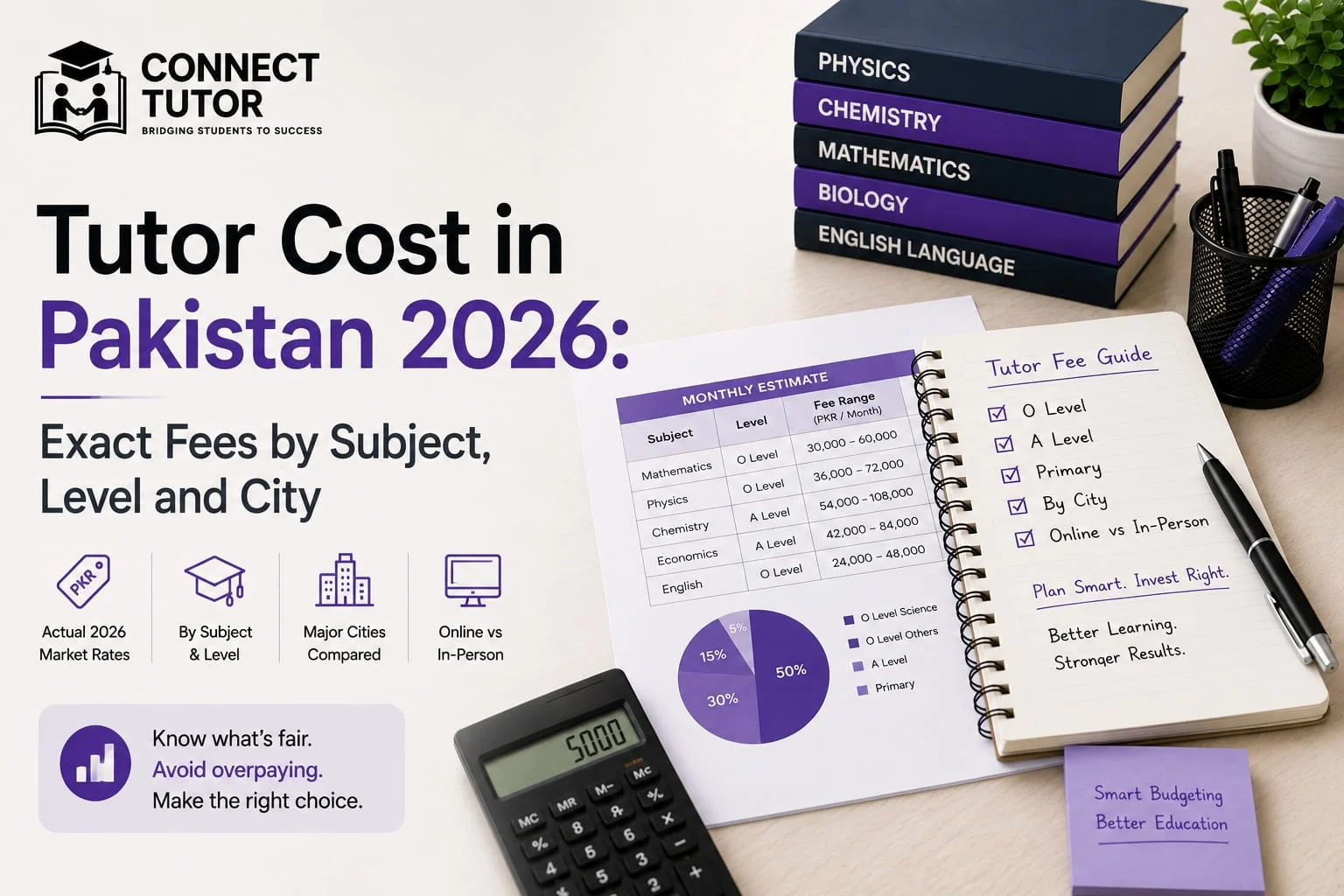
Tutoring fees in Pakistan vary by city, subject, mode (online/in-person), and tutor experience. Here are the typical ranges based on the Pakistani tutoring market in 2026:
| City | Subject | Online (PKR/hr) | In-Person (PKR/hr) | Notes |
| Karachi | Physics / Chemistry / Maths | 2,500 – 6,000 | 3,500 – 8,000 | Higher rates for tutors from top schools (KGS, Lyceum teachers command premium) |
| Lahore | Physics / Chemistry / Maths | 2,000 – 5,500 | 3,000 – 7,500 | LGS and Aitchison teachers command 20–30% premium; Tutors availability across DHA, Model Town, Bahria and Gulberg. |
| Islamabad | Physics / Chemistry / Maths | 2,500 – 6,000 | 3,500 – 8,000 | Strong demand; Beaconhouse and LGS teachers command premium rates |
| Faisalabad / Rawalpindi | Physics / Chemistry / Maths | 1,500 – 4,000 | 2,000 – 5,000 | Smaller local pool makes online tutoring particularly valuable for specialist subjects |
| All cities | English Language | 1,500 – 4,000 | 2,000 – 5,000 | More tutor availability; rates lower than sciences |
| All cities | Economics / Business | 1,500 – 4,000 | 2,000 – 5,000 | Similar to English; fewer CAIE-specific specialists |
| Monthly estimate (2 subjects, 3 sessions/week) | PKR 40,000 – 60,000 | PKR 60,000 – 80,000 | Most O Level families spend PKR 25,000–50,000/month per subject on tutoring |
Frequently Asked Questions
How many sessions per week does an O Level student need?
For most O Level subjects, 2–3 sessions per week of 1–1.5 hours each is the most effective cadence, consistent with distributed practice principles from educational research. One session per week is often insufficient for complex subjects like Physics or Chemistry, where concepts build on each other and forgetting between sessions erases progress. Five or more sessions per week in the same subject risks fatigue and diminishing returns. The exception is intensive exam-period preparation (6–8 weeks before May/June), where 4–5 sessions per week for specific subjects can accelerate improvement.
Should I hire one tutor for all O Level subjects or different tutors?
Different tutors for different subjects are almost always the better approach. The most common subjects requiring tutoring Mathematics, Physics, Chemistry, and English are highly different disciplines requiring very different expertise. A tutor who genuinely specializes in O Level Physics and knows the 5054 mark scheme intimately is unlikely to have the same depth in O Level Chemistry (5070) or Mathematics (4024). Generalist tutors provide the convenience of one contact but typically the depth of none.
Is it too late to hire a tutor if exams are 2 months away?
No, 2 months is a meaningful amount of time for targeted preparation. With exams on 28 April – 9 June 2026 (May/June 2026 series), a student starting intensive tutoring in late February has approximately 8–10 weeks which, with 3 sessions per week, represents 24–30 sessions. This is sufficient to close specific technique gaps, master exam-critical topics, and do meaningful past paper practice. The key is to focus on the highest-mark topics and the most common error patterns rather than trying to cover everything.
My child’s grades are not improving after 2 months of tutoring. What should I do?
First, measure improvement properly: compare past paper raw scores from Week 1 of tutoring to current scores in the same subject. If there is genuinely no improvement, consider: (1) Is the student doing work between sessions? Tutoring without independent practice rarely improves grades. (2) Is the tutor using past papers and mark schemes? If not, the technique gap is not being addressed. (3) Is the tutor subject-specialist with CAIE experience? If not, the mark scheme language is not being taught. (4) Is 2–3 sessions per week being maintained consistently? If any of these are issues, address them before switching tutors. If all are in place and there is still no progress, change the tutor.
Can online tutoring really match in-person quality for O Level Physics?
Yes, for most students. O Level Physics (5054) involves calculations, diagrams, and written explanations all of which are manageable in an online environment with a shared digital whiteboard and screen sharing. The tutor can show worked examples, review past papers together, and mark student work in real time. Many top CAIE tutors in Pakistan exclusively or primarily teach online. For Paper 6 (Alternative to Practical) preparation, some parents prefer in-person to practice graph drawing on paper, but this is not a structural limitation of online tutoring.
Final Word
Finding the right O Level tutor is not difficult if you know what you are looking for. A subject-specialist with genuine CAIE experience, who uses past papers and mark schemes systematically, who can diagnose your child’s specific errors, and who communicates progress clearly to parents will produce measurable grade improvement in 6–8 weeks.
The five red flags, grade guarantees, resistance to a trial session, inability to explain the mark scheme, teaching from a textbook without past papers, and no subject specialization will reliably identify the tutors who will not produce that improvement, regardless of how confidently they present themselves.
The academic evidence is consistent across decades of research: practiced retrieval (past papers) and spaced repetition (distributed sessions over weeks) are the two most effective study strategies available. A good tutor implements both. A poor tutor implements neither.
ConnectTutorPK connects Pakistani O Level and A Level students with verified, background-checked, subject-specialist tutors available for both online and in-person sessions across Karachi, Lahore, Islamabad, and Pakistan-wide. All tutors are screened for CAIE-specific experience and subject specialization before being listed on the platform.





1 thought on “How to Find the Best O Level Tutor in Pakistan (And 5 Red Flags to Avoid)”
Pingback: Online vs In-Person Tutoring in Pakistan: Which is Better?