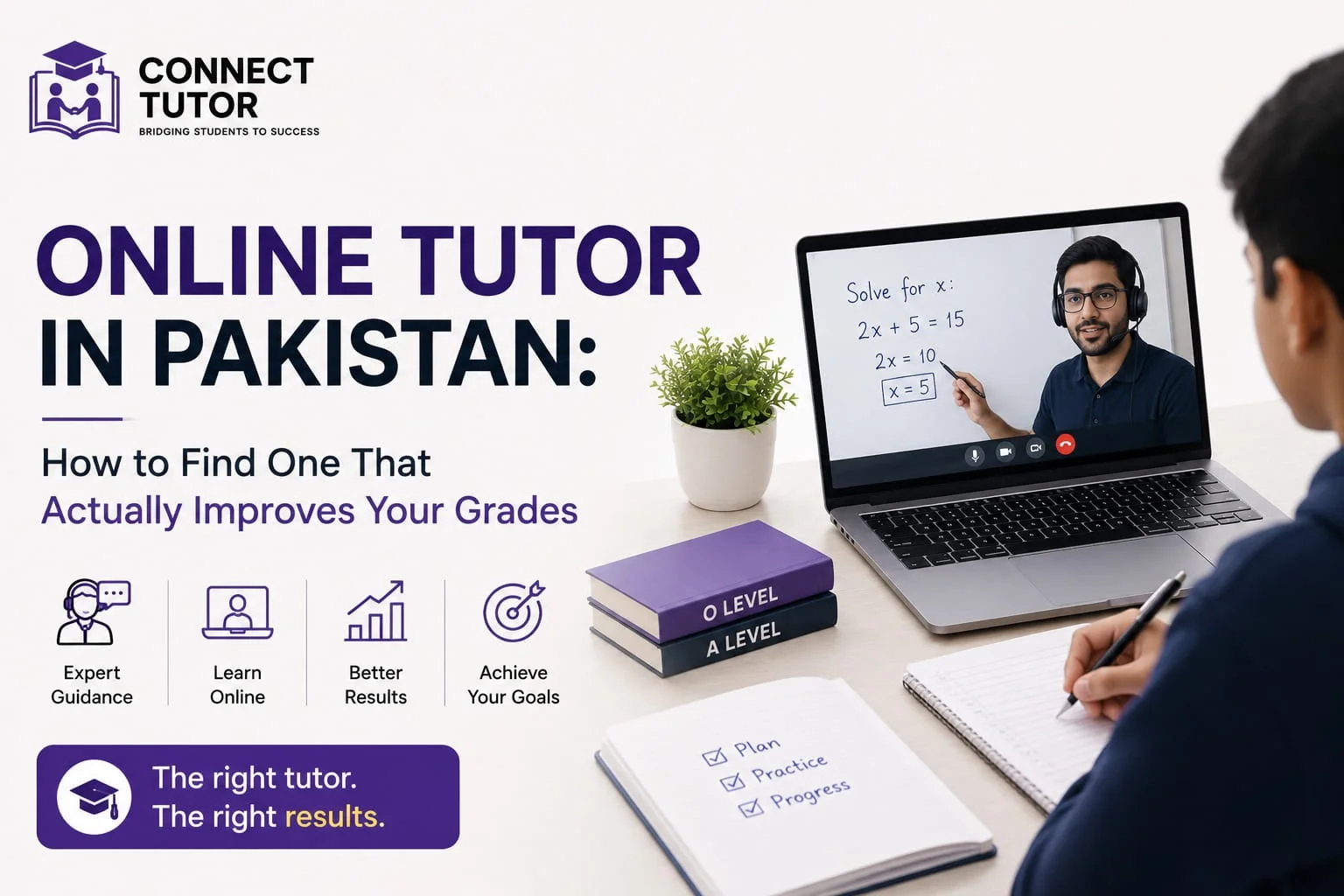
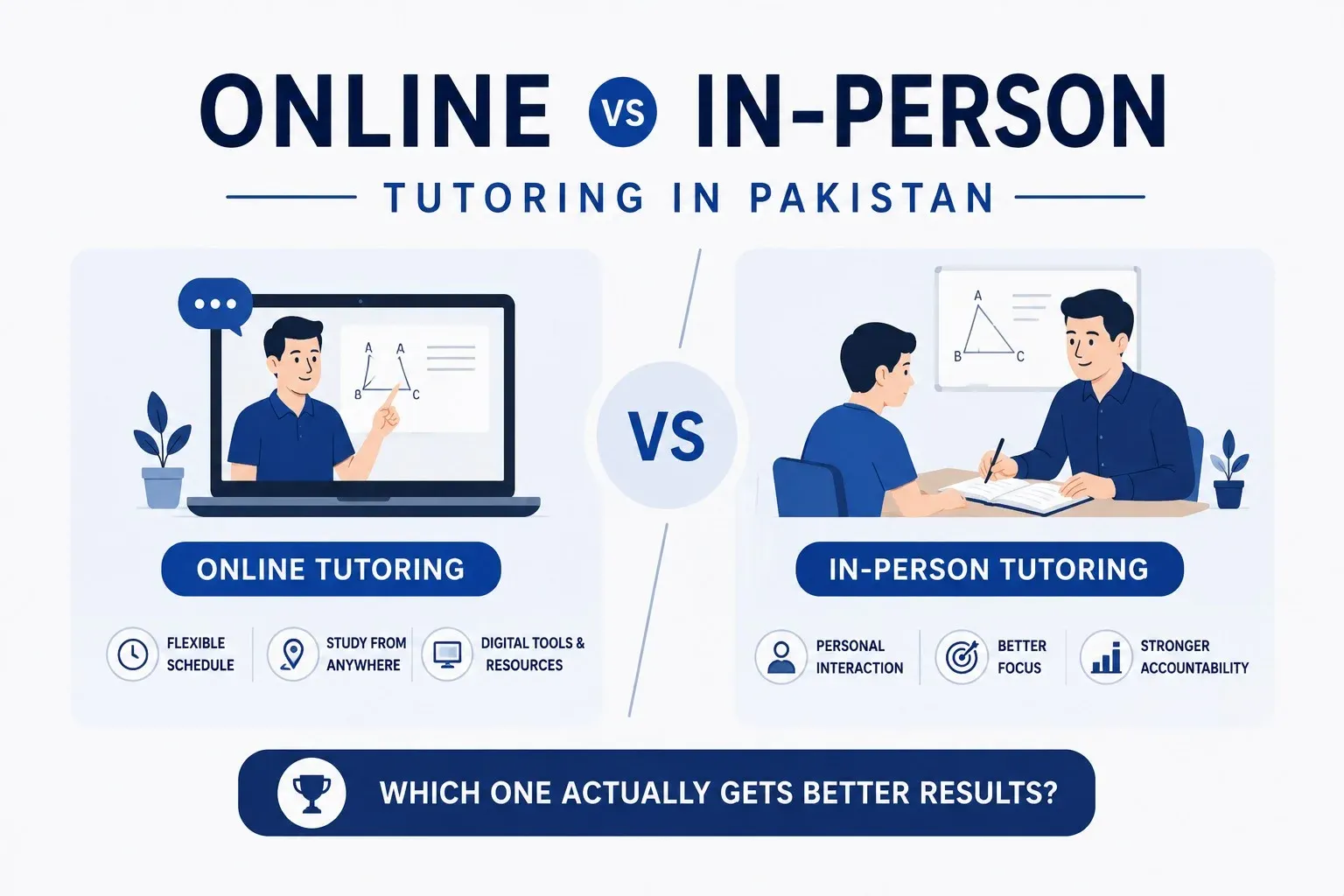
Ask ten Pakistani O Level parents whether online or in-person tutoring is better, and you will get ten different answers. Most will base their view on instinct, what worked for a cousin’s child, or whatever their school recommends.
Online tutoring, cognitive outcomes, and soft skills found that online tutoring produced large positive effects on both academic grades and soft skills for students. Decades of educational research suggest that personalized tutoring can significantly improve student learning outcomes and academic performance. The delivery method (online vs in-person) makes no difference to academic outcomes what matters is tutor quality and teaching approach.
But ‘no difference on average’ does not mean ‘no difference for your child in your specific situation.’ The research also shows that certain student profiles, subject types, and circumstances favor one mode over the other. This guide gives Pakistani O Level and A Level students and parents the full picture what the research says, how Pakistan’s tutoring market has evolved, and how to make the right choice for your specific child.
What the Research Actually Says: Online vs In-Person Effectiveness
The academic evidence on tutoring effectiveness has grown substantially since 2020. Here is what the best studies conclude:
Finding 1: Tutor Quality Matters More Than Delivery Mode
The Education Endowment Foundation (EEF), which synthesizes decades of education research, states clearly: ‘The delivery method (online vs in-person) makes no difference to academic outcomes. What matters is tutor quality and teaching approach.
A large-scale study in Italy comparing online and in-person tutoring for thousands of students found both groups showed significant improvements in test scores and grades. The online group showed slightly higher engagement in some cases, possibly because students felt more
Finding 2: One-to-One Tutoring is the Critical Variable — Not Online vs In-Person
First graders assigned to one-to-one tutoring gained the equivalent of 30 additional days of school. Children tutored in pairs showed no statistically significant difference from untutored children.
The Stanford National Student Support Accelerator (NSSA, 2024) summarizing five years of tutoring research identifies the critical variable consistently: one-to-one or very small group tutoring, regardless of whether it is online or in-person. Groups larger than 3–4 students show rapidly diminishing effects.
Finding 3: Online Tutoring Works — When Students Show Up
The primary risk factor for online tutoring: attendance. In one US programme study, only 1 in 5 students received the full intended number of sessions. The 80% who did not attend sufficiently showed no improvement over untutored peers.
Tutoring interventions that are conducted during the school day consistently result in greater student attendance and academic outcomes than those held after Top schools or during the summer.’ This applies to both online and in-person tutoring.
The implication for Pakistani O Level families: online tutoring is as effective as in-person when the student attends consistently. The parent’s role in ensuring attendance and focus during online sessions is more active than in in-person tutoring, where physical presence creates natural accountability.
The Pakistan Context: How the Market Has Evolved
Understanding the research is one thing. Understanding how it applies to Pakistan’s specific O Level tutoring environment is another.
| Factor | Pakistan-Specific Reality | Impact on Online vs In-Person Choice |
| Urban concentration of tutoring demand | 62% of Lahore secondary students receive private tutoring. Similar rates in Karachi and Islamabad | Large in-person tutor pools in major cities; online opens access to specialist tutors in smaller cities like Faisalabad, Rawalpindi, Peshawar |
| CAIE-specialist tutor scarcity | Tutors with deep O Level (5054 Physics, 5070 Chemistry, 4024 Maths) mark scheme knowledge are limited; concentrated in Lahore and Karachi | Online tutoring democratizes access to the best CAIE specialists regardless of city; a student in Multan can work with the top O Level Chemistry tutor in Karachi |
| Internet and device access | Urban Pakistani households have good smartphone and broadband access; video calling quality is generally adequate | Online tutoring is practically viable for most urban O Level families in Pakistan |
| Cultural comfort with technology | Post-2020 rapid normalization of video calls for education; Pakistani students are comfortable with Zoom, Google Meet, and online whiteboards | Psychological barrier to online tutoring has largely disappeared in urban Pakistan post-COVID |
| Traffic and logistics in major cities | Karachi, Lahore, and Islamabad traffic makes in-person tutor travel time-consuming; evening sessions after 5pm can mean tutor arrives late | Online eliminates travel entirely; sessions can start on time without logistics complications |
| Safety and safeguarding | Families are increasingly cautious about unknown individuals entering the home for in-person tutoring | Online tutoring eliminates the need for a stranger to enter the home; session can be supervised by parent more easily online than in-person |
Online vs In-Person: The Complete Head-to-Head Comparison
| Factor | Online Tutoring | In-Person (Home) Tutoring | Verdict |
| Academic Outcomes | Equivalent to in-person when student attends. | Traditionally the most-studied mode; consistent evidence of effectiveness. | Draw — no meaningful difference in outcomes when both are done well |
| Tutor Quality & Selection | Access to best CAIE specialists across Pakistan; not limited by geography | Limited to tutors who can physically travel to your area; specialist depth depends on local availability | Online wins |
| Cost | Typically, 10–20% lower (no tutor travel time factored in); more competitive market | Higher — tutor travel time and logistics add to cost; less competition in some areas | Online wins |
| Scheduling Flexibility | Sessions can be at any time; easier to reschedule; works across time zones | Travel logistics constrain scheduling; evening sessions in traffic-heavy cities often start late | Online wins |
| Student Accountability & Focus | Requires student self-discipline; distractions at home are common; parent oversight more important | Physical presence of tutor creates natural accountability; harder for student to disengage | In-person wins for students who struggle with focus |
| Attendance Consistency | Attendance is the primary risk factor for online tutoring; easy to cancel without physical commitment | Harder to cancel once tutor has committed to travel; stronger commitment signal on both sides | In-person wins — attendance more reliable |
| Subject Suitability | Excellent for: theory, calculations, past paper analysis, essay writing, economics, English, chemistry theory; interactive whiteboard handles complex math’s | Slightly preferred for: Paper 6 practical skills (graph drawing on paper), geometry constructions, very young students | Subject-dependent online suits most O Level subjects well |
| Parental Oversight | Parent can observe session through an open door or separate device without disrupting; recording possible with consent | Parent must be more careful about creating space for the session while remaining accessible | Online slightly easier for parent oversight |
| Safeguarding | No unknown adult in the home; session recorded if agreed; parent can monitor easily | Requires trust in tutor entering home; background verification more important | Online safer from safeguarding perspective |
| Soft Skills & Relationship | Online tutoring produces large positive effects on soft skills; relationship builds effectively online | Physical rapport may develop slightly faster; some students find human connection easier in person | Draw both modes build effective tutor-student relationships |
| Technical Issues | Internet dropout; audio/video lag; power cuts (more of a risk in some Pakistani areas) | No technology dependency; consistent session environment | In-person more reliable in areas with unstable internet or power supply |
| Travel Time for Student | Zero log on from home immediately after school | If student goes to tutor’s location: significant; if tutor comes to student: zero | Online wins (no travel required on either side) |
Which Mode Is Right for Your Child? A Profile-Based Guide
The research conclusion is clear: mode does not predict outcomes. Student profile and tutor quality do. Here is how to match the mode to your child:
| Student Profile | Recommended Mode | Reason |
| Strong self-discipline; comfortable with technology; needs specialist subject expertise | Online | Access to best CAIE specialists regardless of location; self-discipline means attendance and focus will be maintained |
| Struggles with focus; easily distracted at home; younger (Grade 9) | In-person | Physical presence of tutor creates accountability; distraction risk lower; relationship building faster for less focused students |
| Located in a smaller city (Faisalabad, Rawalpindi, Multan, Quetta) | Online | In-person pool of CAIE-specialist tutors is much smaller in smaller cities; online opens access to Karachi and Lahore specialists |
| Located in Karachi, Lahore, or Islamabad — with strong local tutor pool | Either; trial both | Strong local pools mean in-person is viable; cost and convenience difference between modes is smaller in major cities |
| Preparing for Paper 6 / Alternative to Practical (Chemistry, Physics, Biology) | In-person preferred (or hybrid) | Physical graph drawing, data table work, and practical technique benefit from face-to-face in the final month before exams. Online works for understanding; in-person adds physical practice element. |
| O Level English Language Paper 2 (writing and directed writing) | Online | Excellent for shared document review; tutor can annotate student’s writing directly on screen; no physical materials needed |
| Mathematics (4024) — calculation and working display | Either — both works well | Digital whiteboard handles math’s calculations effectively; tutor can see student’s working step by step online; in-person allows physical checking of graph drawing technique |
| Student has anxiety or is shy about asking questions in person | Online | Primary Tutor Project (citing EEF and Italian study): ‘Comfort reduces anxiety. Many children feel more relaxed at home. They’re more willing to ask questions, admit confusion, and take risks.’ |
| Safety / safeguarding concern about unknown adult entering home | Online | Eliminates physical access concern; parent can monitor easily; session can be recorded with consent |
Subject-by-Subject: Online or In-Person for Each O Level Paper?
| Subject / Paper | Online Suitability | In-Person Suitability | Recommendation |
| Physics Paper 1 (MCQ) | Excellent — questions reviewed on shared screen; elimination technique practiced easily | Good | Either works well |
| Physics Paper 2 (Theory) | Excellent — calculations shown on whiteboard; diagrams drawn digitally; mark scheme reviewed together | Excellent | Either — no meaningful difference |
| Physics Paper 6 (Alt. to Practical) | Good for concept; digital graph drawing possible on whiteboard | Better for final weeks — physical graph paper practice | Hybrid: online for concept, in-person for practical technique |
| Chemistry Paper 1 & 2 | Excellent — equations balanced on whiteboard; organic naming practiced on shared doc | Excellent | Either works well |
| Chemistry Paper 4 (Alt. to Practical) | Good — chemical test tables reviewed; observation language practiced | Slightly preferred for physical equipment familiarity | Either; in-person if student has not done enough practical work at school |
| Mathematics (4024) P1 & P2 | Excellent — step-by-step working shown on digital whiteboard; mark scheme reviewed instantly | Excellent | Either; online whiteboard is as effective as paper for most Math’s work |
| English Language Papers | Excellent — student’s essay reviewed and annotated on shared document in real time | Good | Online slightly preferred — annotation and review faster digitally |
| Biology Theory & Alt. to Practical | Excellent for theory; diagrams drawable digitally | Preferred for diagram labelling practice and visual learners | Either for theory; slight in-person preference for diagram technique |
| Economics / Business Studies | Excellent — case study analysis, data response, essay technique all work online | Good | Online strongly suitable; no physical materials needed |
| Computer Science (2210) | Excellent — pseudocode and algorithms reviewed on shared screen; programming logic discussed | Good | Online preferred; screen sharing makes code review natural |
Making Online Tutoring Work: The Non-Negotiables
If you choose online tutoring, these are the conditions that determine whether it will be as effective as the research suggests:
| Condition | Why It Matters | How to Ensure It |
| Consistent attendance every scheduled session | The primary failure mode of online tutoring is attendance drop-off. Students who miss sessions do not improve. | Parent confirms each session 24 hours before; student is at their device 5 minutes early; treat online sessions with the same commitment as in-person school |
| Dedicated, distraction-free environment | Online sessions at a kitchen table with siblings watching TV are not equivalent to focused learning. Environment determines concentration. | Dedicate a specific room or desk for tutoring sessions; phone on silent; no other screens open; inform siblings and parents that this time is protected |
| Working internet connection and device | Audio/video dropout interrupts the learning process and reduces effective session time | Test internet speed before the first session; have a mobile hotspot as backup; use a laptop or tablet (not phone) for math’s and science sessions where whiteboard work is important |
| Tutor uses a digital whiteboard, not just verbal explanation | Online tutoring without a visual component is less effective for sciences and mathematics. Verbal-only tutoring online does not match in-person quality. | Before hiring: ask if the tutor uses an interactive whiteboard, If they only use screen share or verbal explanation, consider whether this suits the subject. |
| Past papers completed on paper, not digitally | O Level exams are handwritten on paper. Practicing on a screen builds habits that do not transfer to the physical exam. | Student completes all past paper practice by hand on paper. Scans or photographs the answers to share with the online tutor for marking and feedback. |
| Regular progress review with parent | Online sessions are less visible to parents than in-person; progress can stagnate without anyone noticing for weeks. | Tutor sends a brief written summary after each session (or bi-weekly): topics covered, weak areas identified, scores on any practice papers completed. Parent reviews monthly. |
Making In-Person Tutoring Work: The Non-Negotiables
In-person tutoring has its own conditions for effectiveness:
| Condition | Why It Matters | How to Ensure It |
| Tutor arrives on time, every session | A tutor who consistently arrives 15–20 minutes late is effectively wasting 20–25% of session time across a month. | Clear agreement on session time in writing before starting; first late arrival addressed directly; two late arrivals without notice = review the arrangement |
| Session has a structured agenda | In-person sessions can drift into informal conversation or re-teaching comfortable topics rather than targeting weak areas. | At the start of each session: the tutor states what will be covered and why. At the end: the tutor summarizes what was practiced and what to do before the next session. |
| Past papers are central, not supplementary | A tutor who spends 60 minutes explaining a topic from a textbook without a single past paper question has not prepared the student for the exam. | By Week 3 of tutoring: at least 50% of session time should be on past paper practice, mark scheme review, or examiner report analysis. |
| Materials are organized in advance | Sessions where tutor and student spend time searching for the right past paper or printing mark schemes waste paid time. | Student prints past papers before each session; tutor brings or shares mark schemes; both know which paper and which specific questions will be covered. |
| Safeguarding is addressed | An unknown adult entering your home for in-person tutoring requires basic verification regardless of the tutor’s credentials. | Request degree certificate and one parent reference before first session; first session with parent present in the house; review the door-open policy for sessions |
The Hybrid Approach: What Many Successful Families Actually Do
The online vs in-person debate assumes a binary choice. In practice, many Pakistani O Level families use a hybrid model and this is often the most effective approach:
| Hybrid Model | How It Works | Best For |
| Online for regular weekly sessions; in-person for monthly intensive | Regular 2–3 weekly sessions online with a CAIE specialist; one longer in-person session monthly for intensive past paper practice and physical exam technique | Students in major cities who want specialist access online but value periodic face-to-face interaction |
| Online for theory subjects; in-person for practical sciences | English, Economics, Computer Science — fully online. Physics Paper 6, Chemistry Paper 4, Biology Paper 4 — in-person in the 4–6 weeks before exams. | Students taking 7–8 subjects with a mix of theoretical and practical papers |
| In-person first 3 months (relationship building); online for final exam phase | Initial relationship established in-person; once tutor-student rapport and routine are established, switch to online for scheduling flexibility in the busy pre-exam period | Students who need relationship building before they engage well; families where logistics become complicated in April–May |
| Fully online with online whiteboard + paper-based past paper submission | Student does all past paper practice by hand on paper; photographs and sends to tutor before session; tutor reviews digitally and discusses in session | Students with good self-discipline; families who want maximum tutor pool access and scheduling flexibility |
The Question That Actually Determines Results
After reviewing all the research, the Pakistani tutoring market, and the practical realities of O Level preparation, one conclusion is clear: the question ‘online or in-person’ is the wrong question.
The right questions are:
- Does this tutor understand the CAIE examination system, not just the subject content?
- Does this tutor use past papers and mark schemes systematically in every session?
- Does this tutor diagnose specific gaps rather than re-teaching comfortable topics?
- Will this student attend every scheduled session — regardless of whether it is online or in-person?
- Is there a clear system for tracking progress and communicating it to parents?
If the answer to all five is yes, the tutoring will produce results. If any of the five is no, the format does not matter.
The Education Endowment Foundation analysis is unambiguous: the delivery method (online vs in-person) makes no difference to academic outcomes. What matters is tutor quality and teaching approach. A great online tutor will outperform a mediocre in-person tutor every time.
Frequently Asked Questions
Is online tutoring really as effective as in-person for O Level Physics?
Yes, according to the best available research which synthesizes decades of tutoring research, concludes that delivery method (online vs in-person) makes no difference to academic outcomes. A 2025 study found large positive effects on both grades and soft skills from online tutoring. For O Level Physics specifically, online tutoring works very well for Paper 1 (MCQ review), Paper 2 (theory and calculations via digital whiteboard), and Paper 6 concept preparation. For the final weeks of Paper 6 practical technique (graph drawing on physical paper), some parents prefer supplementary in-person sessions.
My child gets distracted during online sessions. Should I switch to in-person?
Not necessarily switch, first address the environment. Distraction during online tutoring is almost always environmental: phone nearby, other family members in the room, multiple browser tabs open. Before switching modes, try: dedicated study space with phone in another room; parent visible but not intrusive; tutor using interactive whiteboard (more engaging than verbal-only sessions); session starting with a specific past paper question to create immediate focus. If after 3–4 sessions with an improved environment the student still cannot focus online, in-person tutoring is likely better for this specific student profile.
How do I know if an online tutor is genuinely good without meeting them?
Use the same evaluation framework as for in-person tutors (Blog 19) plus one additional check: ask for a free 15–20-minute trial session using the online whiteboard. In that trial, ask the tutor to review a past paper question the student has already attempted and explain why marks were lost. A genuinely expert online CAIE tutor will use the digital whiteboard to show the mark scheme, point out the command word error or missing step, and explain what the correct answer should look like. This takes 15 minutes and tells you everything you need to know.
Can I hire an online tutor from another city?
Absolutely, and this is one of the primary advantages of online tutoring for Pakistani families. A student in Faisalabad can work with the top CAIE Chemistry tutor in Lahore. A student in Quetta can access an A Level Physics specialist in Karachi. Connect Tutor online network covers tutors across Pakistan and the platform matches students to subject-specialist CAIE tutors regardless of location.
Which is cheaper? Online or In-person O Level tutoring?
Online tutoring is typically 10–20% less expensive than in-person tutoring for the same subject and tutor quality level. This is because online tutors do not factor travel time and cost into their fees. In major cities like Karachi and Lahore, a strong in-person CAIE Physics tutor might charge PKR 5,000–7,000/hour; the same tutor online would typically charge PKR 4,000–6,000/hour. Over 24 sessions (3 sessions/week for 12 weeks), this represents a saving of PKR 24,000–48,000 — a meaningful amount.
What technology does my child need for effective online tutoring?
The minimum setup for effective online O Level tutoring: (1) a laptop or tablet (phone screen is too small for whiteboard work in sciences and math’s); (2) stable internet connection of at least 10 Mbps; (3) a quiet, dedicated space; (4) the Zoom or Google Meet app (free). For math’s and sciences, the tutor should use an interactive digital whiteboard (Bitpaper, Jamboard, or equivalent). Students should also have physical paper and pen nearby for any past paper practice done during the session.
Final Word
The online vs in-person debate in Pakistani tutoring is the wrong debate. The research is settled: both formats produce equivalent outcomes when the tutor is skilled, the student is consistent, and the sessions are structured around exam technique not just content explanation.
What online tutoring offers that in-person cannot: access to the best CAIE specialists across Pakistan regardless of city, lower cost, scheduling flexibility, and a broader competitive tutor market. What in-person tutoring offers that online sometimes cannot: stronger natural accountability for students who struggle with focus, and slightly easier physical session logistics for subjects requiring paper-based practical work.
For most Pakistani O Level students in 2026 particularly those in larger cities with good internet access and sufficient self-discipline online tutoring is not a compromise. It is the most efficient path to the best available subject specialist, at competitive cost, with maximum scheduling flexibility. The key is choosing a verified, CAIE-experienced tutor and maintaining consistent attendance.
Connect Tutor connects O Level and A Level students with verified, background-checked, subject-specialist tutors available for online sessions across Pakistan and in-person sessions in Karachi, Lahore, and Islamabad. All tutors are screened for CAIE-specific experience before being listed on the platform.