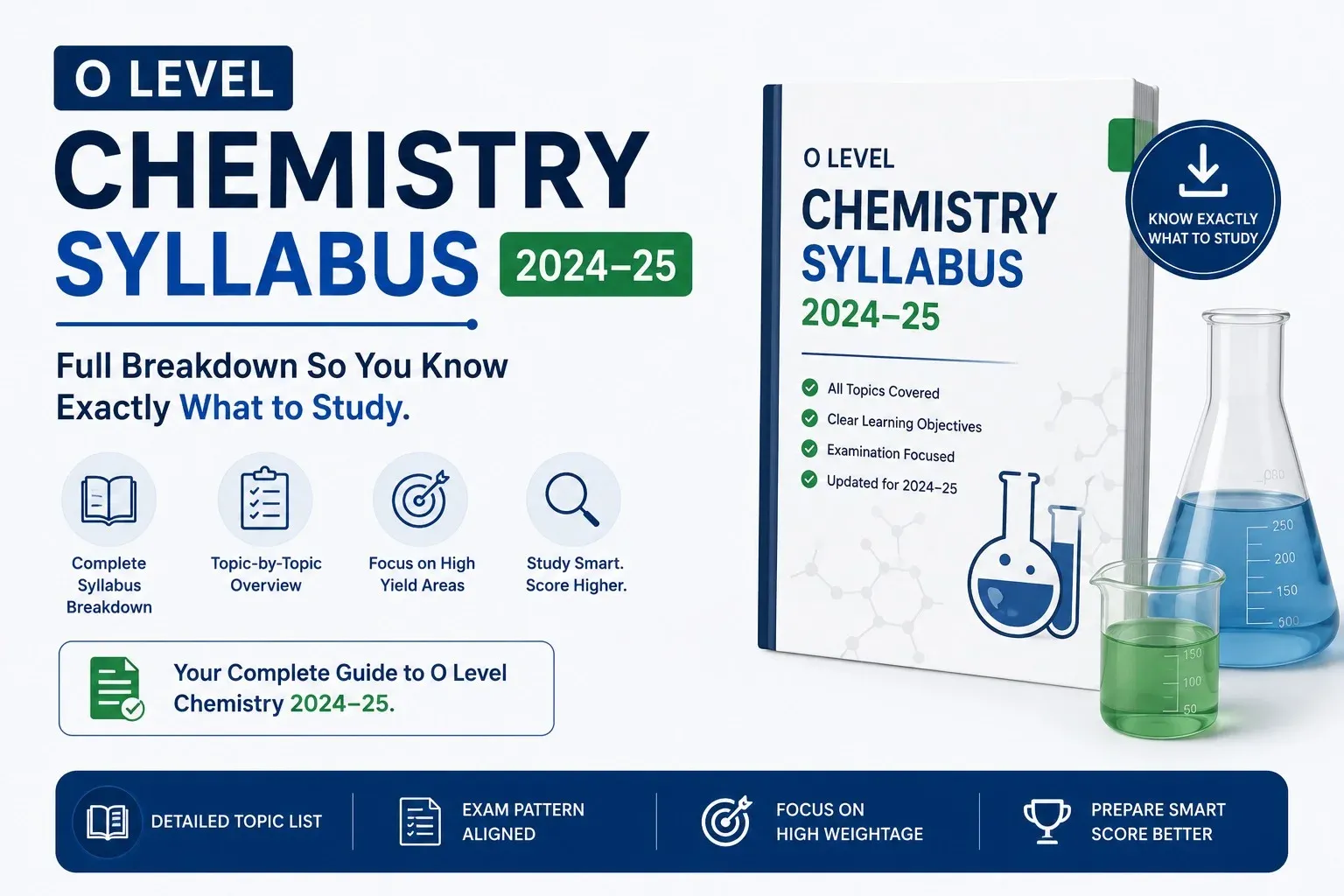
Most O Level Chemistry students revise from textbooks, notes, and past papers without ever reading the syllabus document. This is a structural mistake.
The CAIE O Level Chemistry syllabus (5070) is the only document that defines what will be tested in every exam. Every MCQ in Paper 1, every structured question in Paper 2, every practical scenario in Paper 4 all derived from specific learning objectives listed in this document. If a concept is not in the syllabus, it will not be tested. If it is in the syllabus and you skipped it, you are leaving marks on the table.
This guide gives you the complete Chemistry 5070 syllabus breakdown: all 12 topics verbatim from the official CAIE document, the assessment objective weightings, a topic-by-topic priority guide for Pakistani students, and the key formulas and definitions you need for every section.
Paper Structure and Assessment Weightings: Confirmed from Official CAIE Syllabus
| Paper | Title | Duration | Marks | % of Grade | Format |
| Paper 1 | Multiple Choice | 1 hour | 40 marks | 30% | 40 four-option MCQ questions; all compulsory; externally assessed by CAIE |
| Paper 2 | Theory | 1 hour 45 minutes | 80 marks | 50% | Short-answer and structured questions; all compulsory; externally assessed |
| Paper 4 | Alternative to Practical | 1 hour | 40 marks | 20% | Written paper testing experimental skills (observations, analysis, design); most used in Pakistan |
| Paper 3 | Practical Test (less common) | 1 hour 30 minutes | 40 marks | 20% | Hands-on laboratory practical; used where school facilities allow |
Total marks: 160 (Paper 1: 40 + Paper 2: 80 + Paper 4: 40). All candidates eligible for grades A* to E.
| Assessment Objective | What It Tests | % of Total Qualification | % in Papers 1 & 2 | % in Papers 3 & 4 |
| AO1 — Knowledge with Understanding | Scientific phenomena, facts, laws, definitions, concepts, theories, vocabulary, applications | 50% | 63% | — |
| AO2 — Handling Information & Problem-Solving | Translating data; identifying patterns; making predictions; solving quantitative problems; presenting explanations | 30% | 37% | — |
| AO3 — Experimental Skills & Investigations | Planning experiments; recording observations; interpreting data; evaluating methods; suggesting improvements | 20% | — | 100% |
The 12 Topics: Official Content Overview
The CAIE O Level Chemistry 5070 Syllabus (2023–2025), Section 2: Content Overview, lists the following 12 topics verbatim: ‘Candidates study the following topics: 1 States of matter; 2 Atoms, elements and compounds; 3 Stoichiometry; 4 Electrochemistry; 5 Chemical energetics; 6 Chemical reactions; 7 Acids, bases and salts; 8 The Periodic Table; 9 Metals; 10 Chemistry of the environment; 11 Organic chemistry; 12 Experimental techniques and chemical analysis.’
| # | Topic | Key Content Areas | Paper 1 Frequency | Paper 2 Frequency | Priority |
| 1 | States of Matter | Kinetic particle model; solids/liquids/gases; changes of state; diffusion | Medium | Medium | High — kinetic theory explain questions in most sessions |
| 2 | Atoms, Elements & Compounds | Atomic structure; proton/nucleon number; isotopes; electronic configuration; ionic/covalent/metallic bonding; dot-and-cross diagrams | High | High | Very High — bonding and structure appear in virtually every paper |
| 3 | Stoichiometry | Mole concept; molar mass; Avogadro’s number; reacting masses; volumes of gases; concentration; percentage yield; limiting reagent | High | Very High — mole calculations are the most mark-heavy topic in Paper 2 | HIGHEST — single biggest mark-loss area across all sessions |
| 4 | Electrochemistry | Electrolysis; electrode reactions; products at electrodes; Faraday; electroplating; fuel cells | High | High | Very High — electrode equations and product identification tested consistently |
| 5 | Chemical Energetics | Exothermic/endothermic; bond breaking/forming; activation energy; energy profile diagrams; catalysts | Medium | High | High |
| 6 | Chemical Reactions | Rate of reaction; collision theory; factors affecting rate; reversible reactions; equilibrium; Le Chatelier’s Principle; industrial processes (Haber, Contact) | High | High | High — equilibrium and Haber Process tested frequently |
| 7 | Acids, Bases and Salts | pH scale; acids and alkalis; neutralisation; salt preparation methods; titration; indicators | High | High | Very High — salt preparation method questions appear in virtually every Paper 2 |
| 8 | The Periodic Table | Groups and periods; Group I (alkali metals); Group VII (halogens); Group 0 (noble gases); transition metals; metallic/non-metallic properties | High | Medium | High — Group I and Group VII trends are consistently tested |
| 9 | Metals | Reactivity series; reactions of metals with water, acids, oxygen; extraction methods (blast furnace, electrolysis); uses; corrosion and rust prevention | Medium | High | High — reactivity series questions and blast furnace appear frequently |
| 10 | Chemistry of the Environment | Air composition; pollution (CO, SO₂, NOx, particulates); water treatment; hardness of water; nitrogen cycle; fertilisers; greenhouse effect | Medium | Medium | Medium — lower frequency but easier marks when tested |
| 11 | Organic Chemistry | Alkanes; alkenes; alcohols; carboxylic acids; esters; polymers (addition and condensation); naming; reactions; conditions; uses | Very High | Very High — organic chemistry is consistently one of the highest-mark topics in Paper 2 | Very High — naming, reactions, and conditions all tested; second biggest mark-loss area |
| 12 | Experimental Techniques & Chemical Analysis | Separation techniques; purification; gas tests; ion tests (cation, anion); chromatography; acid-base and redox titration | Medium | Paper 4 dominant — chemical tests and separation are core Paper 4 content | High — essential for Paper 4 performance |
Topic-by-Topic Full Breakdown
The following section covers every topic with key learning objectives from the CAIE syllabus, the critical exam requirements, and the most common errors identified in past paper analysis.
Topic 1: States of Matter
The syllabus (Section 3, Topic 1) specifies two sub-sections: 1.1 Solids, Liquids and Gases and 1.2 Diffusion. The exact learning objectives from the CAIE official document include:
| Sub-Topic | Key CAIE Learning Objectives (Verbatim from Syllabus) | Exam Requirement |
| 1.1 Solids, Liquids & Gases | State distinguishing properties; describe structures in terms of particle separation, arrangement and motion; describe and explain changes of state using kinetic particle theory; interpret heating and cooling curves; describe effects of temperature and pressure on gas volume | Explain questions require particle-level reasoning: always refer to ‘particles’ and their ‘kinetic energy’, ‘separation’, and ‘forces’ |
| 1.2 Diffusion | Describe and explain diffusion using kinetic particle theory; describe and explain the effect of relative molecular mass on rate of diffusion of gases | Heavier molecules (higher Mr) diffuse more slowly. This is a direct CAIE syllabus point — quote the relationship precisely. |
Topic 2: Atoms, Elements and Compounds
The CAIE syllabus specifies four sub-sections: 2.1 Elements/compounds/mixtures; 2.2 Atomic structure and the Periodic Table; 2.3 Isotopes; 2.4 Ions and ionic bonds; plus, covalent and metallic bonding.
| Sub-Topic | Key Definitions (Verbatim from Syllabus) | Critical Exam Point |
| Proton Number | Define proton number/atomic number as the number of protons in the nucleus of an atom (Syllabus 2.2.3) | Must state ‘number of protons in the nucleus’ — not electrons |
| Nucleon Number | Define mass number/nucleon number as the total number of protons and neutrons in the nucleus of an atom (Syllabus 2.2.4) | Must state ‘total number of protons and neutrons’ |
| Isotopes | Define isotopes as different atoms of the same element that have the same number of protons but different numbers of neutrons (Syllabus 2.3.1) | CAIE Specimen Paper 2 Answers (2023) flags isotope confusion as a common mistake |
| Electronic Configuration | Determine electronic configuration of elements with proton number 1 to 20, e.g. 2,8,3 (Syllabus 2.2.5) | Must know all configurations up to Z=20 (calcium). Shell filling: 2, 8, 8 |
| Ionic Bond | State that an ionic bond is a strong electrostatic attraction between oppositely charged ions (Syllabus 2.4.3) | State BOTH that it is electrostatic AND between oppositely charged ions |
| Covalent Bond | A shared pair of electrons between two atoms | Dot-and-cross diagrams: show only outer shell electrons; shared pairs between atoms |
| Metallic Bond | Lattice of positive ions surrounded by a sea of delocalised electrons | Explain conductivity: ‘delocalised electrons are free to move and carry charge’ |
Topic 3: Stoichiometry — The Most Important Topic
Stoichiometry is identified by as ‘arguably the most important topic as it forms the basis for chemical calculations across multiple topics’. Teachers identifies mole confusion as ‘the single biggest source of stoichiometry errors.’ Every Paper 2 session contains multiple stoichiometry calculation questions worth 8–15 marks.
| Formula / Concept | Definition & Formula | Critical Rule |
| Mole (mol) | Amount of substance; 1 mol contains 6.02 × 10²³ particles (Avogadro’s constant, L) | Define mole as ‘the amount of substance containing 6.02 × 10²³ particles’ — this exact definition is in the CAIE syllabus |
| Moles from mass | n = m / Mr; n = moles; m = mass in grams; Mr = relative formula mass | Always calculate Mr first. Show the Mr calculation. Then divide m by Mr. |
| Moles from solution | n = c × V; c = concentration in mol/dm³; V = volume in dm³ (convert cm³ ÷ 1000) | Volume must be in dm³. 25 cm³ = 0.025 dm³. |
| Moles from gas (RTP) | n = V / 24; V = volume in dm³; 1 mole of gas at RTP occupies 24 dm³ | RTP = room temperature and pressure. Use 24 dm³/mol unless given a different value. |
| Stoichiometric ratio | Use balanced equation to find mole ratio; multiply or divide accordingly | CAIE Specimen (2023): ‘common mistake — candidates forget to apply stoichiometry, missing the step of dividing by two.’ |
| Percentage yield | % yield = (actual yield / theoretical yield) × 100% | Always calculate theoretical yield from stoichiometry first. Show both values before dividing. |
| Concentration | c = n / V; or: g/dm³ = mol/dm³ × Mr | Two concentration units exist. Specify which unit is being used. Convert between them using Mr. |
Topic 4: Electrochemistry
| Sub-Topic | Key Content | Critical Exam Point |
| Electrolysis Basics | Decomposition of ionic compound by electricity; requires ionic substance in molten or aqueous form | Electrolysis requires ions that are free to move. Solid ionic compounds cannot be electrolyzed. |
| Cathode (negative) | Reduction occurs at cathode; cations (positive ions) attracted and discharged | OILRIG: Oxidation Is Loss, Reduction Is Gain. Cathode = reduction = cations discharged. |
| Anode (positive) | Oxidation occurs at anode; anions (negative ions) attracted and discharged | Reactive anode (copper): anode dissolves. Inert anode (platinum/carbon): anions discharged. |
| Products at Electrodes | Depends on: (1) substance being electrolyzed; (2) concentration; (3) electrode material | Dilute H₂SO₄/NaOH: H₂ at cathode; O₂ at anode. CuSO₄ with copper electrodes: Cu deposited at cathode; Cu dissolves at anode. |
| Electrode Equations | Must balance charge AND atoms. Cathode (reduction): Cu²⁺ + 2e⁻ → Cu. Anode (oxidation): 2H₂O → O₂ + 4H⁺ + 4e⁻ | Check both charge balance and atom balance before finalising. Most common error: unbalanced charges. |
| Faraday Calculations | Charge Q = I × t (seconds); moles of electrons = Q ÷ F (F = 96500 C/mol); then use electrode equation stoichiometry | Time must be in seconds. Minutes × 60 = seconds. Show all steps. |
Topic 5: Chemical Energetics
| Sub-Topic | Key Content | Exam Requirement |
| Exothermic Reactions | Energy released to surroundings; temperature increases; ΔH is negative. Examples: combustion, neutralization, oxidation | State: ‘energy released to surroundings’; ‘temperature of surroundings increases’; ‘ΔH is negative’. All three for full marks. |
| Endothermic Reactions | Energy absorbed from surroundings; temperature decreases; ΔH is positive. Examples: thermal decomposition, photosynthesis | State: ‘energy absorbed from surroundings’; ‘temperature of surroundings decreases’. |
| Bond Breaking & Forming | Breaking bonds: endothermic (energy input required). Forming bonds: exothermic (energy released). Net ΔH = energy released in bond forming − energy needed for bond breaking | If energy released > energy absorbed: exothermic overall. If energy absorbed > energy released: endothermic. |
| Activation Energy | Minimum energy particles need to react; shown as peak on energy profile diagram | A catalyst lowers activation energy but does NOT change ΔH. Show lower peak on diagram; same reactant and product energy levels. |
| Energy Profile Diagrams | Sketch showing reactant energy, activation energy peak, and product energy. Difference = ΔH | Label: reactants, products, activation energy (Ea), overall energy change (ΔH). Exothermic: products lower than reactants. |
Topic 6: Chemical Reactions (Rate and Equilibrium)
| Sub-Topic | Key Content | Critical Exam Point |
| Rate of Reaction | Factors: temperature; concentration; surface area; catalyst; light (for some reactions) | For each factor: state the change AND explain using collision theory — ‘particles collide more frequently AND with more energy than activation energy.’ |
| Collision Theory | Reaction occurs when particles collide with energy ≥ activation energy | Both frequency AND energy of collisions must exceed Ea. Missing either loses the mark. |
| Reversible Reactions | Some reactions do not go to completion; products can react to reform reactants | State the double arrow ⇌ for reversible reactions. Single arrow indicates complete (irreversible) reaction. |
| Equilibrium | State of dynamic equilibrium: forward and reverse reactions occur at equal rates; concentrations of reactants and products remain constant | Dynamic equilibrium: both reactions still occurring (not static). This distinction is tested. |
| Le Chatelier’s Principle | If a system at equilibrium is disturbed, it shifts to oppose the change | State the principle before applying it. Then state the direction of shift and the reason. |
| Haber Process | N₂ + 3H₂ ⇌ 2NH₃; conditions: 450°C, 200 atm, iron catalyst (Fe) | Explain the compromise: high pressure favours yield (fewer moles of gas on right side) but is expensive. Higher temperature speeds rate but reduces yield (exothermic reaction). 450°C is the compromise. |
| Contact Process | 2SO₂ + O₂ ⇌ 2SO₃; conditions: 450°C, 1–2 atm, V₂O₅ catalyst | Know the steps: S burned to SO₂; SO₂ oxidised to SO₃ (Contact Process); SO₃ dissolved in H₂SO₄ then water added. Purpose: industrial manufacture of sulfuric acid. |
Topic 7: Acids, Bases and Salts
This is one of the two highest-frequency Paper 2 topics alongside organic chemistry. Salt preparation questions appear in almost every session.
| Sub-Topic | Key Content | Exam Requirement |
| pH Scale | 0–7: acidic; 7: neutral; 7–14: alkaline. Strong acids have lower pH than weak acids of same concentration (strong acids fully ionise; weak acids partially ionise) | State the difference between strong and weak acids: ‘strong acids fully dissociate in solution; weak acids partially dissociate.’ |
| Acids, Alkalis, Bases | Acid: produces H⁺ ions in solution. Base: reacts with acids; metal oxides, hydroxides, and ammonia. Alkali: a base soluble in water; produces OH⁻ ions | Define each precisely. An alkali is a special case of a base. |
| Salt Preparation — Method 1 | Insoluble base or carbonate + acid: add excess solid to acid; filter; evaporate to crystallise | Used for: CuO + H₂SO₄ → CuSO₄; CaCO₃ + 2HCl → CaCl₂; insoluble bases only |
| Salt Preparation — Method 2 | Alkali + acid (both soluble): titration; add exact volume of alkali to acid using indicator; repeat without indicator; evaporate | Used for: NaOH + HCl → NaCl; soluble bases only. Indicator must be removed before evaporation. |
| Salt Preparation — Method 3 | Precipitation: mix two soluble salt solutions; insoluble salt precipitates; filter | Used for: BaCl₂ + Na₂SO₄ → BaSO₄(s) + 2NaCl; insoluble products only |
| Acid Reactions | Acid + metal → salt + H₂; acid + oxide → salt + water; acid + hydroxide → salt + water; acid + carbonate → salt + water + CO₂ | Memorise all four reaction types. State products correctly for each combination. |
Topic 8: The Periodic Table
| Group / Element | Key Properties to Know | Exam Tip |
| Group I — Alkali Metals (Li, Na, K) | React vigorously with water (producing H₂ and metal hydroxide); reactivity increases down the group; low density; soft; one outer electron | Reactivity trend: increase down group because outer electron is further from nucleus and more easily lost (less nuclear attraction). |
| Group VII — Halogens (F, Cl, Br, I) | Diatomic molecules (F₂, Cl₂, Br₂, I₂); reactivity decreases down group; displacement reactions (more reactive halogen displaces less reactive) | Cl₂ displaces Br⁻ and I⁻. Br₂ displaces I⁻ only. I₂ cannot displace any. Colour change is the observable evidence: Cl₂ (yellow-green gas); Br₂ (orange-brown); I₂ (grey solid, purple vapour). |
| Group 0 — Noble Gases | Full outer electron shells; chemically inert; exist as single atoms (monatomic) | Explain inertness: ‘full outer electron shell; no tendency to gain or lose electrons.’ |
| Transition Metals | Found between Groups II and III; hard; high melting points; variable oxidation states; coloured compounds; good catalysts | Iron catalyst in Haber Process; vanadium(V) oxide (V₂O₅) in Contact Process. Know specific catalyst for each industrial process. |
| Periodic Trends | Across a period: nuclear charge increases; atomic radius decreases; ionisation energy increases. Down a group: more electron shells; atomic radius increases; ionisation energy decreases | State the trend AND the reason. Trend alone is insufficient for ‘explain’ questions. |
Topic 9: Metals
| Sub-Topic | Key Content | Exam Requirement |
| Reactivity Series | Order (most to least reactive): K, Na, Ca, Mg, Al, Zn, Fe, Ni, Sn, Pb, H, Cu, Hg, Ag, Au, Pt | Memorise the reactivity series. Displacement reactions: more reactive metal displaces less reactive metal from its salt solution. |
| Reactions of Metals | With water: K, Na, Ca react vigorously; Mg reacts slowly with hot water; Zn, Fe react with steam only; Cu, Ag, Au do not react. With acids: metals above H react; Cu and below do not. | Specific observations for K, Na, Ca, Mg with water — frequently tested in Paper 2 describe questions. |
| Extraction — Blast Furnace | Iron extracted from iron ore (haematite, Fe₂O₃) using carbon (coke) and limestone. Reactions: C + O₂ → CO₂; C + CO₂ → 2CO; Fe₂O₃ + 3CO → 2Fe + 3CO₂; CaCO₃ → CaO + CO₂; CaO + SiO₂ → CaSiO₃ (slag) | Know all five equations and the role of each reagent. Slag removes acidic impurities (SiO₂). This is one of the most tested Paper 2 sub-questions. |
| Extraction — Electrolysis | Used for metals above carbon in reactivity series (Al, Na, K, Ca, Mg). Aluminium extracted from molten alumina (Al₂O₃) using electrolysis. | Explain why electrolysis (not carbon reduction): aluminium is more reactive than carbon; carbon cannot reduce Al₂O₃. |
| Rusting and Prevention | Iron rusts in presence of both water AND oxygen. Prevention: painting, galvanising (zinc coating), sacrificial protection (more reactive metal) | Rusting requires BOTH water and oxygen — not just one. State both conditions. |
Topic 10: Chemistry of the Environment
| Sub-Topic | Key Content | Exam Tip |
| Composition of Air | Approximately 78% N₂, 21% O₂, 0.9% Ar, 0.04% CO₂ (variable trace gases) | State approximate percentages; N₂ and O₂ are always required; CO₂ is variable |
| Air Pollution | CO (from incomplete combustion): toxic; binds to haemoglobin. SO₂ (from combustion of S-containing fuels): causes acid rain. NOx (from combustion at high temperatures): causes acid rain and photochemical smog. Particulates: respiratory damage. | For each pollutant: source, effect, and method of reduction. All three parts needed for full marks. |
| Water Treatment | Sedimentation; filtration; chlorination (kills bacteria) | State the three stages in order and the purpose of each. |
| Hard and Soft Water | Hard water: contains dissolved Ca²⁺ or Mg²⁺ ions from dissolved limestone; does not lather with soap easily. Temporary hardness: removed by boiling (Ca(HCO₃)₂ → CaCO₃ + H₂O + CO₂). Permanent hardness: not removed by boiling; removed by ion exchange or distillation. | Distinguish temporary (Ca(HCO₃)₂; removed by boiling) from permanent (CaSO₄; not removed by boiling). |
| Greenhouse Effect | CO₂, CH₄, H₂O vapour absorb infrared radiation; prevent Earth from cooling; enhanced greenhouse effect from increased CO₂ from fossil fuel combustion | Link increased CO₂ specifically to human activity (fossil fuels, deforestation) for full marks on ‘explain’ questions. |
Topic 11: Organic Chemistry — High Mark Area
| Compound Class | Formula / Structure | Key Reactions & Conditions | Naming |
| Alkanes (CₙH₂ₙ₊₂) | Saturated; single bonds only; CH₄ (methane), C₂H₆ (ethane), C₃H₈ (propane), C₄H₁₀ (butane) | Combustion: complete (CO₂ + H₂O); incomplete (CO + H₂O). Substitution with Cl₂ in UV light. | Prefix: meth-(1C), eth-(2C), prop-(3C), but-(4C). Suffix: -ane |
| Alkenes (CₙH₂ₙ) | Unsaturated; contain C=C double bond; CH₂=CH₂ (ethene), CH₂=CHCH₃ (propene) | Addition reactions: + H₂ (Ni catalyst, 150°C); + HBr; + Br₂ (decolourise bromine water — test for alkene). Addition polymerisation. | Suffix: -ene. Bromine water test: alkene decolourises orange bromine water. |
| Alcohols (CₙH₂ₙ₊₁OH) | CH₃OH (methanol), C₂H₅OH (ethanol), C₃H₇OH (propan-1-ol) | Combustion (CO₂ + H₂O). Oxidation to carboxylic acid: ethanol + [O] → ethanoic acid (reagent: acidified K₂Cr₂O₇ or acidified KMnO₄). Fermentation: glucose → ethanol + CO₂ (yeast, 25–35°C, anaerobic). | Suffix: -ol |
| Carboxylic Acids | HCOOH (methanoic acid), CH₃COOH (ethanoic acid) | React with alcohols to form esters (+ acid catalyst, reflux); react with Na₂CO₃ (effervescence); react with alkalis (neutralisation) | Suffix: -anoic acid |
| Esters | Formed from alcohol + carboxylic acid; -COO- linkage; sweet/fruity smell | Condensation reaction (water produced). Reverse by hydrolysis. Name: [alcohol]-yl [acid]-anoate. E.g. ethyl ethanoate from ethanol + ethanoic acid. | Format: [alkyl]-yl [acid name]-anoate |
| Addition Polymers | Alkene monomers link by breaking C=C; no small molecule released; e.g. polyethene from ethene | Identify from monomer: if monomer has C=C, product is addition polymer. Draw repeat unit. | Prefix poly- + monomer name |
| Condensation Polymers | Two different monomers; small molecule (H₂O or HCl) released. Nylon: diamine + dioyl chloride. Polyester: diol + dicarboxylic acid. | Identify from: two different functional groups; small molecule produced. Protein = condensation polymer of amino acids. | Nylon and polyester are the main examples |
Topic 12: Experimental Techniques and Chemical Analysis
This topic is the foundation of Paper 4 (Alternative to Practical). The chemical test table below is the single most mark-efficient revision resource for Paper 4.
| Separation Technique | When Used | Method |
| Filtration | To separate insoluble solid from a liquid | Pour mixture through filter paper in funnel; solid (residue) stays on paper; liquid (filtrate) passes through |
| Evaporation | To obtain dissolved salt from solution (when salt is heat-stable) | Heat solution in evaporating basin; water evaporates; solid salt remains |
| Crystallisation | To obtain pure salt crystals from solution | Heat until small volume remains; cool slowly; filter to collect crystals; dry |
| Simple Distillation | To obtain pure solvent from solution (single liquid) | Heat solution; vapour condenses in condenser; pure liquid collected |
| Fractional Distillation | To separate miscible liquids with different boiling points | Fractionating column; liquid with lower boiling point distils first |
| Chromatography | To separate dissolved substances; to identify components of a mixture | Spot on baseline; solvent runs up paper; each substance travels different distance. Rf = distance travelled by substance / distance travelled by solvent |
| Test For | Reagent & Method | Positive Result |
| Carbonate ion (CO₃²⁻) | Add dilute HCl | Effervescence; gas produced turns limewater milky (CO₂ confirmed) |
| Chloride ion (Cl⁻) | Add dilute HNO₃, then AgNO₃ solution | White precipitate of AgCl; insoluble in dilute HNO₃ |
| Sulfate ion (SO₄²⁻) | Add dilute HCl, then BaCl₂ solution | White precipitate of BaSO₄; insoluble in dilute HCl |
| Ammonium ion (NH₄⁺) | Add NaOH solution and warm | Pungent gas (NH₃); turns moist red litmus blue |
| Iron(II) ion (Fe²⁺) | Add NaOH solution | Green precipitate of Fe(OH)₂ |
| Iron(III) ion (Fe³⁺) | Add NaOH solution | Brown/orange precipitate of Fe(OH)₃ |
| Copper(II) ion (Cu²⁺) | Add NaOH solution | Blue precipitate of Cu(OH)₂ |
| CO₂ gas | Bubble through limewater | Milky/cloudy white precipitate |
| H₂ gas | Apply burning splint | Burns with a squeaky pop |
| O₂ gas | Apply glowing splint | Glowing splint relights |
| Cl₂ gas | Place moist litmus paper near gas | Litmus paper bleached/decolourised |
| NH₃ gas | Place moist red litmus paper near gas | Red litmus turns blue; pungent smell |
| Starch | Add iodine solution | Blue-black colour formed |
| Reducing sugar | Add Benedict’s/Fehling’s solution; heat | Brick-red precipitate formed |
Key Formulas You Must Know for Chemistry 5070
| Formula | Variables | Topic |
| n = m / Mr | n = moles; m = mass (g); Mr = relative formula mass | Stoichiometry |
| n = c × V | c = concentration (mol/dm³); V = volume in dm³ | Stoichiometry |
| n = V / 24 | V = volume in dm³; 1 mol gas = 24 dm³ at RTP | Stoichiometry |
| % yield = (actual / theoretical) × 100% | Actual and theoretical in same units (g or mol) | Stoichiometry |
| Rf = d(substance) / d(solvent) | d = distance travelled from baseline | Chromatography |
| Q = I × t | Q = charge (C); I = current (A); t = time (s) | Electrochemistry |
| n(e⁻) = Q / F | F = 96500 C/mol; n = moles of electrons | Electrochemistry (Faraday) |
| Concentration (g/dm³) = mol/dm³ × Mr | Conversion between concentration units | Stoichiometry |
Frequently Asked Questions
How many topics are in the O Level Chemistry 5070 syllabus?
Exactly 12 topics, as listed in the CAIE O Level Chemistry 5070 Syllabus (2023–2025), Section 2: Content Overview: States of matter; Atoms, elements and compounds; Stoichiometry; Electrochemistry; Chemical energetics; Chemical reactions; Acids, bases and salts; The Periodic Table; Metals; Chemistry of the environment; Organic chemistry; Experimental techniques and chemical analysis.
Is there a new syllabus for Chemistry 5070 after 2025?
Yes. The 2023–2025 syllabus (the version fully covered in this guide) is being updated for 2026 onwards. CambridgeClassroom.com notes: ‘The 2025 syllabus emphasizes environmental chemistry, data analysis, and scientific inquiry. Some older industrial processes have been streamlined.’ Students sitting exams in 2026 or later should download the updated syllabus from cambridgeinternational.org/5070 to confirm any changes. The core 12 topics and fundamental content are expected to remain largely consistent.
Which Chemistry topic has the most marks in Paper 2?
Based on past paper analysis across 2019–2024 sessions, Stoichiometry and Organic Chemistry consistently carry the most marks in Paper 2 — often 10–18 marks each per session. These two topics alone can account for 25–35% of Paper 2 marks. Acids, Bases and Salts (salt preparation) and Electrochemistry (electrode equations) are the next highest contributors.
Do I need to memorize all the equations in Chemistry?
Yes — for key reactions, including: combustion of alkanes and alkenes; reactions of metals with water and acids; reactions of acids (with metals, oxides, hydroxides, carbonates); blast furnace reactions (all 5); electrode equations; organic reaction equations (addition, substitution, combustion, esterification, fermentation). A data sheet and periodic table are provided but no equation sheet. All equations must be memorized.
What is the difference between Topic 11 (Organic Chemistry) in the 5070 syllabus and A Level Organic Chemistry?
O Level Organic Chemistry (Topic 11) covers the basics: homologous series (alkanes, alkenes, alcohols, carboxylic acids, esters), addition and condensation polymerization, and simple reaction mechanisms (combustion, addition, substitution, fermentation, esterification). A Level Chemistry goes significantly deeper: carbonyl chemistry, aromatic chemistry (benzene), more complex mechanisms (nucleophilic addition, electrophilic substitution), NMR spectroscopy, and multi-step synthesis. O Level provides the essential foundation; A Level builds extensively on it.
Final Word
The O Level Chemistry 5070 syllabus is 12 topics not a mystery, not a surprise. Every exam question is drawn from specific learning objectives within those 12 sections. A student who has systematically covered all 12 topics, understands the key definitions (AO1), can apply them to calculations and explanations (AO2), and knows the chemical test table for Paper 4 (AO3), is ready for every exam scenario CAIE can create.
The practical reality for most Pakistani students: Stoichiometry and Organic Chemistry are where exams are won or lost. These two topics alone regularly determine whether a student achieves an A or a B. They also happen to be the topics most students neglect in favour of the more comfortable topics they already feel confident in.
Revision should follow the marks. Start with stoichiometry. Then organic chemistry. Then acids, bases, and salts. Build from the highest-mark topics outward. Use the syllabus as a checklist not just past paper.
If your child is studying O Level Chemistry and needs systematic topic support whether building from scratch or targeting specific weak areas before exams a CAIE-experienced Chemistry tutor who follows the syllabus topic by topic can accelerate grade improvement significantly more than self-study alone.